Raunio Antti, Rauhala Esa, Kiviharju Minna, Lehmijoki Ossi, Sándor George K B, Oikarinen Kyösti
Department of Oral and Maxillofacial Surgery, Institute of Dentistry, University of Oulu, Oulu Finland.
J Oral Maxillofac Res. 2012 Apr 1;3(1):e5. doi: 10.5037/jomr.2012.3105. eCollection 2012.
Bimaxillary advancement surgery has proven to be effective treatment of obstructive sleep apnea syndrome. According to the Stanford protocol upper airway soft tissue surgery or advancement of tongue by chin plastic surgery is first carried out and if obstructive sleep apnea persists, then bimaxillary advancement is done. This study describes the 5 year outcome of 13 obstructive sleep apnea patients in whom the Stanford protocol was omitted and bimaxillary advancement was carried out as initial surgical treatment.
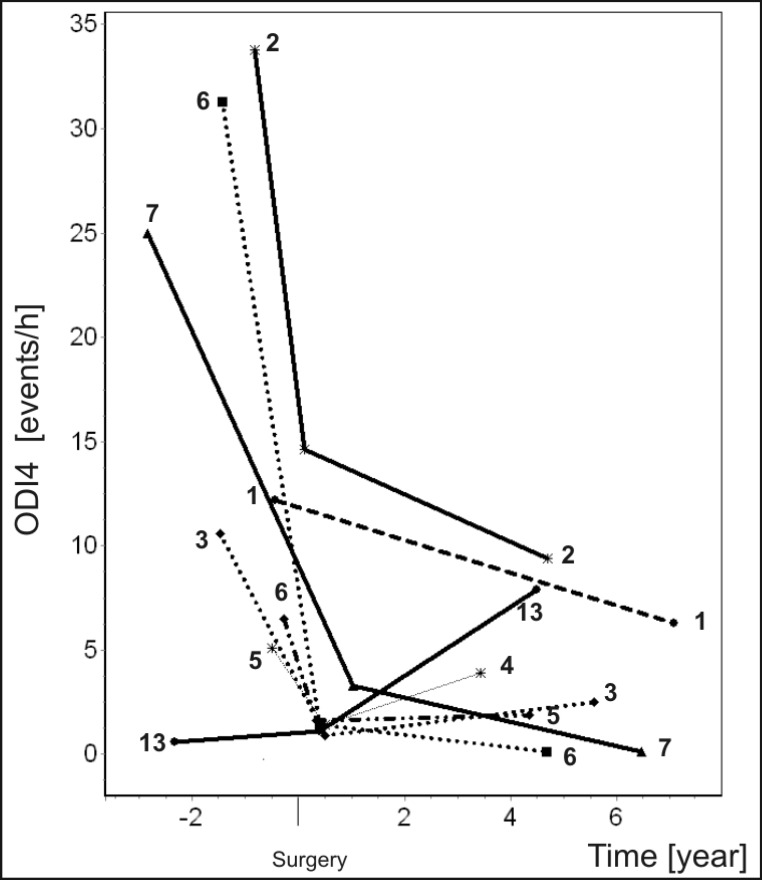
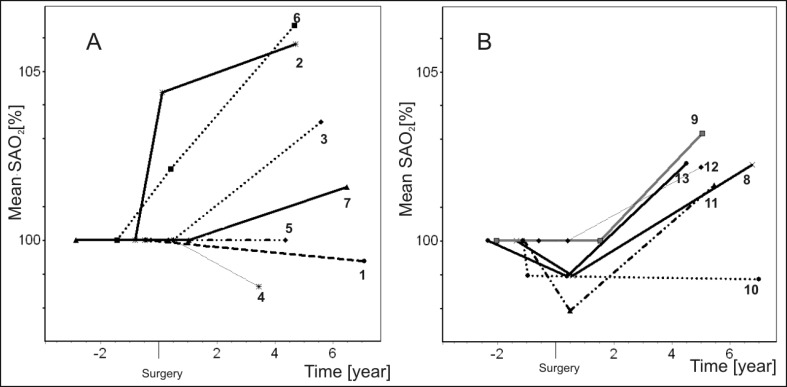
Patients were divided in two groups. Group A comprised patients with obstructive sleep apnea (OSAS) confirmed by polysomnography in whom ODI-4 (oxygen desaturation index) was 5 or more. Group B consisted of patients with occlusal problems needing orthognathic surgery and with OSAS symptoms but no clear disease on polysomnography, where the ODI-4 index was less than 5. Both groups were treated with bimaxillary advancement surgery (BAS) as initial therapy.
In the group A mean ODI-4 was 17.8 (SD 12) before treatment and 3.5 (SD 3.4) at 5-year follow-up (P = 0.018 in paired differences t-test). In group B the ODI-4 remained below 5. In group A mean saturation improved from 94.3% (SD 1.6) to 96.3% (SD 2), P = 0.115 and in group B from 96.3% (SD 1.2) to 97.8% (SD 1.7), P = 0.056 (in paired differences t-test). The static charge sensitive bed evaluation showed improvement in all patients except one.
Bimaxillary advancement surgery is safe and reliable as an initial surgical treatment of obstructive sleep apnea syndrome.
双颌前徙手术已被证明是治疗阻塞性睡眠呼吸暂停综合征的有效方法。根据斯坦福方案,首先进行上气道软组织手术或通过颏成形术推进舌体,如果阻塞性睡眠呼吸暂停仍然存在,则进行双颌前徙手术。本研究描述了13例阻塞性睡眠呼吸暂停患者的5年随访结果,这些患者未采用斯坦福方案,而是将双颌前徙手术作为初始手术治疗。
患者分为两组。A组包括经多导睡眠图证实为阻塞性睡眠呼吸暂停(OSAS)且氧减饱和指数(ODI-4)为5或更高的患者。B组由需要正颌手术且有OSAS症状但多导睡眠图无明确疾病、ODI-4指数小于5的咬合问题患者组成。两组均采用双颌前徙手术(BAS)作为初始治疗。
A组治疗前平均ODI-4为17.8(标准差12),5年随访时为3.5(标准差3.4)(配对差异t检验,P = 0.018)。B组ODI-4仍低于5。A组平均血氧饱和度从94.3%(标准差1.6)提高到96.3%(标准差2),P = 0.115;B组从96.3%(标准差1.2)提高到97.8%(标准差1.7),P = 0.056(配对差异t检验)。静态电荷敏感床评估显示,除1例患者外,所有患者均有改善。
双颌前徙手术作为阻塞性睡眠呼吸暂停综合征的初始手术治疗是安全可靠的。