Centre for Clinical Studies, University Hospital Regensburg, Franz-Josef-Strauss-Allee 11, Regensburg 93053, Germany.
Health Qual Life Outcomes. 2014 Jan 14;12:7. doi: 10.1186/1477-7525-12-7.
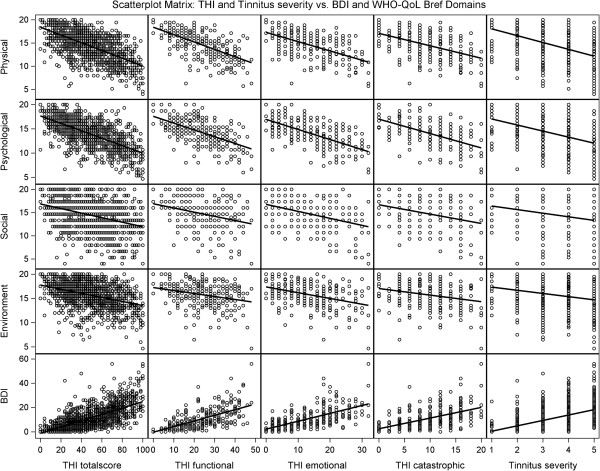
The aim of the present study was to investigate, which aspects of tinnitus are most relevant for impairment of quality of life. For this purpose we analysed how responses to the Tinnitus Handicap Inventory (THI) and to the question "How much of a problem is your tinnitus at present" correlate with the different aspects of quality of life and depression.
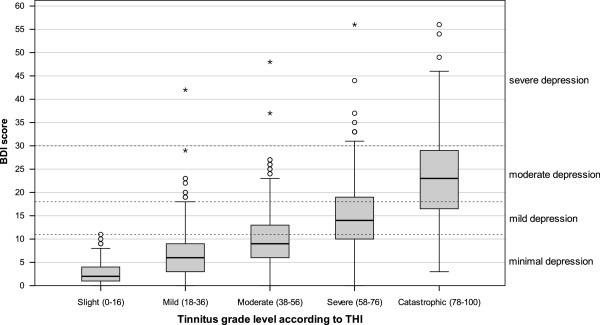
1274 patients of the Tinnitus Research Initiative database were eligible for analysis. The Tinnitus Research Initiative database is composed of eight study centres from five countries. We assessed to which extent the Tinnitus Handicap Inventory (THI) and its subscales and single items as well as the tinnitus severity correlate with Beck Depression Inventory (BDI) score and different domains of the short version of the WHO-Quality of Life questionnaire (WHO-QoL Bref) by means of simple and multiple linear regression models.
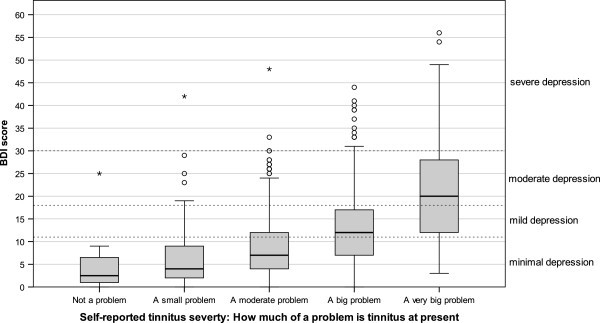
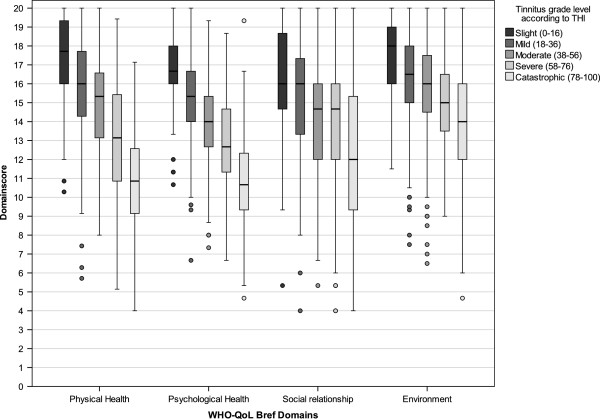
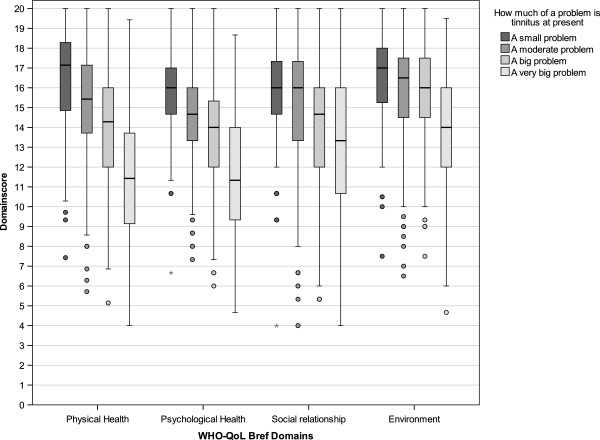
The THI explained considerable portions of the variance of the WHO-QoL Physical Health (R2 = 0.39) and Psychological Health (R2 = 0.40) and the BDI (R2 = 0.46). Furthermore, multiple linear regression models which included each THI item separately explained an additional 5% of the variance compared to the THI total score. The items feeling confused from tinnitus, the trouble of falling asleep at night, the interference with job or household responsibilities, getting upset from tinnitus, and the feeling of being depressed were those with the highest influence on quality of life and depression. The single question with regard to tinnitus severity explained 18%, 16%, and 20% of the variance of Physical Health, Psychological Health, and BDI respectively.
In the context of a cross-sectional correlation analysis, our findings confirmed the strong and consistent relationships between self-reported tinnitus burden and both quality of life, and depression. The single question "How much of a problem is your tinnitus" reflects tinnitus-related impairment in quality of life and can thus be recommended for use in clinical routine.
本研究旨在探讨耳鸣哪些方面与生活质量受损最相关。为此,我们分析了耳鸣残疾量表(THI)和“目前您的耳鸣问题有多大”这一问题的回答与生活质量和抑郁的不同方面如何相关。
1274 名耳鸣研究倡议数据库的患者符合分析条件。耳鸣研究倡议数据库由来自五个国家的八个研究中心组成。我们通过简单和多元线性回归模型评估耳鸣残疾量表(THI)及其分量表和单项以及耳鸣严重程度与贝克抑郁量表(BDI)评分和世界卫生组织生活质量简表(WHO-QoL Bref)不同领域之间的相关性。
THI 解释了 WHO-QoL 生理健康(R2=0.39)和心理健康(R2=0.40)和 BDI(R2=0.46)的相当大比例的方差。此外,包括每个 THI 项目在内的多元线性回归模型分别比 THI 总分解释了额外的 5%的方差。对生活质量和抑郁影响最大的 THI 项目分别为耳鸣导致的困惑感、夜间难以入睡、妨碍工作或家务责任、因耳鸣而烦恼以及感到沮丧。关于耳鸣严重程度的单一问题分别解释了生理健康、心理健康和 BDI 方差的 18%、16%和 20%。
在横断面相关分析的背景下,我们的研究结果证实了自我报告的耳鸣负担与生活质量和抑郁之间的强烈和一致关系。“您的耳鸣问题有多大”这一单一问题反映了与耳鸣相关的生活质量受损,因此可推荐用于临床常规。