Vater Jana, Gröschel Moritz, Szczepek Agnieszka J, Olze Heidi
Department of Otorhinolaryngology, Head and Neck Surgery, Charité-Universitätsmedizin Berlin, Corporate Member of Freie Universität and Berlin Humboldt Universität zu Berlin, Charitéplatz 1, 10117 Berlin, Germany.
J Clin Med. 2024 May 1;13(9):2663. doi: 10.3390/jcm13092663.
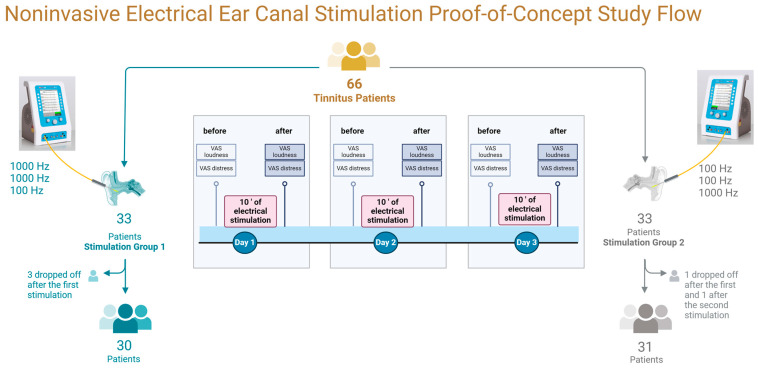
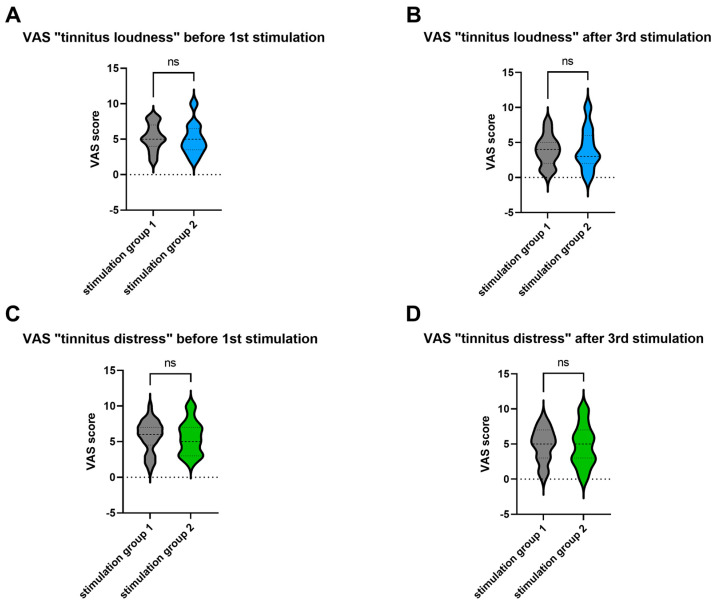
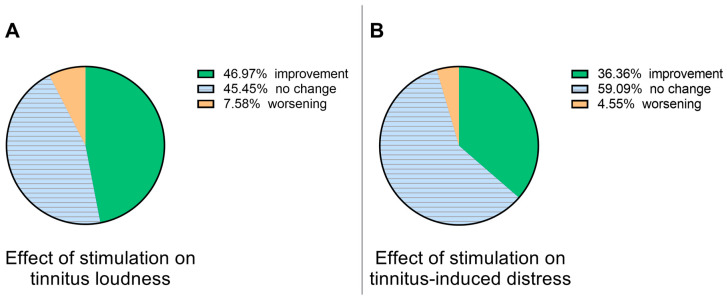
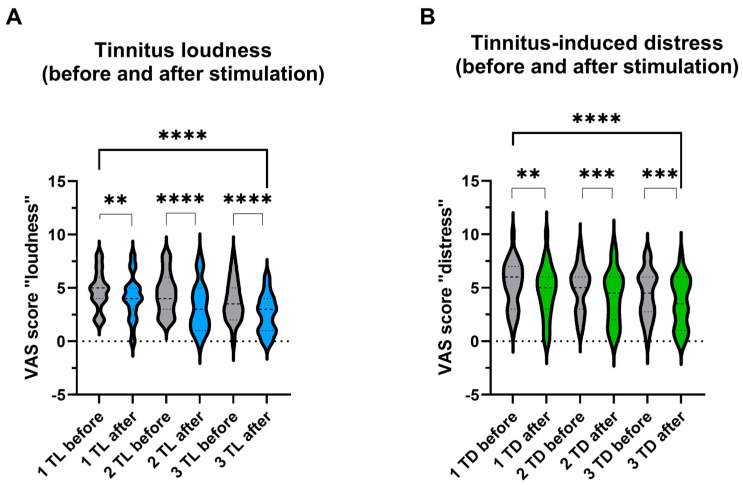
Tinnitus-the perception of sound despite the absence of an external source-can be a debilitating condition for which there are currently no pharmacological remedies. Our proof of concept study focused on the immediate effects of non-invasive electrical stimulation through the ear canal on loudness and tinnitus-induced distress. In addition, we aimed to identify variables that may affect the simulation outcomes. Sixty-six patients (29 women and 37 men, mean age 54.4 ± 10.4) with chronic tinnitus were recruited to the tertiary referral hospital between December 2019 and December 2021. They underwent 10 min of electrical stimulation through the ear canal for three consecutive days. Visual analog scales measured loudness and tinnitus-induced distress immediately before and after stimulation. : After three days of electrical stimulation, tinnitus loudness decreased in 47% of patients, 45.5% reported no change, and 7.6% reported worsening. Tinnitus severity decreased in 36.4% of cases, 59.1% of patients reported no change, and 4.5% reported worsening. Women responded positively to therapy earlier than men. In addition, tinnitus distress decreased in patients with compensated tinnitus but not in those with uncompensated tinnitus. Finally, patients with bilateral tinnitus improved earlier than those with unilateral tinnitus, and the age of the patients did not influence the stimulation results. : Our proof of concept study confirms the potential of non-invasive electrical stimulation of the ear as a promising screening approach to identifying patients for more advanced electrostimulation treatment, such as an extracochlear anti-tinnitus implant. These findings have practical implications for tinnitus management, offering hope for improved patient care.
耳鸣——即在没有外部声源的情况下对声音的感知——可能是一种使人衰弱的病症,目前尚无药物治疗方法。我们的概念验证研究聚焦于通过耳道进行非侵入性电刺激对响度和耳鸣引起的痛苦的即时影响。此外,我们旨在确定可能影响模拟结果的变量。2019年12月至2021年12月期间,66例慢性耳鸣患者(29名女性和37名男性,平均年龄54.4±10.4岁)被招募到一家三级转诊医院。他们连续三天接受了10分钟的耳道电刺激。在刺激前后,使用视觉模拟量表测量响度和耳鸣引起的痛苦。:经过三天的电刺激后,47%的患者耳鸣响度降低,45.5%的患者报告无变化,7.6%的患者报告病情恶化。36.4%的病例耳鸣严重程度降低,59.1%的患者报告无变化,4.5%的患者报告病情恶化。女性比男性对治疗的反应更早。此外,代偿性耳鸣患者的耳鸣痛苦减轻,而非代偿性耳鸣患者则没有。最后,双侧耳鸣患者比单侧耳鸣患者改善得更早,且患者年龄不影响刺激结果。:我们的概念验证研究证实了对耳朵进行非侵入性电刺激作为一种有前景的筛查方法的潜力,可用于识别适合更先进电刺激治疗(如耳蜗外抗耳鸣植入)的患者。这些发现对耳鸣管理具有实际意义,为改善患者护理带来了希望。