Gabbe Belinda J, Lyons Ronan A, Fitzgerald Mark C, Judson Rodney, Richardson Jeffrey, Cameron Peter A
*Department of Epidemiology and Preventive Medicine, Monash University, Melbourne, Victoria, Australia †College of Medicine, Swansea University, Swansea, Wales, UK ‡Trauma Centre, The Alfred Hospital, Melbourne, Victoria, Australia §Trauma Service, Royal Melbourne Hospital, Melbourne, Victoria, Australia ¶Centre for Health Economics, Monash University, Melbourne, Victoria, Australia; and ‖Emergency and Trauma Centre, The Alfred Hospital, Melbourne, Victoria, Australia.
Ann Surg. 2015 Mar;261(3):565-72. doi: 10.1097/SLA.0000000000000522.
To describe the burden of road transport-related serious injury in Victoria, Australia, over a 10-year period, after the introduction of an integrated trauma system.
Road traffic injury is a leading cause of death and disability worldwide. Efforts to improve care of the injured are important for reducing burden, but the impact of trauma care systems on burden and cost of road traffic injury has not been evaluated.
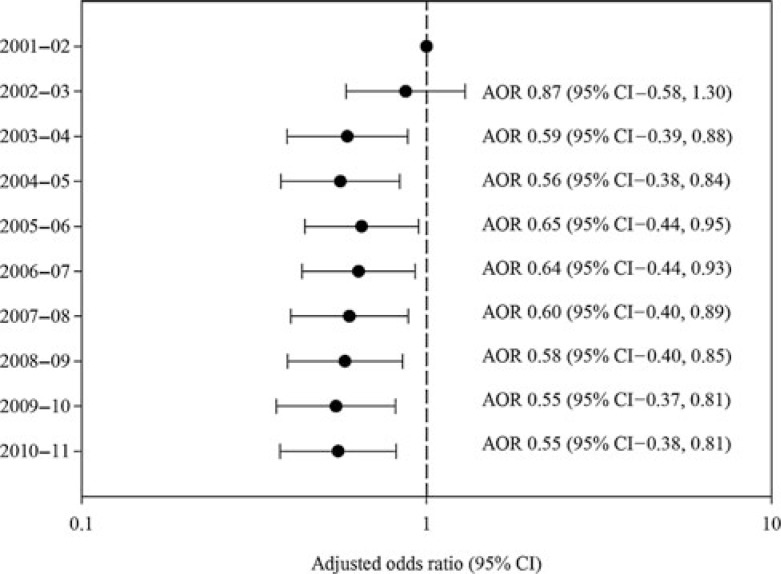
All road transport-related deaths and major trauma (injury severity score >12) cases were extracted from population-based coroner and trauma registry data sets for July 2001 to June 2011. Modeling was used to assess changes in population incidence rates and odds of in-hospital mortality. Disability-adjusted life years, combining years of life lost and years lived with disability, were calculated. Cost of health loss was calculated from estimates of the value of a disability-adjusted life year.
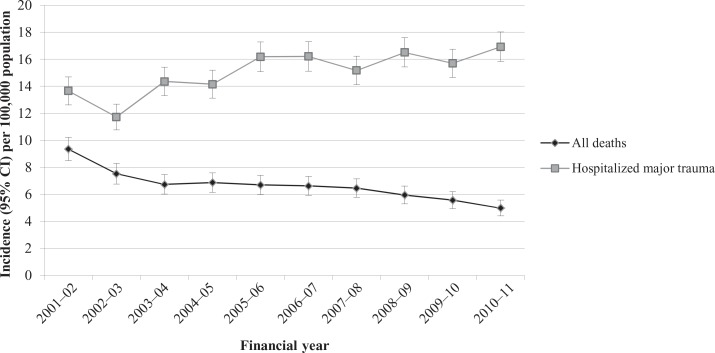
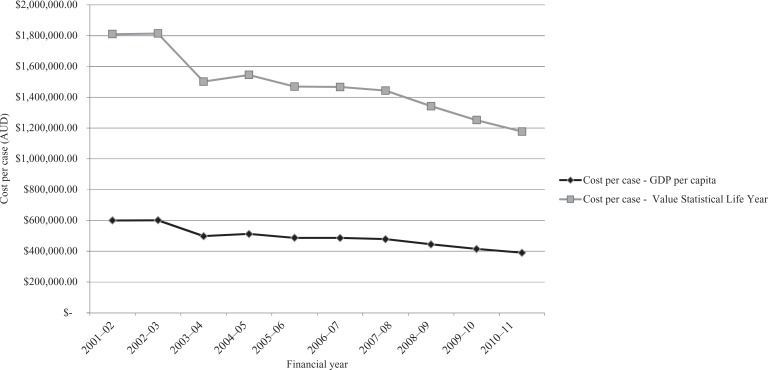
Incidence of road transport-related deaths decreased (incidence rate ratio 0.95, 95% confidence interval: 0.94-0.96), whereas the incidence of hospitalized major trauma increased (incidence rate ratio 1.03, 95% confidence interval: 1.02-1.04). Years of life lost decreased by 43%, and years lived with disability increased by 32%, with an overall 28% reduction in disability-adjusted life years over the decade. There was a cost saving per case of A$633,446 in 2010-2011 compared with the 2001-2002 financial year.
Since introduction of the trauma system in Victoria, Australia, the burden of road transport-related serious injury has decreased. Hospitalized major trauma cases increased, whereas disability burden per case declined. Increased survival does not necessarily result in an overall increase in nonfatal injury burden.
描述澳大利亚维多利亚州在引入综合创伤系统后的10年期间,与道路运输相关的严重伤害负担。
道路交通伤害是全球死亡和残疾的主要原因。改善伤者护理的努力对于减轻负担很重要,但创伤护理系统对道路交通伤害负担和成本的影响尚未得到评估。
从基于人群的验尸官和创伤登记数据集提取2001年7月至2011年6月期间所有与道路运输相关的死亡和重大创伤(损伤严重程度评分>12)病例。采用建模方法评估人群发病率和院内死亡率的变化。计算伤残调整生命年,将生命损失年数和残疾生存年数相结合。根据伤残调整生命年价值估计计算健康损失成本。
与道路运输相关的死亡发病率下降(发病率比0.95,95%置信区间:0.94-0.96),而住院重大创伤发病率上升(发病率比1.03,95%置信区间:1.02-1.04)。生命损失年数减少了43%,残疾生存年数增加了32%,十年间伤残调整生命年总体减少了28%。与2001-2002财政年度相比,2010-2011年每例病例节省成本633,446澳元。
自澳大利亚维多利亚州引入创伤系统以来,与道路运输相关的严重伤害负担有所下降。住院重大创伤病例增加,而每例病例的残疾负担下降。生存率提高不一定会导致非致命伤害负担总体增加。