Masalski Marcin, Grysiński Tomasz, Kręcicki Tomasz
Department and Clinic of Otolaryngology, Head and Neck Surgery, Wroclaw Medical University, Wrocław, Poland.
J Med Internet Res. 2014 Jan 15;16(1):e11. doi: 10.2196/jmir.2798.
Online hearing tests conducted in home settings on a personal computer (PC) require prior calibration. Biological calibration consists of approximating the reference sound level via the hearing threshold of a person with normal hearing.
The objective of this study was to identify the error of the proposed methods of biological calibration, their duration, and the subjective difficulty in conducting these tests via PC.
Seven methods have been proposed for measuring the calibration coefficients. All measurements were performed in reference to the hearing threshold of a normal-hearing person. Three methods were proposed for determining the reference sound level on the basis of these calibration coefficients. Methods were compared for the estimated error, duration, and difficulty of the calibration. Web-based self-assessed measurements of the calibration coefficients were carried out in 3 series: (1) at a otolaryngology clinic, (2) at the participant's home, and (3) again at the clinic. Additionally, in series 1 and 3, pure-tone audiometry was conducted and series 3 was followed by an offline questionnaire concerning the difficulty of the calibration. Participants were recruited offline from coworkers of the Department and Clinic of Otolaryngology, Wroclaw Medical University, Poland.
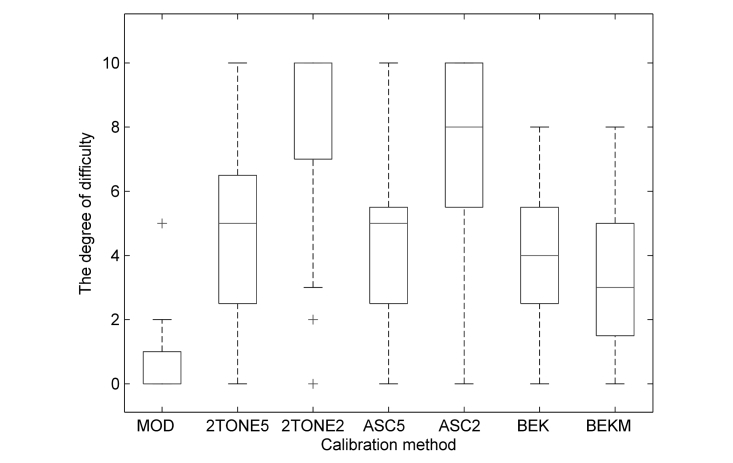
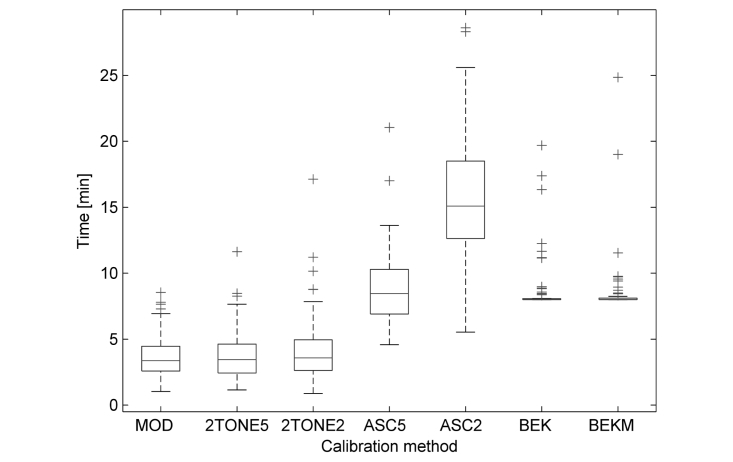
All 25 participants, aged 22-35 years (median 27) completed all tests and filled in the questionnaire. The smallest standard deviation of the calibration coefficient in the test-retest measurement was obtained at the level of 3.87 dB (95% CI 3.52-4.29) for the modulated signal presented in accordance with the rules of Bekesy's audiometry. The method is characterized by moderate duration time and a relatively simple procedure. The simplest and shortest method was the method of self-adjustment of the sound volume to the barely audible level. In the test-retest measurement, the deviation of this method equaled 4.97 dB (95% CI 4.53-5.51). Among methods determining the reference sound level, the levels determined independently for each frequency revealed the smallest error. The estimated standard deviations of the difference in the hearing threshold between the examination conducted on a biologically calibrated PC and pure-tone audiometry varied from 7.27 dB (95% CI 6.71-7.93) to 10.38 dB (95% CI 9.11-12.03), depending on the calibration method.
In this study, an analysis of biological calibration was performed and the presented results included calibration error, calibration time, and calibration difficulty. These values determine potential applications of Web-based hearing tests conducted in home settings and are decisive factors when selecting the calibration method. If there are no substantial time limitations, it is advisable to use Bekesy method and determine the reference sound level independently at each frequency because this approach is characterized by the lowest error.
在家庭环境中通过个人电脑(PC)进行的在线听力测试需要事先校准。生物校准包括通过听力正常者的听力阈值来近似参考声级。
本研究的目的是确定所提出的生物校准方法的误差、持续时间以及通过PC进行这些测试的主观难度。
已提出七种测量校准系数的方法。所有测量均参照听力正常者的听力阈值进行。基于这些校准系数,提出了三种确定参考声级的方法。对校准的估计误差、持续时间和难度的方法进行了比较。校准系数的基于网络的自我评估测量分三个系列进行:(1)在耳鼻喉科诊所,(2)在参与者家中,(3)再次在诊所。此外,在系列1和系列3中进行了纯音听力测定,系列3之后是一份关于校准难度的离线问卷。参与者是从波兰弗罗茨瓦夫医科大学耳鼻喉科系和诊所的同事中线下招募的。
所有25名年龄在22 - 35岁(中位数27岁)的参与者完成了所有测试并填写了问卷。对于按照贝凯西听力测定规则呈现的调制信号,重测测量中校准系数的最小标准差在3.87 dB(95%可信区间3.52 - 4.29)水平获得。该方法的特点是持续时间适中且程序相对简单。最简单且最短的方法是将音量自我调整到刚刚可听水平的方法。在重测测量中,该方法的偏差为4.97 dB(95%可信区间4.53 - 5.51)。在确定参考声级的方法中,对每个频率独立确定的声级误差最小。根据校准方法,在生物校准的PC上进行的检查与纯音听力测定之间听力阈值差异的估计标准差在7.27 dB(95%可信区间6.71 - 7.93)至10.38 dB(95%可信区间9.11 - 12.03)之间变化。
在本研究中,对生物校准进行了分析,呈现的结果包括校准误差、校准时间和校准难度。这些值决定了在家庭环境中基于网络的听力测试的潜在应用,并且是选择校准方法时的决定性因素。如果没有严格的时间限制,建议使用贝凯西方法并对每个频率独立确定参考声级,因为这种方法的误差最低。