Abacus International, 6 Talisman Business Centre, Talisman Road, Bicester OX26 6HR, UK.
BMC Musculoskelet Disord. 2014 Jan 20;15:26. doi: 10.1186/1471-2474-15-26.
An updated economic evaluation was conducted to compare the cost-effectiveness of the four tumour necrosis factor (TNF)-α inhibitors adalimumab, etanercept, golimumab and infliximab in active, progressive psoriatic arthritis (PsA) where response to standard treatment has been inadequate.
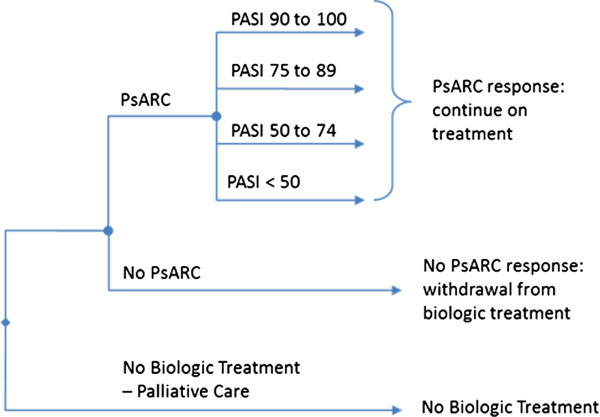
A systematic review was conducted to identify relevant, recently published studies and the new trial data were synthesised, via a Bayesian network meta-analysis (NMA), to estimate the relative efficacy of the TNF-α inhibitors in terms of Psoriatic Arthritis Response Criteria (PsARC) response, Health Assessment Questionnaire (HAQ) scores and Psoriasis Area and Severity Index (PASI). A previously developed economic model was updated with the new meta-analysis results and current cost data. The model was adapted to delineate patients by PASI 50%, 75% and 90% response rates to differentiate between psoriasis outcomes.
All four licensed TNF-α inhibitors were significantly more effective than placebo in achieving PsARC response in patients with active PsA. Adalimumab, etanercept and infliximab were significantly more effective than placebo in improving HAQ scores in patients who had achieved a PsARC response and in improving HAQ scores in PsARC non-responders. In an analysis using 1,000 model simulations, on average etanercept was the most cost-effective treatment and, at the National Institute for Health and Care Excellence willingness-to-pay threshold of between £20,000 to £30,000, etanercept is the preferred option.
The economic analysis agrees with the conclusions from the previous models, in that biologics are shown to be cost-effective for treating patients with active PsA compared with the conventional management strategy. In particular, etanercept is cost-effective compared with the other biologic treatments.
对四种肿瘤坏死因子(TNF)-α抑制剂阿达木单抗、依那西普、戈利木单抗和英夫利昔单抗在标准治疗反应不足的活动性、进展性银屑病关节炎(PsA)中的成本效益进行了更新的经济评估。
系统检索以确定相关的、最近发表的研究,并通过贝叶斯网络荟萃分析(NMA)综合新的试验数据,以评估 TNF-α抑制剂在银屑病关节炎反应标准(PsARC)反应、健康评估问卷(HAQ)评分和银屑病面积和严重程度指数(PASI)方面的相对疗效。使用新的荟萃分析结果和当前成本数据更新了先前开发的经济模型。该模型经过改编,通过 PASI 50%、75%和 90%的反应率来区分患者,以区分银屑病的结果。
在活动性 PsA 患者中,所有四种获得许可的 TNF-α抑制剂在实现 PsARC 反应方面均显著优于安慰剂。阿达木单抗、依那西普和英夫利昔单抗在实现 PsARC 反应的患者中改善 HAQ 评分以及在 PsARC 无反应者中改善 HAQ 评分方面均显著优于安慰剂。在使用 1000 次模型模拟的分析中,依那西普平均而言是最具成本效益的治疗方法,并且在国家卫生与保健卓越研究所(NICE)的支付意愿阈值为 20000 英镑至 30000 英镑之间,依那西普是首选。
经济分析与先前模型的结论一致,即与常规管理策略相比,生物制剂在治疗活动性 PsA 患者方面具有成本效益。特别是与其他生物治疗药物相比,依那西普具有成本效益。