Howard Hughes Medical Institute, University of California at San Diego, La Jolla, CA 92093, USA.
Phys Chem Chem Phys. 2014 Apr 14;16(14):6398-406. doi: 10.1039/c3cp53962h. Epub 2014 Jan 21.
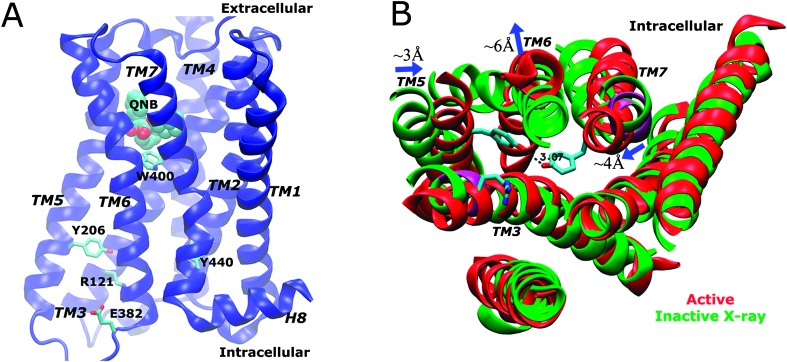
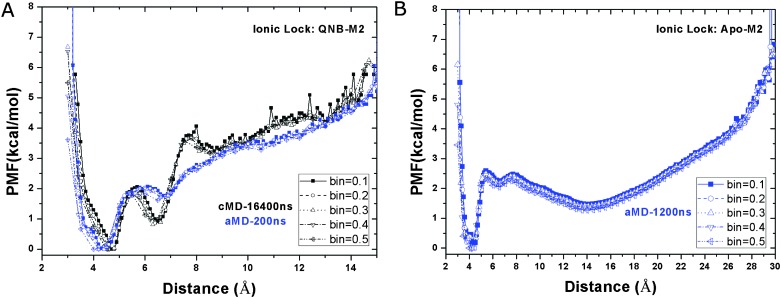
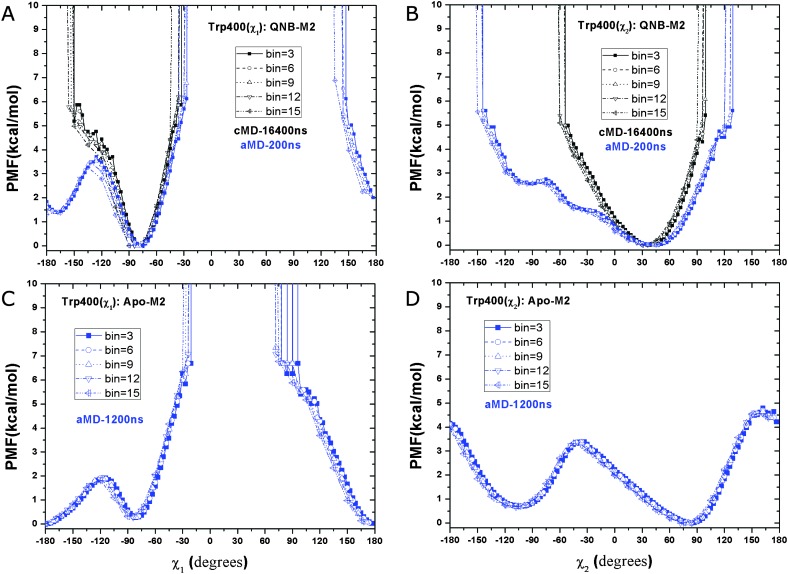
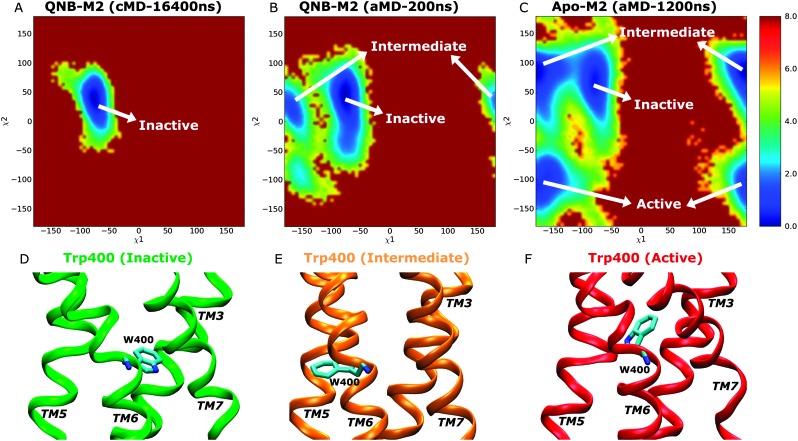
G-protein coupled receptors (GPCRs) mediate cellular responses to various hormones and neurotransmitters and are important targets for treating a wide spectrum of diseases. They are known to adopt multiple conformational states (e.g., inactive, intermediate and active) during their modulation of various cell signaling pathways. Here, the free energy landscape of GPCRs is explored using accelerated molecular dynamics (aMD) simulations as demonstrated on the M2 muscarinic receptor, a key GPCR that regulates human heart rate and contractile forces of cardiomyocytes. Free energy profiles of important structural motifs that undergo conformational transitions upon GPCR activation and allosteric signaling are analyzed in detail, including the Arg(3.50)-Glu(6.30) ionic lock, the Trp(6.48) toggle switch and the hydrogen interactions between Tyr(5.58)-Tyr(7.53).
G 蛋白偶联受体 (GPCRs) 介导细胞对各种激素和神经递质的反应,是治疗广泛疾病的重要靶点。已知它们在调节各种细胞信号通路时采用多种构象状态(例如,无活性、中间和活性)。在这里,使用加速分子动力学 (aMD) 模拟来探索 GPCR 的自由能景观,如在调节人心率和心肌细胞收缩力的关键 GPCR M2 毒蕈碱受体上所示。详细分析了 GPCR 激活和变构信号传导时经历构象转变的重要结构模体的自由能曲线,包括 Arg(3.50)-Glu(6.30)离子锁、Trp(6.48) 翻转开关以及 Tyr(5.58)-Tyr(7.53) 之间的氢键相互作用。