School of Life Sciences, University of Dundee, Dundee DD1 5EH, UK; School of Science and Engineering, University of Dundee, Dundee DD1 4NH, UK.
Department of Biological Sciences, Bridge Institute, University of Southern California, Los Angeles, CA 90089, USA.
Structure. 2018 Jan 2;26(1):171-180.e2. doi: 10.1016/j.str.2017.11.013. Epub 2017 Dec 14.
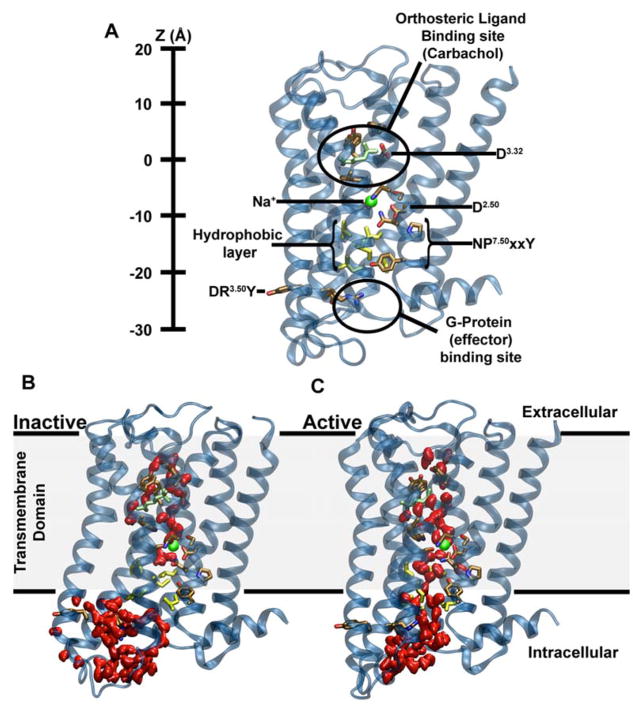
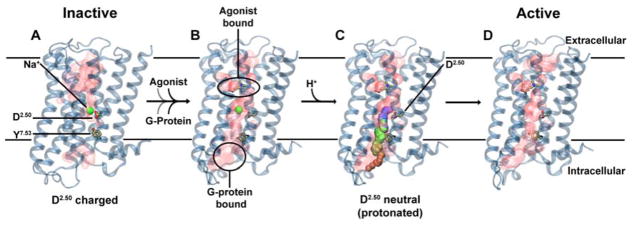
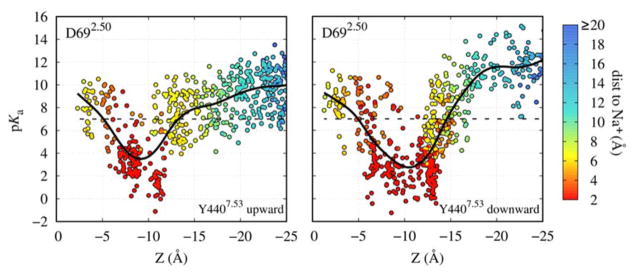
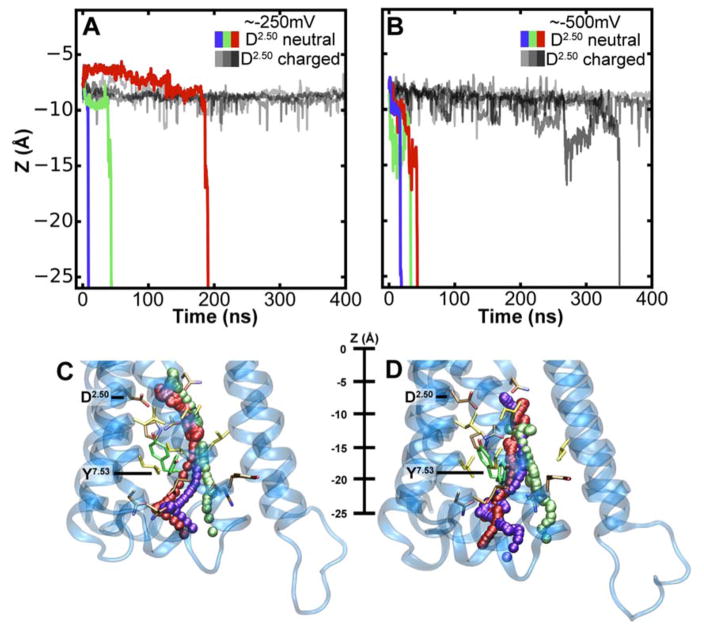
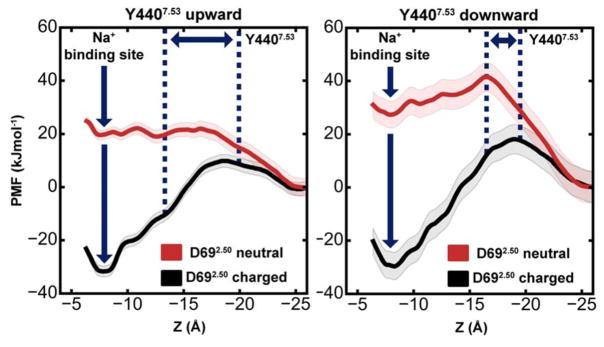
Playing a central role in cell signaling, G-protein-coupled receptors (GPCRs) are the largest superfamily of membrane proteins and form the majority of drug targets in humans. How extracellular agonist binding triggers the activation of GPCRs and associated intracellular effector proteins remains, however, poorly understood. Structural studies have revealed that inactive class A GPCRs harbor a conserved binding site for Na ions in the center of their transmembrane domain, accessible from the extracellular space. Here, we show that the opening of a conserved hydrated channel in the activated state receptors allows the Na ion to egress from its binding site into the cytosol. Coupled with protonation changes, this ion movement occurs without significant energy barriers, and can be driven by physiological transmembrane ion and voltage gradients. We propose that Na ion exchange with the cytosol is a key step in GPCR activation. Further, we hypothesize that this transition locks receptors in long-lived active-state conformations.
在细胞信号转导中发挥核心作用的 G 蛋白偶联受体(GPCRs)是最大的膜蛋白超家族,也是人类大多数药物靶点的组成部分。然而,细胞外激动剂结合如何触发 GPCR 及其相关细胞内效应蛋白的激活仍然知之甚少。结构研究表明,无活性的 A 类 GPCR 在其跨膜域的中心具有保守的钠离子结合位点,可从细胞外空间进入。在这里,我们表明,在激活状态下,受体中保守的水合通道的打开允许钠离子从其结合位点排出到细胞质中。与质子化变化耦合,这种离子运动不会遇到明显的能量障碍,并且可以由生理跨膜离子和电压梯度驱动。我们提出钠离子与细胞质的交换是 GPCR 激活的关键步骤。此外,我们假设这种转变将受体锁定在长寿命的活性构象中。