Sturla Shana J, Boobis Alan R, FitzGerald Rex E, Hoeng Julia, Kavlock Robert J, Schirmer Kristin, Whelan Maurice, Wilks Martin F, Peitsch Manuel C
Department of Health Sciences and Technology, Institute of Food, Nutrition and Health, ETH Zürich , Schmelzbergstrasse 9, 8092 Zürich, Switzerland.
Chem Res Toxicol. 2014 Mar 17;27(3):314-29. doi: 10.1021/tx400410s. Epub 2014 Jan 21.
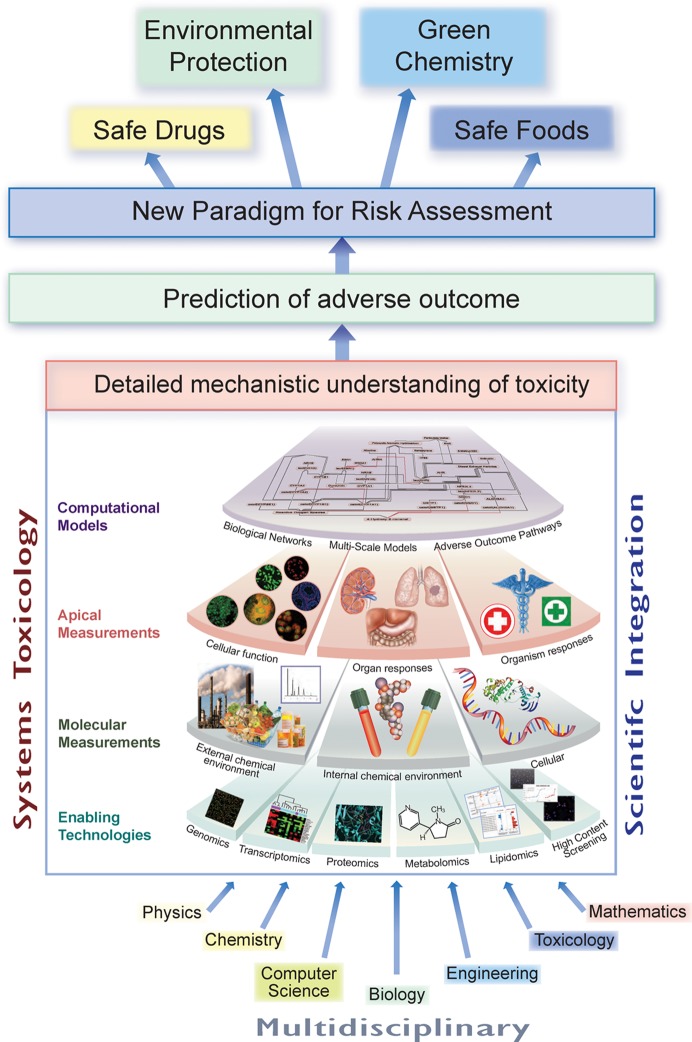
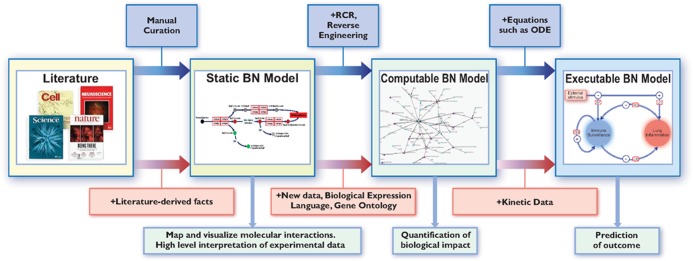
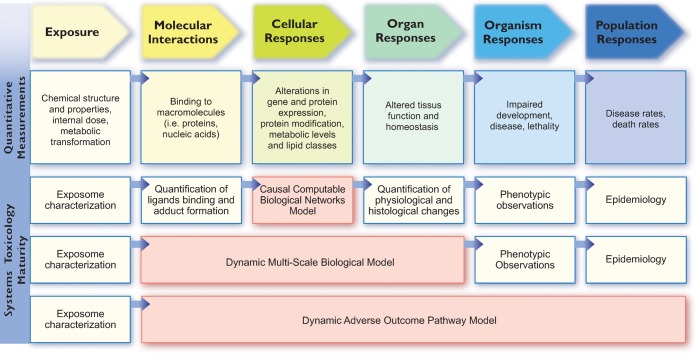
Systems Toxicology is the integration of classical toxicology with quantitative analysis of large networks of molecular and functional changes occurring across multiple levels of biological organization. Society demands increasingly close scrutiny of the potential health risks associated with exposure to chemicals present in our everyday life, leading to an increasing need for more predictive and accurate risk-assessment approaches. Developing such approaches requires a detailed mechanistic understanding of the ways in which xenobiotic substances perturb biological systems and lead to adverse outcomes. Thus, Systems Toxicology approaches offer modern strategies for gaining such mechanistic knowledge by combining advanced analytical and computational tools. Furthermore, Systems Toxicology is a means for the identification and application of biomarkers for improved safety assessments. In Systems Toxicology, quantitative systems-wide molecular changes in the context of an exposure are measured, and a causal chain of molecular events linking exposures with adverse outcomes (i.e., functional and apical end points) is deciphered. Mathematical models are then built to describe these processes in a quantitative manner. The integrated data analysis leads to the identification of how biological networks are perturbed by the exposure and enables the development of predictive mathematical models of toxicological processes. This perspective integrates current knowledge regarding bioanalytical approaches, computational analysis, and the potential for improved risk assessment.
系统毒理学是将经典毒理学与对生物组织多个层面发生的分子和功能变化的大型网络进行定量分析相结合。社会日益要求对与接触日常生活中存在的化学物质相关的潜在健康风险进行更严格的审查,这导致对更具预测性和准确性的风险评估方法的需求不断增加。开发此类方法需要对异源物质扰乱生物系统并导致不良后果的方式有详细的机制理解。因此,系统毒理学方法通过结合先进的分析和计算工具,为获取此类机制知识提供了现代策略。此外,系统毒理学是识别和应用生物标志物以改进安全性评估的一种手段。在系统毒理学中,测量暴露情况下全系统范围内的定量分子变化,并解读将暴露与不良后果(即功能和顶端终点)联系起来的分子事件因果链。然后建立数学模型以定量描述这些过程。综合数据分析可确定生物网络如何受到暴露的干扰,并有助于开发毒理学过程的预测性数学模型。本综述整合了有关生物分析方法、计算分析以及改进风险评估潜力的当前知识。