Division of Pulmonary, Critical Care and Sleep, New York University, School of Medicine, 462 First Avenue, NB7N24, New York NY, USA.
Respir Res. 2014 Jan 21;15(1):5. doi: 10.1186/1465-9921-15-5.
After 9/11/2001, most FDNY workers had persistent lung function decline but some exposed workers recovered. We hypothesized that the protease/anti-protease balance in serum soon after exposure predicts subsequent recovery.
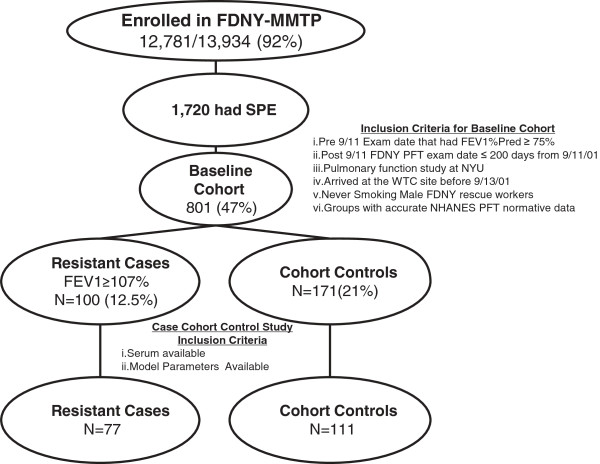
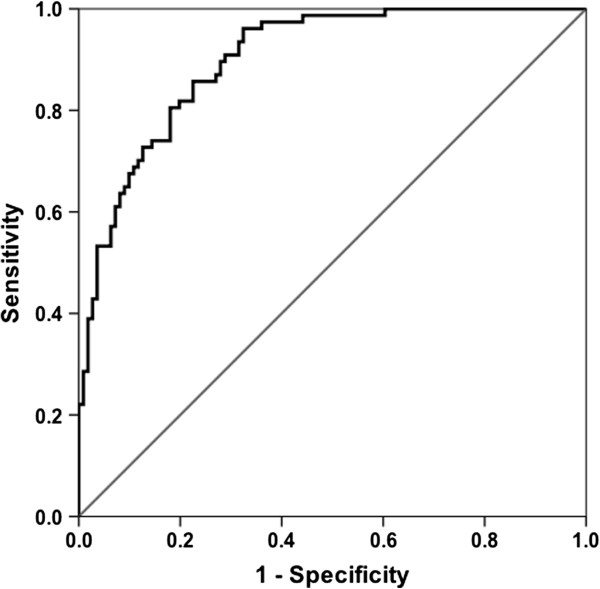
We performed a nested case-control study measuring biomarkers in serum drawn before 3/2002 and subsequent forced expiratory volume at one second (FEV1) on repeat spirometry before 3/2008. Serum was assayed for matrix metalloproteinases (MMP-1,2,3,7,8,9,12 and 13) and tissue inhibitors of metalloproteinases (TIMP-1,2,3,4). The representative sub-cohort defined analyte distribution and a concentration above 75th percentile defined elevated biomarker expression. An FEV1 one standard deviation above the mean defined resistance to airway injury. Logistic regression was adjusted for pre-9/11 FEV1, BMI, age and exposure intensity modeled the association between elevated biomarker expression and above average FEV1.
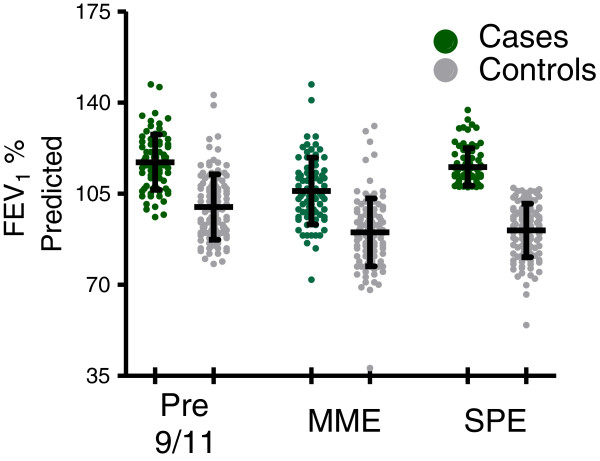
FEV1 in cases and controls declined 10% of after 9/11/2001. Cases subsequently returned to 99% of their pre-exposure FEV1 while decline persisted in controls. Elevated TIMP-1 and MMP-2 increased the odds of resistance by 5.4 and 4.2 fold while elevated MMP-1 decreased it by 0.27 fold.
Resistant cases displayed healing, returning to 99% of pre-exposure values. High TIMP-1 and MMP-2 predict healing. MMP/TIMP balance reflects independent pathways to airway injury and repair after WTC exposure.
2001 年 9 月 11 日之后,大多数 FDNY 工人的肺功能持续下降,但一些接触过有害物质的工人恢复了。我们假设暴露后血清中的蛋白酶/抗蛋白酶平衡可以预测随后的恢复情况。
我们进行了一项嵌套病例对照研究,在 2002 年 3 月之前采集血清生物标志物,并在 2008 年 3 月之前重复进行肺活量测定时测量第一秒用力呼气量(FEV1)。血清中测定了基质金属蛋白酶(MMP-1、2、3、7、8、9、12 和 13)和金属蛋白酶组织抑制剂(TIMP-1、2、3、4)。代表性的亚队列定义了分析物的分布,超过第 75 百分位的浓度定义为升高的生物标志物表达。FEV1 高于平均值一个标准差定义为对气道损伤有抵抗力。逻辑回归调整了 9/11 之前的 FEV1、BMI、年龄和暴露强度,以模拟升高的生物标志物表达与平均 FEV1 以上之间的关联。
病例和对照组的 FEV1 在 2001 年 9 月 11 日之后下降了 10%。随后病例恢复到暴露前 FEV1 的 99%,而对照组的下降仍在持续。升高的 TIMP-1 和 MMP-2 使抵抗的几率增加了 5.4 和 4.2 倍,而升高的 MMP-1 使抵抗的几率降低了 0.27 倍。
有抵抗力的病例表现出愈合,恢复到暴露前值的 99%。高 TIMP-1 和 MMP-2 预示着愈合。MMP/TIMP 平衡反映了 WTC 暴露后气道损伤和修复的独立途径。