Eco-Systems Biology Group, Luxembourg Centre for Systems Biomedicine, University of Luxembourg, Avenue des Hauts-Fourneaux, 7, Esch-sur-Alzette, L-4362, Luxembourg.
Microbiome. 2013 May 3;1(1):14. doi: 10.1186/2049-2618-1-14.
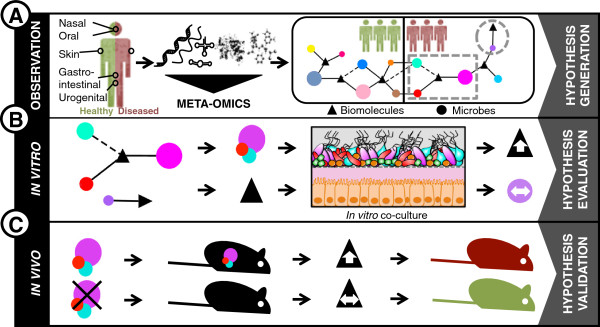
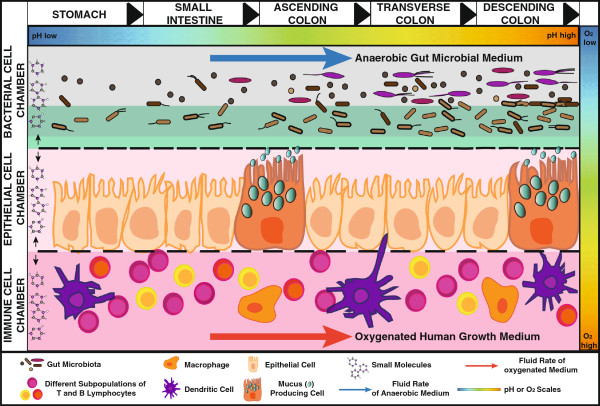
Large-scale 'meta-omic' projects are greatly advancing our knowledge of the human microbiome and its specific role in governing health and disease states. A myriad of ongoing studies aim at identifying links between microbial community disequilibria (dysbiosis) and human diseases. However, due to the inherent complexity and heterogeneity of the human microbiome, cross-sectional, case-control and longitudinal studies may not have enough statistical power to allow causation to be deduced from patterns of association between variables in high-resolution omic datasets. Therefore, to move beyond reliance on the empirical method, experiments are critical. For these, robust experimental models are required that allow the systematic manipulation of variables to test the multitude of hypotheses, which arise from high-throughput molecular studies. Particularly promising in this respect are microfluidics-based in vitro co-culture systems, which allow high-throughput first-pass experiments aimed at proving cause-and-effect relationships prior to testing of hypotheses in animal models. This review focuses on widely used in vivo, in vitro, ex vivo and in silico approaches to study host-microbial community interactions. Such systems, either used in isolation or in a combinatory experimental approach, will allow systematic investigations of the impact of microbes on the health and disease of the human host. All the currently available models present pros and cons, which are described and discussed. Moreover, suggestions are made on how to develop future experimental models that not only allow the study of host-microbiota interactions but are also amenable to high-throughput experimentation.
大规模的“元组学”项目极大地推动了我们对人类微生物组及其在调节健康和疾病状态方面的特定作用的认识。目前有大量正在进行的研究旨在确定微生物群落失衡(失调)与人类疾病之间的联系。然而,由于人类微生物组固有的复杂性和异质性,横断面、病例对照和纵向研究可能没有足够的统计能力来从高分辨率组学数据集中变量之间的关联模式推断出因果关系。因此,为了摆脱对经验方法的依赖,实验至关重要。为此,需要稳健的实验模型,这些模型允许系统地操纵变量,以检验高通量分子研究产生的大量假设。在这方面特别有前途的是基于微流控的体外共培养系统,它允许进行高通量的初步实验,以在动物模型中测试假设之前证明因果关系。本综述重点介绍了广泛用于研究宿主-微生物群落相互作用的体内、体外、离体和计算方法。这些系统,无论是单独使用还是组合使用,都将允许系统地研究微生物对人类宿主健康和疾病的影响。目前所有可用的模型都有其优缺点,本文对其进行了描述和讨论。此外,还就如何开发未来的实验模型提出了建议,这些模型不仅允许研究宿主-微生物群相互作用,而且还适合高通量实验。