Aliabadian Mansour, Beentjes Kevin K, Roselaar C S Kees, van Brandwijk Hans, Nijman Vincent, Vonk Ronald
Department of Biology, Ferdowsi University of Mashhad, Mashhad, Iran ; Naturalis Biodiversity Center, Leiden, the Netherlands.
Naturalis Biodiversity Center, Leiden, the Netherlands.
Zookeys. 2013 Dec 30(365):25-48. doi: 10.3897/zookeys.365.6287.
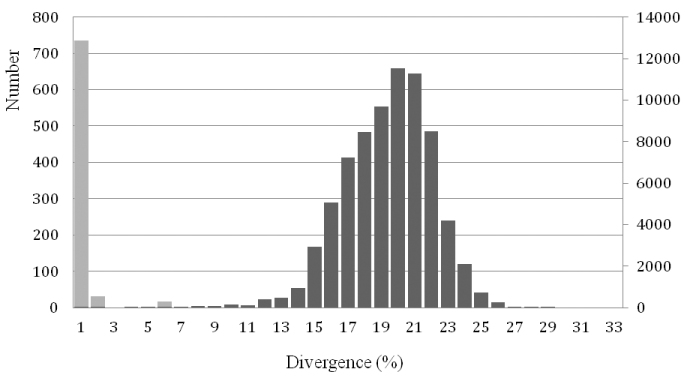
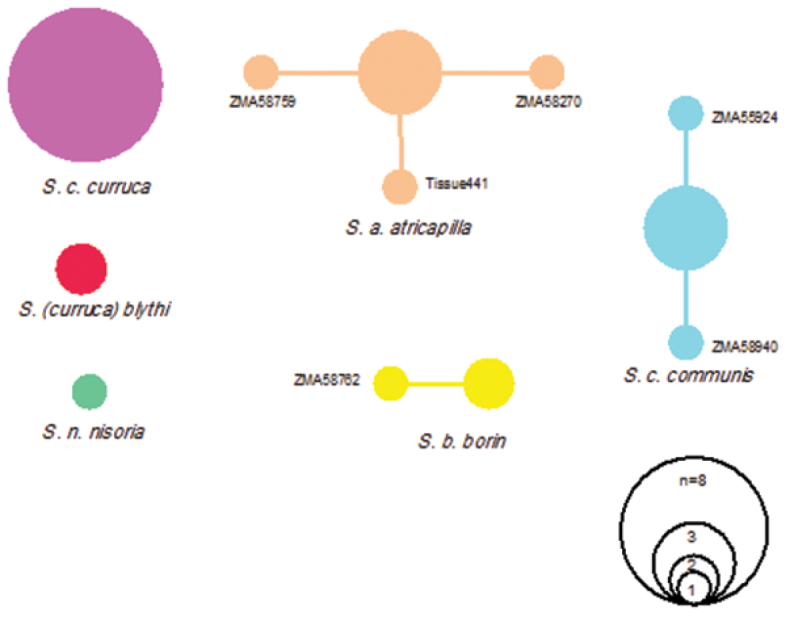
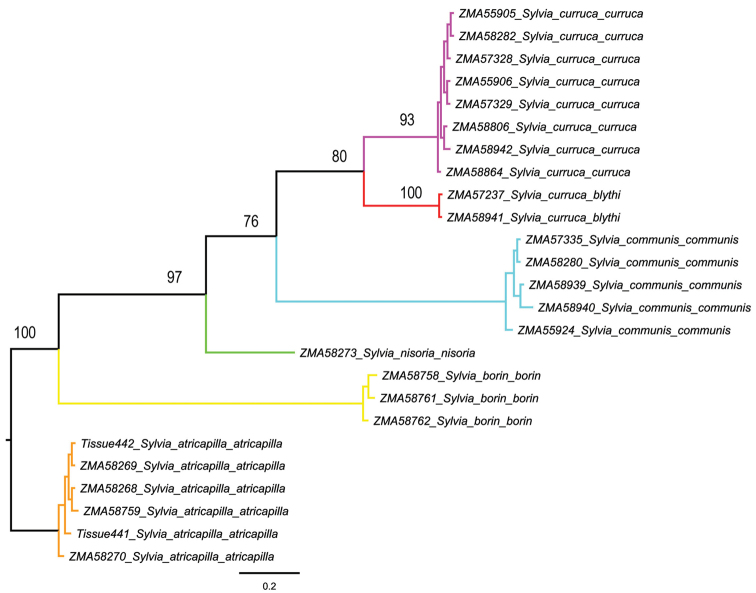
The mitochondrial cytochrome c oxidase subunit I (COI) can serve as a fast and accurate marker for the identification of animal species, and has been applied in a number of studies on birds. We here sequenced the COI gene for 387 individuals of 147 species of birds from the Netherlands, with 83 species being represented by > 2 sequences. The Netherlands occupies a small geographic area and 95% of all samples were collected within a 50 km radius from one another. The intraspecific divergences averaged 0.29% among this assemblage, but most values were lower; the interspecific divergences averaged 9.54%. In all, 95% of species were represented by a unique barcode, with 6 species of gulls and skua (Larus and Stercorarius) having at least one shared barcode. This is best explained by these species representing recent radiations with ongoing hybridization. In contrast, one species, the Lesser Whitethroat Sylvia curruca showed deep divergences, averaging 5.76% and up to 8.68% between individuals. These possibly represent two distinct taxa, S. curruca and S. blythi, both clearly separated in a haplotype network analysis. Our study adds to a growing body of DNA barcodes that have become available for birds, and shows that a DNA barcoding approach enables to identify known Dutch bird species with a very high resolution. In addition some species were flagged up for further detailed taxonomic investigation, illustrating that even in ornithologically well-known areas such as the Netherlands, more is to be learned about the birds that are present.
线粒体细胞色素c氧化酶亚基I(COI)可作为快速准确鉴定动物物种的标记物,已应用于多项鸟类研究中。我们对来自荷兰的147种鸟类的387个个体的COI基因进行了测序,其中83种鸟类有超过2条序列。荷兰地域面积小,所有样本的95%是在彼此半径50公里范围内采集的。该样本集合中种内差异平均为0.29%,但大多数值更低;种间差异平均为9.54%。总体而言,95%的物种由独特的条形码代表,有6种鸥类和贼鸥(鸥属和中贼鸥属)至少有一个共享条形码。这最好的解释是这些物种代表了正在进行杂交的近期辐射演化。相比之下,一种鸟类,即白斑尾柳莺,个体间差异很大,平均为5.76%,最高可达8.68%。这些可能代表两个不同的分类单元,即白斑尾柳莺和 Blythi柳莺,在单倍型网络分析中两者明显分开。我们的研究增加了越来越多可用于鸟类的DNA条形码,并表明DNA条形码方法能够以非常高的分辨率识别已知的荷兰鸟类物种。此外,一些物种被标记出来进行进一步详细的分类学研究,这表明即使在像荷兰这样鸟类学研究较为深入的地区,仍有更多关于当地鸟类的知识有待了解。