Hutka Stefanie, Bidelman Gavin M, Moreno Sylvain
Department of Psychology, University of Toronto Toronto, ON, Canada ; NeuroEducation across the Lifespan Laboratory, Rotman Research Institute, Baycrest Centre for Geriatric Care Toronto, ON, Canada.
Institute for Intelligent Systems, University of Memphis Memphis, TN, USA ; School of Communication Sciences and Disorders, University of Memphis Memphis, TN, USA.
Front Psychol. 2013 Dec 30;4:984. doi: 10.3389/fpsyg.2013.00984.
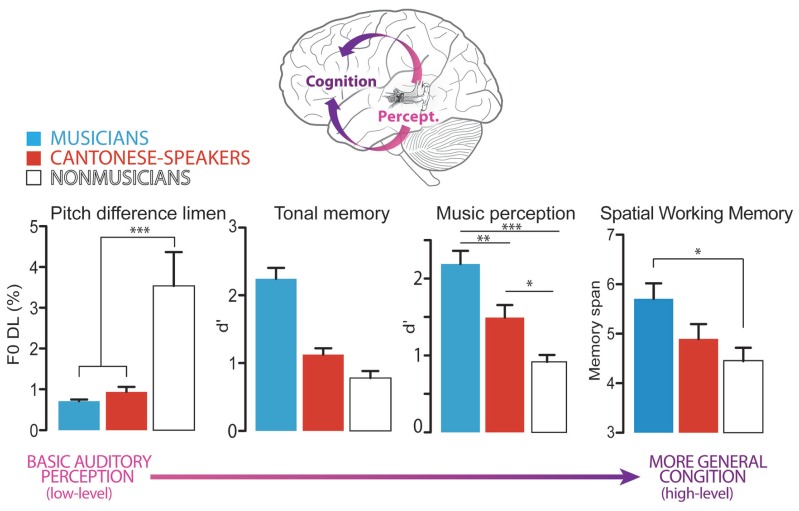
There is convincing empirical evidence for bidirectional transfer between music and language, such that experience in either domain can improve mental processes required by the other. This music-language relationship has been studied using linear models (e.g., comparing mean neural activity) that conceptualize brain activity as a static entity. The linear approach limits how we can understand the brain's processing of music and language because the brain is a nonlinear system. Furthermore, there is evidence that the networks supporting music and language processing interact in a nonlinear manner. We therefore posit that the neural processing and transfer between the domains of language and music are best viewed through the lens of a nonlinear framework. Nonlinear analysis of neurophysiological activity may yield new insight into the commonalities, differences, and bidirectionality between these two cognitive domains not measurable in the local output of a cortical patch. We thus propose a novel application of brain signal variability (BSV) analysis, based on mutual information and signal entropy, to better understand the bidirectionality of music-to-language transfer in the context of a nonlinear framework. This approach will extend current methods by offering a nuanced, network-level understanding of the brain complexity involved in music-language transfer.
有令人信服的实证证据表明音乐和语言之间存在双向转移,即任一领域的经验都能改善另一领域所需的心理过程。这种音乐与语言的关系已通过线性模型(例如,比较平均神经活动)进行研究,这些模型将大脑活动概念化为一个静态实体。线性方法限制了我们对大脑处理音乐和语言方式的理解,因为大脑是一个非线性系统。此外,有证据表明支持音乐和语言处理的网络以非线性方式相互作用。因此,我们认为最好通过非线性框架来审视语言和音乐领域之间的神经处理与转移。对神经生理活动的非线性分析可能会为这两个认知领域之间的共性、差异和双向性带来新的见解,而这些是无法在皮质区域的局部输出中测量到的。因此,我们提出一种基于互信息和信号熵的脑信号变异性(BSV)分析的新应用,以便在非线性框架下更好地理解音乐到语言转移的双向性。这种方法将通过提供对音乐 - 语言转移中涉及的大脑复杂性的细致入微的、网络层面的理解来扩展当前方法。