Kim Soo Wan
Department of Internal Medicine, Chonnam National University Medical School, Gwangju, Korea.
Electrolyte Blood Press. 2006 Nov;4(2):66-71. doi: 10.5049/EBP.2006.4.2.66.
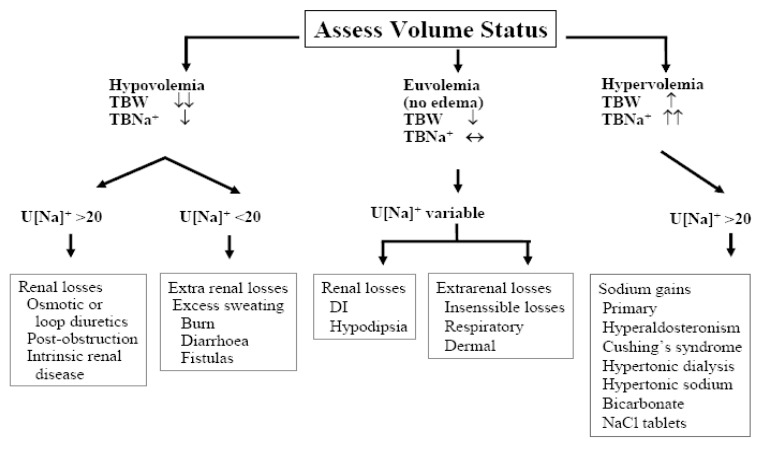
Hypernatremia reflects a net water loss or a hypertonic sodium gain, with inevitable hyperosmolality. Severe symptoms are usually evident only with acute and large increases in plasma sodium concentrations to above 158-160 mmol/l. Importantly, the sensation of intense thirst that protects against severe hypernatremia in health may be absent or reduced in patients with altered mental status or with hypothalamic lesions affecting their sense of thirst and in infants and elderly people. Non-specific symptoms such as anorexia, muscle weakness, restlessness, nausea, and vomiting tend to occur early. More serious signs follow, with altered mental status, lethargy, irritability, stupor, and coma. Acute brain shrinkage can induce vascular rupture, with cerebral bleeding and subarachnoid hemorrhage. However, in the vast majority of cases, the onset of hypertonicity is low enough to allow the brain to adapt and thereby to minimize cerebral dehydration. Organic osmolytes accumulated during the adaptation to hypernatremia are slow to leave the cell during rehydration. Therefore, if the hypernatremia is corrected too rapidly, cerebral edema results as the relatively more hypertonic ICF accumulates water. To be safe, the rate of correction should not exceed 12 mEq/liter/day.
高钠血症反映了净失水量或高渗性钠增加,必然伴有高渗状态。严重症状通常仅在血浆钠浓度急性大幅升高至158 - 160 mmol/L以上时才明显。重要的是,健康时能预防严重高钠血症的强烈口渴感,在精神状态改变的患者、影响口渴感的下丘脑病变患者以及婴儿和老年人中可能缺失或减弱。诸如厌食、肌肉无力、烦躁不安、恶心和呕吐等非特异性症状往往较早出现。随后会出现更严重的体征,包括精神状态改变、嗜睡、易怒、昏迷和昏迷。急性脑萎缩可导致血管破裂,引起脑出血和蛛网膜下腔出血。然而,在绝大多数情况下,高渗状态的发生程度较低,足以使大脑适应,从而将脑脱水降至最低。在适应高钠血症过程中积累的有机渗透物在补液时离开细胞的速度较慢。因此,如果高钠血症纠正过快,相对高渗的细胞内液会积水,导致脑水肿。为安全起见,纠正速度不应超过12 mEq/升/天。