Ozgul Ulku, Begec Zekine, Karahan Kalender, Ali Erdogan Mehmet, Said Aydogan Mustafa, Colak Cemil, Durmus Mahmut, Ozcan Ersoy M
Department of Anesthesiology and Reanimation, School of Medicine, Inonu University, Malatya, Turkey.
Department of Biostatistics, School of Medicine, Inonu University, Malatya, Turkey.
Curr Ther Res Clin Exp. 2013 Dec;75:39-43. doi: 10.1016/j.curtheres.2013.06.003.
The aim of our study is to compare the effect of ketamine-propofol mixture (ketofol) and propofol on the laryngeal tube-Suction II (LTS II) insertion conditions and hemodynamics.
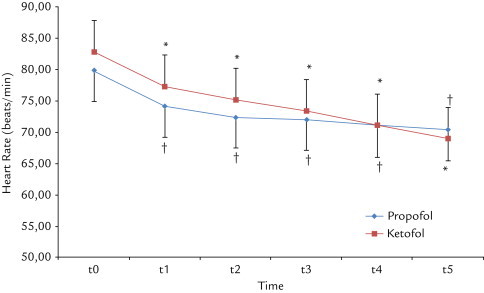
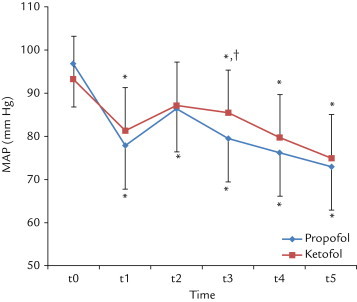
Eighty American Society of Anesthesiologists class 1 and 2 patients were divided into 2 random groups to receive either 1 µg/kg remifentanil and propofol 2 mg/kg in Group P (n = 40), or 1 µg/kg remifentanil and ketofol (using a 1:1 single syringe mixture of 5 mg/mL ketamine and 5 mg/mL propofol) in Group K (n = 40) before induction of anesthesia. After induction, LTS II was inserted. Heart rate and noninvasive blood pressure were recorded before induction of anesthesia (t0); immediately following induction (t1); immediately after LTS II insertion (t2); and 3 minutes (t3), 5 minutes (t4), and 10 (t5) minutes after LTS II insertion. Conditions of insertion of LTS II were assessed and scored 1 to 3 using 6 variables as follows: mouth opening, swallowing, coughing, head and body movements, laryngospasm, and ease of LTS II insertion by the same experienced anesthesiologist who did not know the agents. LTS II insertion summed score was prepared depending upon these variables.
In regard to LTS II insertion summed score, Group K was more favorable than Group P (P < 0.05). Apnea duration was longer in Group P (385.0 seconds [range = 195.0-840.0 seconds]) compared with Group K (325.50 seconds [range = 60.0-840.0 seconds]) but this was not statically significant. The heart rate values were significantly lower at all measurement intervals in both groups compared with the baseline values (P < 0.05). There was no difference in heart rate between Group P and Group K. The mean arterial pressure values were significantly lower at all measurement intervals in Group P compared with baseline values (P < 0.05). In Group K, the mean arterial pressure values were significantly lower at all measurement intervals compared with the baseline values, except t2 (P < 0.05). There was a significant difference between Group P and Group K in terms of mean arterial pressure at t3 (P < 0.05).
We found that ketofol provided better insertion summed score for LTS II than propofol, with minimal hemodynamic changes.
本研究旨在比较氯胺酮 - 丙泊酚合剂(氯胺酚)与丙泊酚对喉罩 - 吸引Ⅱ型(LTSⅡ)插入条件及血流动力学的影响。
80例美国麻醉医师协会1级和2级患者被随机分为2组,麻醉诱导前,P组(n = 40)接受1μg/kg瑞芬太尼和2mg/kg丙泊酚,K组(n = 40)接受1μg/kg瑞芬太尼和氯胺酚(使用5mg/mL氯胺酮与5mg/mL丙泊酚1:1的单注射器混合液)。诱导后插入LTSⅡ。记录麻醉诱导前(t0)、诱导后即刻(t1)、LTSⅡ插入后即刻(t2)、LTSⅡ插入后3分钟(t3)、5分钟(t4)和10分钟(t5)的心率和无创血压。由同一位不知道所用药物的经验丰富的麻醉医师使用以下6个变量对LTSⅡ的插入条件进行评估并评分1至3分:张口、吞咽、咳嗽、头部和身体运动、喉痉挛以及LTSⅡ插入的难易程度。根据这些变量计算LTSⅡ插入总分。
关于LTSⅡ插入总分,K组优于P组(P < 0.05)。P组的呼吸暂停持续时间(385.0秒[范围 = 195.0 - 840.0秒])比K组(325.50秒[范围 = 60.0 - 840.0秒])长,但差异无统计学意义。两组在所有测量时间点的心率值均显著低于基线值(P < 0.05)。P组和K组的心率无差异。P组在所有测量时间点的平均动脉压值均显著低于基线值(P < 0.05)。在K组,除t2外,所有测量时间点的平均动脉压值均显著低于基线值(P < 0.05)。在t3时,P组和K组的平均动脉压存在显著差异(P < 0.05)。
我们发现氯胺酚为LTSⅡ提供了比丙泊酚更好的插入总分,且血流动力学变化最小。