CNRS, LAAS, 7 avenue du colonel Roche, F-31077 Toulouse, France.
BMC Biol. 2014 Jan 27;12:6. doi: 10.1186/1741-7007-12-6.
Atomic Force Microscopy (AFM) is a polyvalent tool that allows biological and mechanical studies of full living microorganisms, and therefore the comprehension of molecular mechanisms at the nanoscale level. By combining AFM with genetical and biochemical methods, we explored the biophysical response of the yeast Saccharomyces cerevisiae to a temperature stress from 30°C to 42°C during 1 h.
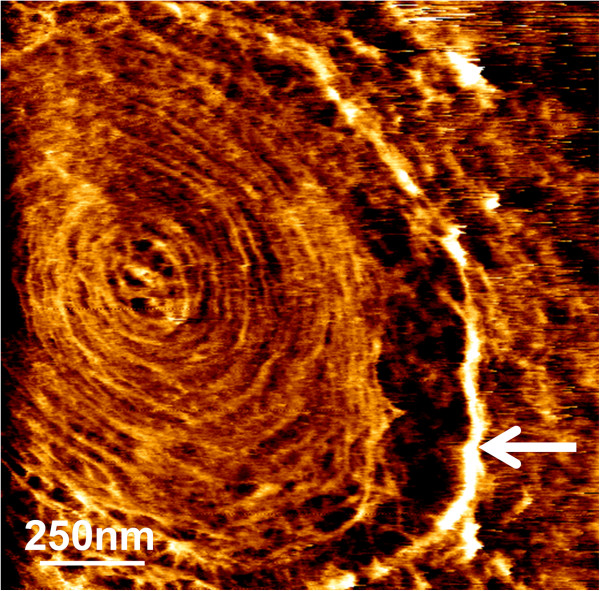
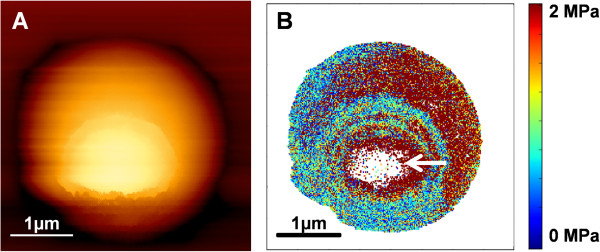
We report for the first time the formation of an unprecedented circular structure at the cell surface that takes its origin at a single punctuate source and propagates in a concentric manner to reach a diameter of 2-3 μm at least, thus significantly greater than a bud scar. Concomitantly, the cell wall stiffness determined by the Young's Modulus of heat stressed cells increased two fold with a concurrent increase of chitin. This heat-induced circular structure was not found either in wsc1Δ or bck1Δ mutants that are defective in the CWI signaling pathway, nor in chs1Δ, chs3Δ and bni1Δ mutant cells, reported to be deficient in the proper budding process. It was also abolished in the presence of latrunculin A, a toxin known to destabilize actin cytoskeleton.
Our results suggest that this singular morphological event occurring at the cell surface is due to a dysfunction in the budding machinery caused by the heat shock and that this phenomenon is under the control of the CWI pathway.
原子力显微镜(AFM)是一种多功能工具,允许对完整的活微生物进行生物和机械研究,因此可以理解纳米尺度水平的分子机制。通过将 AFM 与遗传和生化方法相结合,我们研究了酵母酿酒酵母在 1 小时内从 30°C 到 42°C 的温度应激下的生物物理反应。
我们首次报道了在细胞表面形成一种前所未有的环状结构,该结构起源于单个点状源,并以同心圆的方式传播,其直径至少达到 2-3μm,明显大于芽痕。同时,通过杨氏模量测定的热应激细胞的细胞壁刚性增加了两倍,同时壳聚糖增加。在 CWI 信号通路缺陷的 wsc1Δ 或 bck1Δ 突变体中,或在 chs1Δ、chs3Δ 和 bni1Δ 突变体中均未发现这种热诱导的环状结构,这些突变体被报道在适当的出芽过程中存在缺陷。在存在 latrunculin A 时,这种环状结构也被消除,latrunculin A 是一种已知破坏肌动蛋白细胞骨架稳定性的毒素。
我们的结果表明,这种在细胞表面发生的单一形态事件是由于热冲击引起的出芽机制功能障碍,并且这种现象受 CWI 途径的控制。