1] Queensland Brain Institute, University of Queensland, Brisbane, Queensland, Australia. [2] University of Queensland Diamantina Institute, University of Queensland, Princess Alexandra Hospital, Brisbane, Queensland, Australia. [3].
1] Department of Medicine, Lung Biology Center, University of California, San Francisco, San Francisco, California, USA. [2].
Nat Genet. 2014 Feb;46(2):100-6. doi: 10.1038/ng.2876.
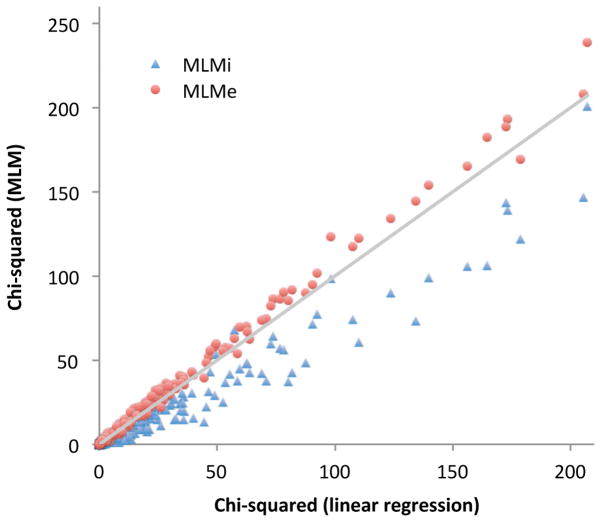
Mixed linear models are emerging as a method of choice for conducting genetic association studies in humans and other organisms. The advantages of the mixed-linear-model association (MLMA) method include the prevention of false positive associations due to population or relatedness structure and an increase in power obtained through the application of a correction that is specific to this structure. An underappreciated point is that MLMA can also increase power in studies without sample structure by implicitly conditioning on associated loci other than the candidate locus. Numerous variations on the standard MLMA approach have recently been published, with a focus on reducing computational cost. These advances provide researchers applying MLMA methods with many options to choose from, but we caution that MLMA methods are still subject to potential pitfalls. Here we describe and quantify the advantages and pitfalls of MLMA methods as a function of study design and provide recommendations for the application of these methods in practical settings.
混合线性模型作为一种在人类和其他生物中进行遗传关联研究的方法,正在逐渐兴起。混合线性模型关联(MLMA)方法的优点包括由于群体或相关性结构而防止假阳性关联,并通过应用特定于该结构的校正来增加获得的功效。一个被低估的观点是,MLMA 还可以通过隐含地对候选基因座以外的相关基因座进行条件处理,从而增加没有样本结构的研究的功效。最近发表了许多关于标准 MLMA 方法的变体,重点是降低计算成本。这些进展为应用 MLMA 方法的研究人员提供了许多可供选择的方案,但我们警告说,MLMA 方法仍然存在潜在的陷阱。在这里,我们描述和量化了 MLMA 方法在研究设计中的优势和陷阱,并为这些方法在实际应用中的应用提供了建议。