Seixas Gonçalo, Salgueiro Patrícia, Silva Ana Clara, Campos Melina, Spenassatto Carine, Reyes-Lugo Matías, Novo Maria Teresa, Ribolla Paulo Eduardo Martins, Silva Pinto João Pedro Soares da, Sousa Carla Alexandra
Unidade de Ensino e Investigação-Parasitologia Médica, Unidade de Ensino e Investigação-Parasitologia Médica.
Departamento de Promoção e Proteção da Saúde, Unidade de Engenharia Sanitária, Instituto de Administração da Saúde e Assuntos Sociais, Portugal, FunchalMadeira, Departamento de Promoção e Proteção da Saúde, Unidade de Engenharia Sanitária, Instituto de Administração da Saúde e Assuntos Sociais, Funchal, Madeira, Portugal.
Mem Inst Oswaldo Cruz. 2013;108 Suppl 1(Suppl 1):3-10. doi: 10.1590/0074-0276130386.
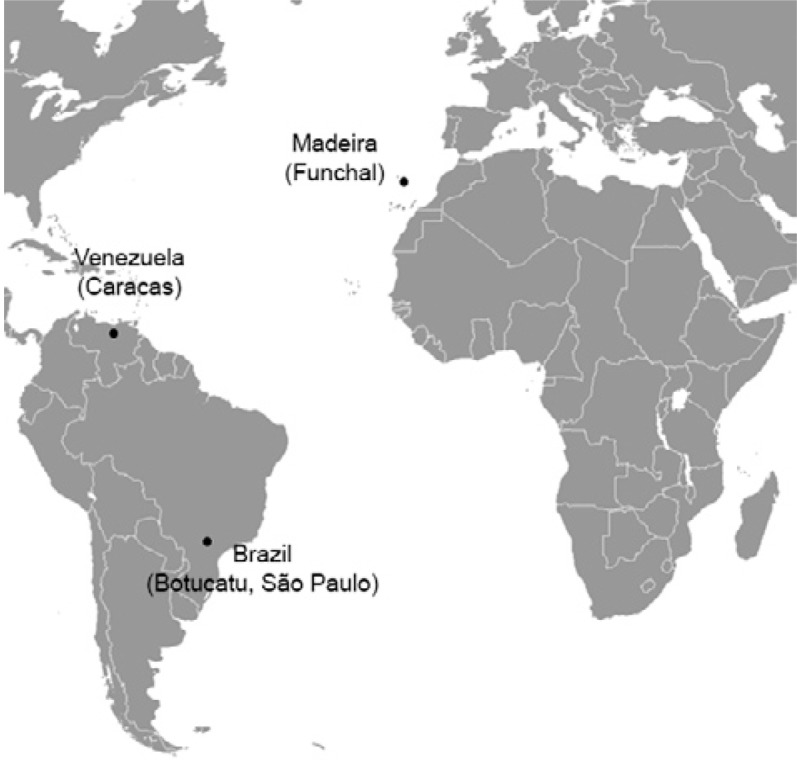
The increasing population of Aedes aegypti mosquitoes on Madeira Island (Portugal) resulted in the first autochthonous dengue outbreak, which occurred in October 2012. Our study establishes the first genetic evaluation based on the mitochondrial DNA (mtDNA) genes [cytochrome oxidase subunit I (COI) and NADH dehydrogenase subunit 4 (ND4)] and knockdown resistance (kdr) mutations exploring the colonisation history and the genetic diversity of this insular vector population. We included mosquito populations from Brazil and Venezuela in the analysis as putative geographic sources. The Ae. aegypti population from Madeira showed extremely low mtDNA genetic variability, with a single haplotype for COI and ND4. We also detected the presence of two important kdr mutations and the quasi-fixation of one of these mutations (F1534C). These results are consistent with a unique recent founder event that occurred on the island of Ae. aegypti mosquitoes that carry kdr mutations associated with insecticide resistance. Finally, we also report the presence of the F1534C kdr mutation in the Brazil and Venezuela populations. To our knowledge, this is the first time this mutation has been found in South American Ae. aegypti mosquitoes. Given the present risk of Ae. aegypti re-invading continental Europe from Madeira and the recent dengue outbreaks on the island, this information is important to plan surveillance and control measures.
葡萄牙马德拉岛埃及伊蚊数量的增加导致了2012年10月发生的首次本土登革热疫情。我们的研究基于线粒体DNA(mtDNA)基因[细胞色素氧化酶亚基I(COI)和烟酰胺腺嘌呤二核苷酸脱氢酶亚基4(ND4)]以及击倒抗性(kdr)突变进行了首次基因评估,以探索这一岛屿病媒种群的定殖历史和遗传多样性。我们在分析中纳入了来自巴西和委内瑞拉的蚊虫种群作为假定的地理来源。马德拉岛的埃及伊蚊种群显示出极低的mtDNA遗传变异性,COI和ND4均只有单一单倍型。我们还检测到两种重要的kdr突变的存在,以及其中一种突变(F1534C)的近乎固定。这些结果与最近在该岛发生的一次独特的奠基者事件一致,该事件涉及携带与杀虫剂抗性相关的kdr突变的埃及伊蚊。最后,我们还报告了巴西和委内瑞拉种群中存在F1534C kdr突变。据我们所知,这是首次在南美洲的埃及伊蚊中发现这种突变。鉴于目前埃及伊蚊从马德拉岛再次入侵欧洲大陆的风险以及该岛最近的登革热疫情,这些信息对于规划监测和控制措施非常重要。