• 文献检索
  • 文档翻译
  • 深度研究
  • 学术资讯
  • Suppr Zotero 插件Zotero 插件
  • 邀请有礼
  • 套餐&价格
  • 历史记录
应用&插件
Suppr Zotero 插件Zotero 插件浏览器插件Mac 客户端Windows 客户端微信小程序
定价
高级版会员购买积分包购买API积分包
服务
文献检索文档翻译深度研究API 文档MCP 服务
关于我们
关于 Suppr公司介绍联系我们用户协议隐私条款
关注我们

Suppr 超能文献

核心技术专利:CN118964589B侵权必究
粤ICP备2023148730 号-1Suppr @ 2026

文献检索

告别复杂PubMed语法,用中文像聊天一样搜索,搜遍4000万医学文献。AI智能推荐,让科研检索更轻松。

立即免费搜索

文件翻译

保留排版,准确专业,支持PDF/Word/PPT等文件格式,支持 12+语言互译。

免费翻译文档

深度研究

AI帮你快速写综述,25分钟生成高质量综述,智能提取关键信息,辅助科研写作。

立即免费体验

设计优化的多物种监测网络以检测气候变化导致的分布范围变化:以葡萄牙北部蝙蝠为例的研究

Designing optimized multi-species monitoring networks to detect range shifts driven by climate change: a case study with bats in the North of Portugal.

作者信息

Amorim Francisco, Carvalho Sílvia B, Honrado João, Rebelo Hugo

机构信息

CIBIO/InBIO, Research Center in Biodiversity and Genetic Resources, University of Porto, Vairão, Portugal.

CIBIO/InBIO, Research Center in Biodiversity and Genetic Resources, University of Porto, Vairão, Portugal ; Department of Biology, Faculty of Sciences of the University of Porto, Porto, Portugal.

出版信息

PLoS One. 2014 Jan 27;9(1):e87291. doi: 10.1371/journal.pone.0087291. eCollection 2014.

DOI:10.1371/journal.pone.0087291
PMID:24475265
原文链接:https://pmc.ncbi.nlm.nih.gov/articles/PMC3903647/
Abstract

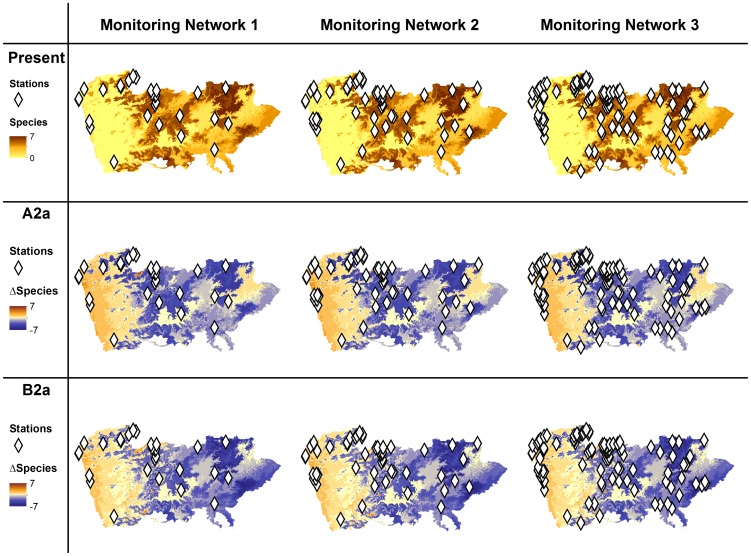
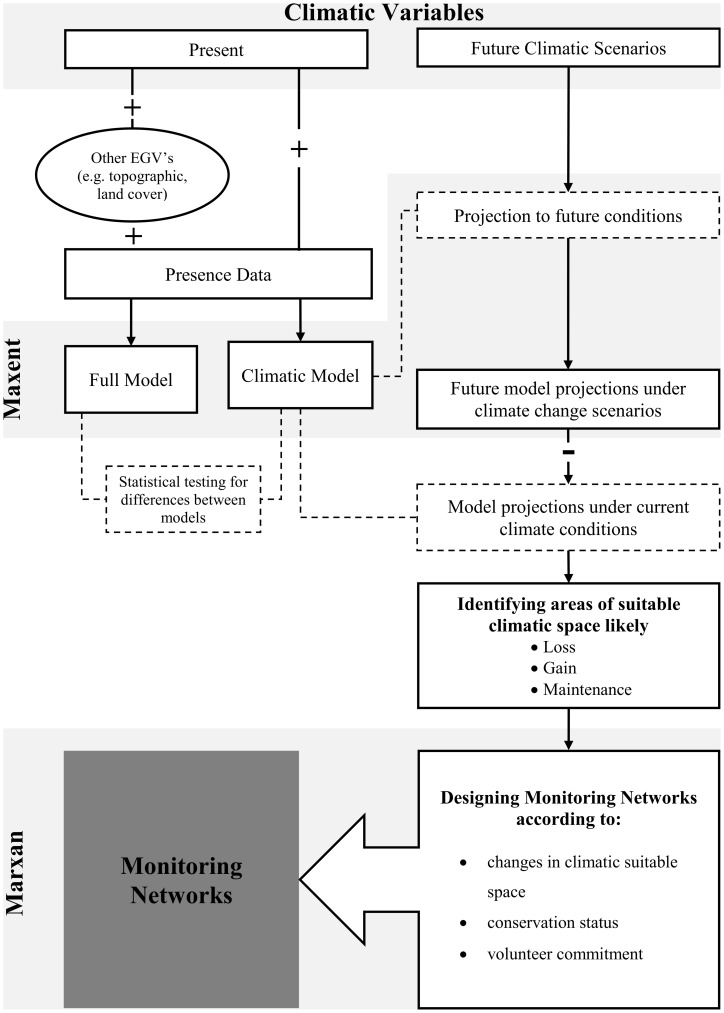
Here we develop a framework to design multi-species monitoring networks using species distribution models and conservation planning tools to optimize the location of monitoring stations to detect potential range shifts driven by climate change. For this study, we focused on seven bat species in Northern Portugal (Western Europe). Maximum entropy modelling was used to predict the likely occurrence of those species under present and future climatic conditions. By comparing present and future predicted distributions, we identified areas where each species is likely to gain, lose or maintain suitable climatic space. We then used a decision support tool (the Marxan software) to design three optimized monitoring networks considering: a) changes in species likely occurrence, b) species conservation status, and c) level of volunteer commitment. For present climatic conditions, species distribution models revealed that areas suitable for most species occur in the north-eastern part of the region. However, areas predicted to become climatically suitable in the future shifted towards west. The three simulated monitoring networks, adaptable for an unpredictable volunteer commitment, included 28, 54 and 110 sampling locations respectively, distributed across the study area and covering the potential full range of conditions where species range shifts may occur. Our results show that our framework outperforms the traditional approach that only considers current species ranges, in allocating monitoring stations distributed across different categories of predicted shifts in species distributions. This study presents a straightforward framework to design monitoring schemes aimed specifically at testing hypotheses about where and when species ranges may shift with climatic changes, while also ensuring surveillance of general population trends.

摘要

在此,我们开发了一个框架,用于设计多物种监测网络,该框架利用物种分布模型和保护规划工具来优化监测站的位置,以检测气候变化驱动的潜在范围变化。在本研究中,我们重点关注了葡萄牙北部(西欧)的七种蝙蝠物种。利用最大熵建模来预测这些物种在当前和未来气候条件下可能出现的区域。通过比较当前和未来预测的分布,我们确定了每个物种可能增加、减少或维持适宜气候空间的区域。然后,我们使用一种决策支持工具(Marxan软件)来设计三个优化的监测网络,考虑因素包括:a)物种可能出现区域的变化,b)物种保护状况,以及c)志愿者参与程度。对于当前气候条件,物种分布模型显示,适合大多数物种的区域位于该地区的东北部。然而,预计未来气候适宜的区域向西转移。这三个模拟的监测网络适用于不可预测的志愿者参与情况,分别包括28个、54个和110个采样地点,分布在研究区域内,覆盖了物种范围变化可能发生的潜在全部条件范围。我们的结果表明,在分配分布于物种分布预测变化不同类别的监测站时,我们的框架优于仅考虑当前物种范围的传统方法。本研究提出了一个直接的框架,用于设计监测方案,专门旨在检验关于物种范围可能随气候变化在何时何地发生变化的假设,同时还确保对总体种群趋势的监测。
https://cdn.ncbi.nlm.nih.gov/pmc/blobs/1d46/3903647/ad5495af52fd/pone.0087291.g006.jpg
https://cdn.ncbi.nlm.nih.gov/pmc/blobs/1d46/3903647/9e61d73b3d57/pone.0087291.g001.jpg
https://cdn.ncbi.nlm.nih.gov/pmc/blobs/1d46/3903647/ef931d00adb9/pone.0087291.g002.jpg
https://cdn.ncbi.nlm.nih.gov/pmc/blobs/1d46/3903647/b99e17537f07/pone.0087291.g003.jpg
https://cdn.ncbi.nlm.nih.gov/pmc/blobs/1d46/3903647/91eff28371bf/pone.0087291.g004.jpg
https://cdn.ncbi.nlm.nih.gov/pmc/blobs/1d46/3903647/b0efa4a9e123/pone.0087291.g005.jpg
https://cdn.ncbi.nlm.nih.gov/pmc/blobs/1d46/3903647/ad5495af52fd/pone.0087291.g006.jpg
https://cdn.ncbi.nlm.nih.gov/pmc/blobs/1d46/3903647/9e61d73b3d57/pone.0087291.g001.jpg
https://cdn.ncbi.nlm.nih.gov/pmc/blobs/1d46/3903647/ef931d00adb9/pone.0087291.g002.jpg
https://cdn.ncbi.nlm.nih.gov/pmc/blobs/1d46/3903647/b99e17537f07/pone.0087291.g003.jpg
https://cdn.ncbi.nlm.nih.gov/pmc/blobs/1d46/3903647/91eff28371bf/pone.0087291.g004.jpg
https://cdn.ncbi.nlm.nih.gov/pmc/blobs/1d46/3903647/b0efa4a9e123/pone.0087291.g005.jpg
https://cdn.ncbi.nlm.nih.gov/pmc/blobs/1d46/3903647/ad5495af52fd/pone.0087291.g006.jpg

相似文献

1
Designing optimized multi-species monitoring networks to detect range shifts driven by climate change: a case study with bats in the North of Portugal.设计优化的多物种监测网络以检测气候变化导致的分布范围变化:以葡萄牙北部蝙蝠为例的研究
PLoS One. 2014 Jan 27;9(1):e87291. doi: 10.1371/journal.pone.0087291. eCollection 2014.
2
Species-free species distribution models describe macroecological properties of protected area networks.无物种的物种分布模型描述了保护区网络的宏观生态特性。
PLoS One. 2017 Mar 16;12(3):e0173443. doi: 10.1371/journal.pone.0173443. eCollection 2017.
3
Wind energy development and wildlife conservation in Lithuania: A mapping tool for conflict assessment.立陶宛的风能开发与野生动物保护:冲突评估的绘图工具。
PLoS One. 2020 Jan 15;15(1):e0227735. doi: 10.1371/journal.pone.0227735. eCollection 2020.
4
Understanding Peripheral Bat Populations Using Maximum-Entropy Suitability Modeling.使用最大熵适宜性模型理解周边蝙蝠种群
PLoS One. 2016 Dec 9;11(12):e0152508. doi: 10.1371/journal.pone.0152508. eCollection 2016.
5
Impacts of climate change on distributions and diversity of ungulates on the Tibetan Plateau.气候变化对青藏高原有蹄类动物分布和多样性的影响。
Ecol Appl. 2015 Jan;25(1):24-38. doi: 10.1890/13-1499.1.
6
Cetacean range and climate in the eastern North Atlantic: future predictions and implications for conservation.北大西洋东部的鲸目动物分布范围和气候:未来预测及其对保护的影响。
Glob Chang Biol. 2014 Jun;20(6):1782-93. doi: 10.1111/gcb.12560. Epub 2014 Mar 28.
7
Rapid climate driven shifts in wintering distributions of three common waterbird species.冬季三种常见水鸟物种分布因快速气候变化而发生变化。
Glob Chang Biol. 2013 Jul;19(7):2071-81. doi: 10.1111/gcb.12200. Epub 2013 Apr 18.
8
Migratory behavior and winter geography drive differential range shifts of eastern birds in response to recent climate change.迁徙行为和冬季地理分布驱动东部鸟类对近期气候变化的差异范围变化。
Proc Natl Acad Sci U S A. 2020 Jun 9;117(23):12897-12903. doi: 10.1073/pnas.2000299117. Epub 2020 May 26.
9
Future climatically suitable areas for bats in South Asia.南亚未来适合蝙蝠生存的气候区域。
Ecol Evol. 2024 May 20;14(5):e11420. doi: 10.1002/ece3.11420. eCollection 2024 May.
10
Evaluating the connectivity of a protected areas' network under the prism of global change: the efficiency of the European Natura 2000 network for four birds of prey.在全球变化的背景下评估保护区网络的连通性:欧洲自然 2000 网络对四种猛禽的效率。
PLoS One. 2013;8(3):e59640. doi: 10.1371/journal.pone.0059640. Epub 2013 Mar 19.

引用本文的文献

1
Lost in Translation-How Transparency Can Improve Comparability and Reusability in Acoustic Bat Research.翻译中的迷失——透明度如何提升声学蝙蝠研究的可比性和可重用性
Ecol Evol. 2025 Jul 29;15(8):e71883. doi: 10.1002/ece3.71883. eCollection 2025 Aug.
2
Predicting habitat suitability for Townsend's big-eared bats across California in relation to climate change.预测加利福尼亚州汤森大耳蝠栖息地适宜性与气候变化的关系。
Ecol Evol. 2022 Dec 15;12(12):e9641. doi: 10.1002/ece3.9641. eCollection 2022 Dec.
3
Bat responses to climate change: a systematic review.

本文引用的文献

1
Efficient species-level monitoring at the landscape scale.在景观尺度上进行高效的物种水平监测。
Conserv Biol. 2012 Jun;26(3):432-41. doi: 10.1111/j.1523-1739.2012.01855.x.
2
Ecological and geographic modes of species divergence in wild tomatoes.野生番茄的物种分歧的生态和地理模式。
Am J Bot. 2010 Apr;97(4):680-93. doi: 10.3732/ajb.0900216. Epub 2010 Mar 11.
3
Planning, implementing, and monitoring multiple-species habitat conservation plans.规划、实施和监测多种物种生境保护计划。
蝙蝠对气候变化的响应:系统综述。
Biol Rev Camb Philos Soc. 2023 Feb;98(1):19-33. doi: 10.1111/brv.12893. Epub 2022 Aug 21.
4
Applying conservation reserve design strategies to define ecosystem monitoring priorities.应用保护地设计策略来确定生态系统监测重点。
Ecol Evol. 2021 Nov 11;11(23):17060-17070. doi: 10.1002/ece3.8344. eCollection 2021 Dec.
5
Update on Potentially Zoonotic Viruses of European Bats.欧洲蝙蝠潜在人畜共患病毒的最新情况
Vaccines (Basel). 2021 Jun 23;9(7):690. doi: 10.3390/vaccines9070690.
6
Delimiting a species' geographic range using posterior sampling and computational geometry.利用后采样和计算几何划分物种的地理分布范围。
Sci Rep. 2019 Jun 20;9(1):8938. doi: 10.1038/s41598-019-45318-5.
7
Following the water? Landscape-scale temporal changes in bat spatial distribution in relation to Mediterranean summer drought.追随水源?与地中海夏季干旱相关的蝙蝠空间分布的景观尺度时间变化。
Ecol Evol. 2018 May 2;8(11):5801-5814. doi: 10.1002/ece3.4119. eCollection 2018 Jun.
Am J Bot. 2011 Mar;98(3):559-71. doi: 10.3732/ajb.1000292. Epub 2011 Feb 25.
4
The importance of distance to resources in the spatial modelling of bat foraging habitat.资源距离在蝙蝠觅食生境空间建模中的重要性。
PLoS One. 2011 Apr 25;6(4):e19227. doi: 10.1371/journal.pone.0019227.
5
Beyond predictions: biodiversity conservation in a changing climate.超越预测:变化气候中的生物多样性保护。
Science. 2011 Apr 1;332(6025):53-8. doi: 10.1126/science.1200303.
6
Biodiversity conservation: challenges beyond 2010.生物多样性保护:2010 年后的挑战。
Science. 2010 Sep 10;329(5997):1298-303. doi: 10.1126/science.1189138.
7
Monitoring does not always count.监测并不总是必要的。
Trends Ecol Evol. 2010 Oct;25(10):547-50. doi: 10.1016/j.tree.2010.07.002. Epub 2010 Aug 19.
8
Global biodiversity: indicators of recent declines.全球生物多样性:近期衰退的指标。
Science. 2010 May 28;328(5982):1164-8. doi: 10.1126/science.1187512. Epub 2010 Apr 29.
9
Adaptive monitoring: a new paradigm for long-term research and monitoring.适应性监测:长期研究与监测的新范式。
Trends Ecol Evol. 2009 Sep;24(9):482-6. doi: 10.1016/j.tree.2009.03.005. Epub 2009 May 4.
10
Environmental niche equivalency versus conservatism: quantitative approaches to niche evolution.环境生态位等效性与保守性:生态位进化的定量方法
Evolution. 2008 Nov;62(11):2868-83. doi: 10.1111/j.1558-5646.2008.00482.x. Epub 2008 Aug 26.