Key Laboratory of Integrated Management of Crop Diseases and Pests (Ministry of Education), College of Plant Protection, Nanjing Agricultural University Nanjing, China.
Department of Entomology, University of Arizona Tucson, AZ, USA.
Evol Appl. 2013 Dec;6(8):1222-35. doi: 10.1111/eva.12099. Epub 2013 Sep 17.
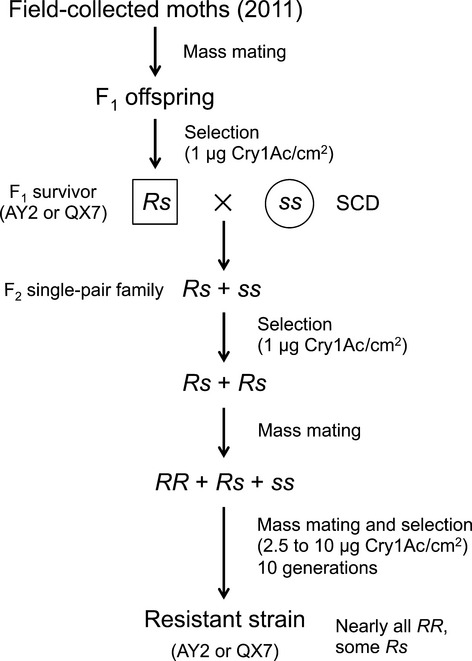
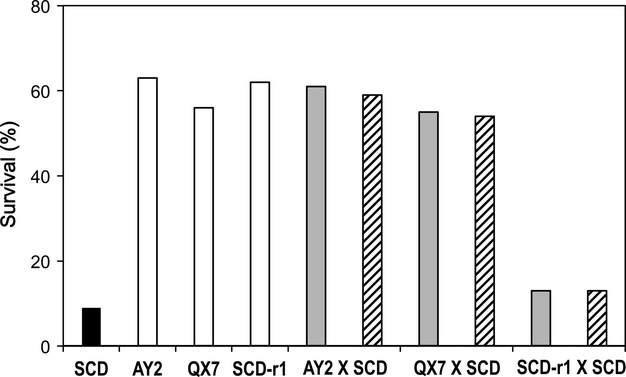
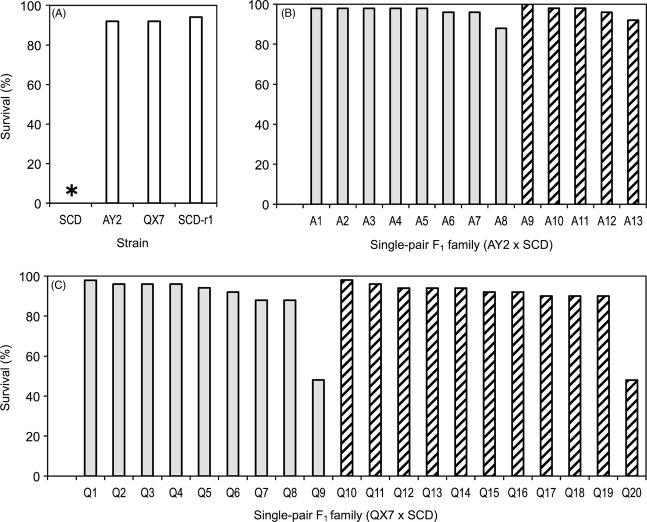
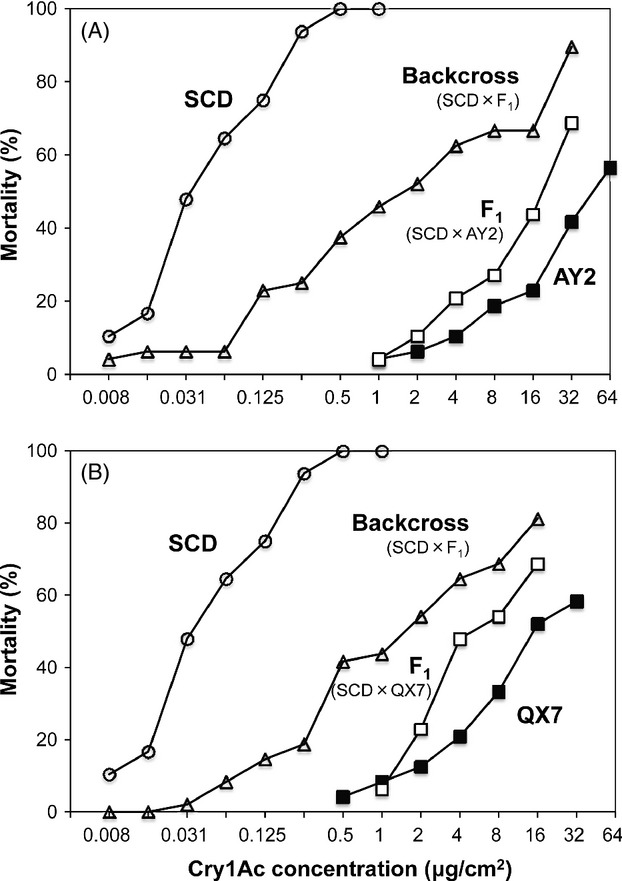
Evolution of resistance by insect pests threatens the long-term benefits of transgenic crops that produce insecticidal proteins from Bacillus thuringiensis (Bt). Previous work has detected increases in the frequency of resistance to Bt toxin Cry1Ac in populations of cotton bollworm, Helicoverpa armigera, from northern China where Bt cotton producing Cry1Ac has been grown extensively for more than a decade. Confirming that trend, we report evidence from 2011 showing that the percentage of individuals resistant to a diagnostic concentration of Cry1Ac was significantly higher in two populations from different provinces of northern China (1.4% and 2.3%) compared with previously tested susceptible field populations (0%). We isolated two resistant strains: one from each of the two field-selected populations. Relative to a susceptible strain, the two strains had 460- and 1200-fold resistance to Cry1Ac, respectively. Both strains had dominant resistance to a diagnostic concentration of Cry1Ac in diet and to Bt cotton leaves containing Cry1Ac. Both strains had low, but significant cross-resistance to Cry2Ab (4.2- and 5.9-fold), which is used widely as the second toxin in two-toxin Bt cotton. Compared with resistance in other strains of H. armigera, the resistance in the two strains characterized here may be especially difficult to suppress.
昆虫抗药性的进化威胁到了转 Bt 基因作物(Bt 产生的杀虫蛋白)的长期效益。此前的研究已经发现,在中国北方,广泛种植生产 Cry1Ac 的 Bt 棉花十多年后,棉铃虫对 Bt 毒素 Cry1Ac 的抗药性频率有所增加。证实了这一趋势,我们报告了 2011 年的证据,显示来自中国北方两个不同省份的两个种群中,对 Cry1Ac 诊断浓度具有抗性的个体比例明显高于之前测试的敏感田间种群(0%)。我们分离出了两个抗性菌株:分别来自这两个田间选择的种群。与敏感菌株相比,这两个菌株对 Cry1Ac 的抗性分别提高了 460 倍和 1200 倍。两种菌株对 Cry1Ac 诊断浓度的饮食和含有 Cry1Ac 的 Bt 棉叶均具有显性抗性。两种菌株对 Cry2Ab 均有低但显著的交叉抗性(分别为 4.2 倍和 5.9 倍),Cry2Ab 广泛用作两种毒素的 Bt 棉花中的第二种毒素。与其他棉铃虫菌株的抗性相比,这里描述的两种菌株的抗性可能特别难以抑制。