Akoua-Koffi Chantal, Asse Kouadio Vincent, Yao Atteby Jean Jacques
Pasteur Institute of Ivory Coast/Medical Sciences Training and Research Unit of Bouake, Abidjan, Republic of Ivory Coast.
BMJ Open. 2014 Jan 31;4(1):e003269. doi: 10.1136/bmjopen-2013-003269.
To estimate the proportion of rotavirus gastroenteritis (RVGE) among children aged less than 5 years who had been diagnosed with acute gastroenteritis (AGE) and admitted to hospitals and emergency rooms (ERs). The seasonal distribution of RVGE and most prevalent rotavirus (RV) strains was also assessed.
A cross-sectional hospital-based surveillance study.
5 reference paediatric hospitals across Abidjan.
Children aged less than 5 years, who were hospitalised/visiting ERs for WHO-defined AGE, were enrolled. Written informed consent was obtained from parents/guardians before enrolment. Children who acquired nosocomial infection were excluded from the study.
The proportion of RVGE among AGE hospitalisations and ER visits was expressed with 95% exact CI. Stool samples were collected from all enrolled children and were tested for the presence of RV using an enzyme immunoassay. RV-positive samples were serotyped using reverse transcriptase-PCR.
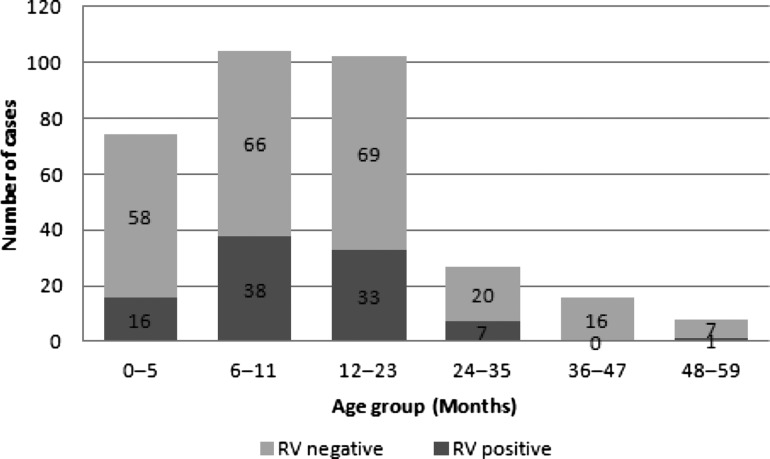
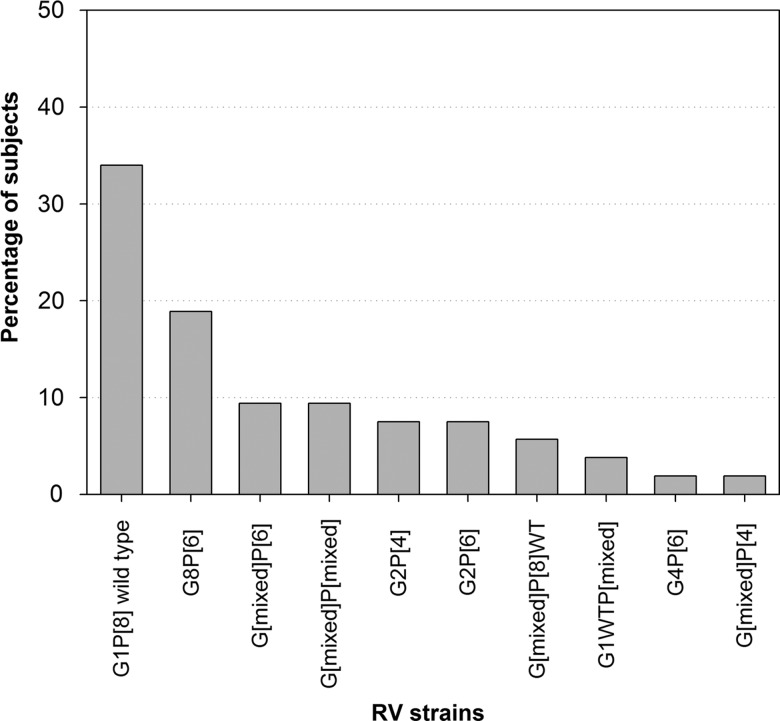
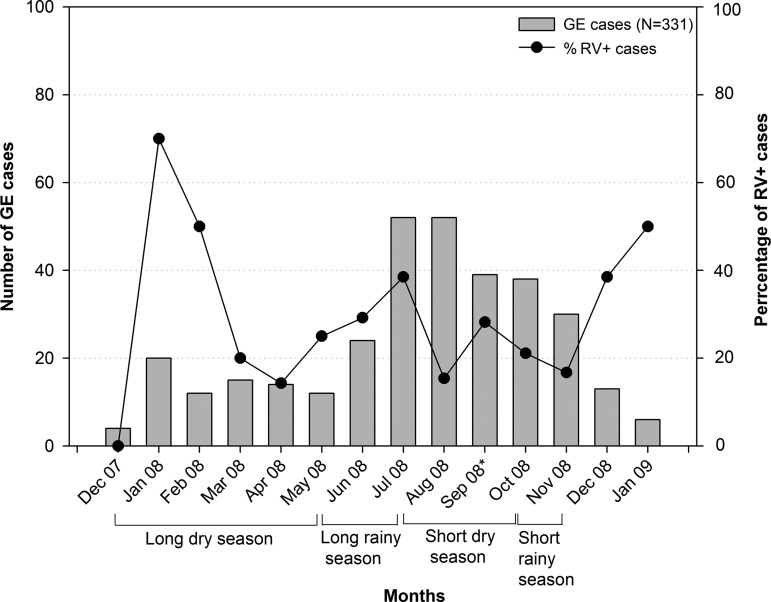
Of 357 enrolled children (mean age 13.6±11.14 months), 332 were included in the final analyses; 56.3% (187/332) were hospitalised and 43.7% (145/332) were admitted to ERs. The proportion of RVGE hospitalisations and ER visits among all AGE cases was 30.1% (95% CI 23.6% to 37.3%) and 26.9% (95% CI 19.9% to 34.9%), respectively. Ninety-five children (28.6%) were RV positive; the highest number of RVGE cases was observed in children aged 6-11 months. The number of GE cases peaked in July and August 2008; the highest percentage of RV-positive cases was observed in January 2008. G1P[8] wild-type and G8P[6] were the most commonly detected strains.
RVGE causes substantial morbidity among children under 5 years of age and remains a health concern in the Republic of Ivory Coast, where implementation of prevention strategies such as vaccination might help to reduce disease burden.
估算5岁以下被诊断为急性胃肠炎(AGE)并入住医院和急诊室(ER)的儿童中轮状病毒胃肠炎(RVGE)的比例。同时评估RVGE的季节分布以及最常见的轮状病毒(RV)毒株。
一项基于医院的横断面监测研究。
阿比让的5家参考儿科医院。
5岁以下因世界卫生组织定义的AGE而住院/就诊于急诊室的儿童被纳入研究。入组前已获得家长/监护人的书面知情同意。获得医院感染的儿童被排除在研究之外。
AGE住院和急诊就诊中RVGE的比例用95%精确可信区间表示。从所有入组儿童中采集粪便样本,并用酶免疫测定法检测RV的存在。RV阳性样本用逆转录聚合酶链反应进行血清分型。
在357名入组儿童(平均年龄13.6±11.14个月)中,332名被纳入最终分析;56.3%(187/332)住院,43.7%(145/332)就诊于急诊室。所有AGE病例中RVGE住院和急诊就诊的比例分别为30.1%(95%可信区间23.6%至37.3%)和26.9%(95%可信区间19.9%至34.9%)。95名儿童(28.6%)RV呈阳性;6至11个月大的儿童中观察到的RVGE病例数最多。GE病例数在2008年7月和8月达到峰值;2008年1月观察到的RV阳性病例百分比最高。G1P[8]野生型和G8P[6]是最常检测到的毒株。
RVGE在5岁以下儿童中导致大量发病,在科特迪瓦共和国仍然是一个健康问题,在该国实施疫苗接种等预防策略可能有助于减轻疾病负担。