Petri Victoria, Jayaraman Pushkala, Tutaj Marek, Hayman G Thomas, Smith Jennifer R, De Pons Jeff, Laulederkind Stanley Jf, Lowry Timothy F, Nigam Rajni, Wang Shur-Jen, Shimoyama Mary, Dwinell Melinda R, Munzenmaier Diane H, Worthey Elizabeth A, Jacob Howard J
Human and Molecular Genetics Center, Medical College of Wisconsin, Milwaukee, WI, USA.
J Biomed Semantics. 2014 Feb 5;5(1):7. doi: 10.1186/2041-1480-5-7.
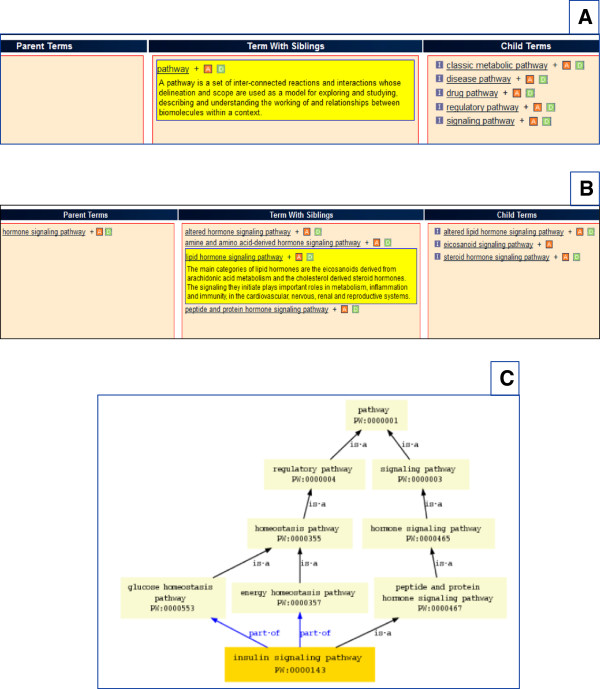
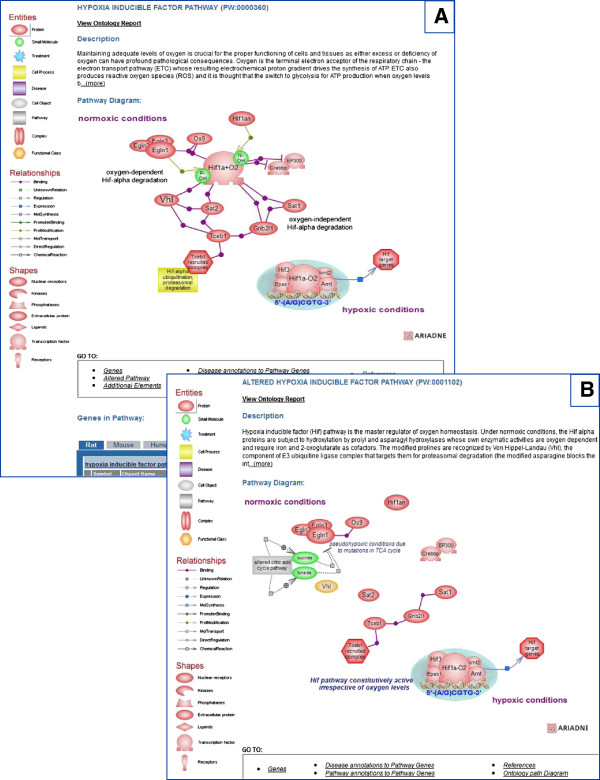
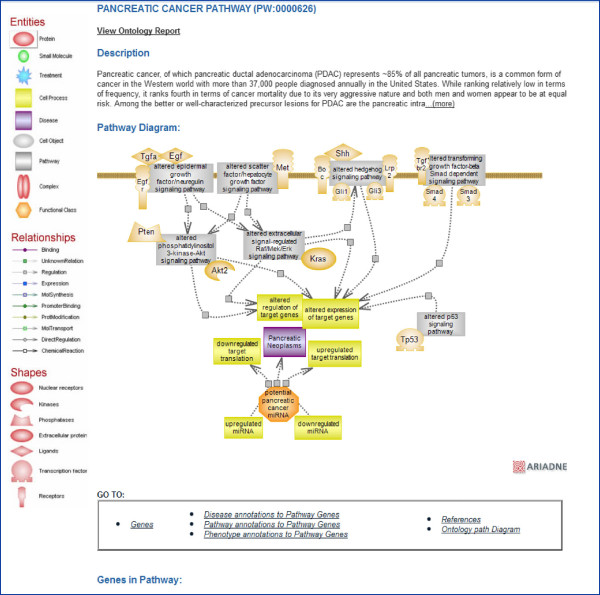
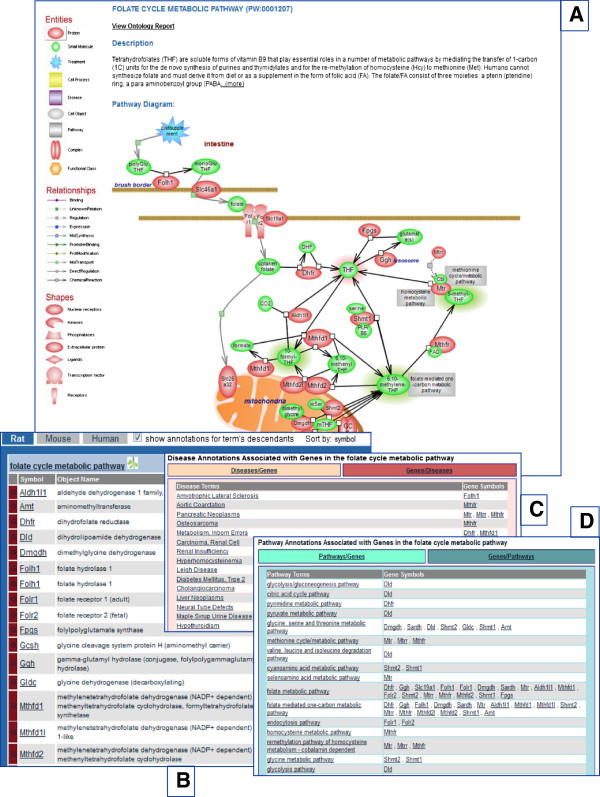
The Pathway Ontology (PW) developed at the Rat Genome Database (RGD), covers all types of biological pathways, including altered and disease pathways and captures the relationships between them within the hierarchical structure of a directed acyclic graph. The ontology allows for the standardized annotation of rat, and of human and mouse genes to pathway terms. It also constitutes a vehicle for easy navigation between gene and ontology report pages, between reports and interactive pathway diagrams, between pathways directly connected within a diagram and between those that are globally related in pathway suites and suite networks. Surveys of the literature and the development of the Pathway and Disease Portals are important sources for the ongoing development of the ontology. User requests and mapping of pathways in other databases to terms in the ontology further contribute to increasing its content. Recently built automated pipelines use the mapped terms to make available the annotations generated by other groups.
The two released pipelines - the Pathway Interaction Database (PID) Annotation Import Pipeline and the Kyoto Encyclopedia of Genes and Genomes (KEGG) Annotation Import Pipeline, make available over 7,400 and 31,000 pathway gene annotations, respectively. Building the PID pipeline lead to the addition of new terms within the signaling node, also augmented by the release of the RGD "Immune and Inflammatory Disease Portal" at that time. Building the KEGG pipeline lead to a substantial increase in the number of disease pathway terms, such as those within the 'infectious disease pathway' parent term category. The 'drug pathway' node has also seen increases in the number of terms as well as a restructuring of the node. Literature surveys, disease portal deployments and user requests have contributed and continue to contribute additional new terms across the ontology. Since first presented, the content of PW has increased by over 75%.
Ongoing development of the Pathway Ontology and the implementation of pipelines promote an enriched provision of pathway data. The ontology is freely available for download and use from the RGD ftp site at ftp://rgd.mcw.edu/pub/ontology/pathway/ or from the National Center for Biomedical Ontology (NCBO) BioPortal website at http://bioportal.bioontology.org/ontologies/PW.
大鼠基因组数据库(RGD)开发的通路本体(PW)涵盖了所有类型的生物通路,包括改变的通路和疾病通路,并在有向无环图的层次结构中捕捉它们之间的关系。该本体允许对大鼠以及人类和小鼠基因进行通路术语的标准化注释。它还构成了一个工具,便于在基因与本体报告页面之间、报告与交互式通路图之间、图中直接相连的通路之间以及通路套件和套件网络中全局相关的通路之间进行导航。文献调研以及通路与疾病门户的开发是该本体持续发展的重要来源。用户请求以及将其他数据库中的通路映射到本体中的术语进一步有助于增加其内容。最近构建的自动化管道使用映射的术语来提供其他团队生成的注释。
两个已发布的管道——通路相互作用数据库(PID)注释导入管道和京都基因与基因组百科全书(KEGG)注释导入管道,分别提供了超过7400个和31000个通路基因注释。构建PID管道导致在信号节点中添加了新术语,当时RGD“免疫和炎症性疾病门户”的发布也增加了相关术语。构建KEGG管道导致疾病通路术语数量大幅增加,例如“传染病通路”父术语类别中的那些术语。“药物通路”节点的术语数量也有所增加,并且该节点进行了重组。文献调研、疾病门户部署和用户请求已经并将继续为整个本体贡献更多新术语。自首次展示以来,PW的内容增加了超过75%。
通路本体的持续发展和管道的实施促进了通路数据的丰富提供。该本体可从RGD的ftp站点(ftp://rgd.mcw.edu/pub/ontology/pathway/)或国家生物医学本体中心(NCBO)的BioPortal网站(http://bioportal.bioontology.org/ontologies/PW)免费下载和使用。