Delahaye Jared L, Foster Olivia K, Vine Annalise, Saxton Daniel S, Curtin Thomas P, Somhegyi Hannah, Salesky Rebecca, Hermann Greg J
Department of Biology, Lewis & Clark College, Portland, OR 97219 Program in Biochemistry and Molecular Biology, Lewis & Clark College, Portland, OR 97219.
Mol Biol Cell. 2014 Apr;25(7):1073-96. doi: 10.1091/mbc.E13-09-0521. Epub 2014 Feb 5.
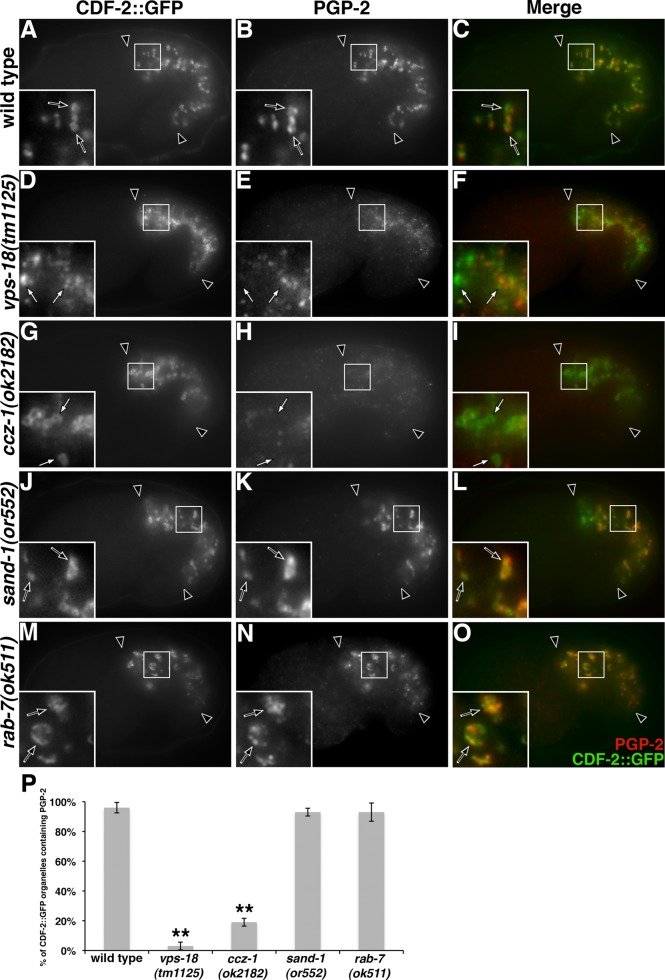
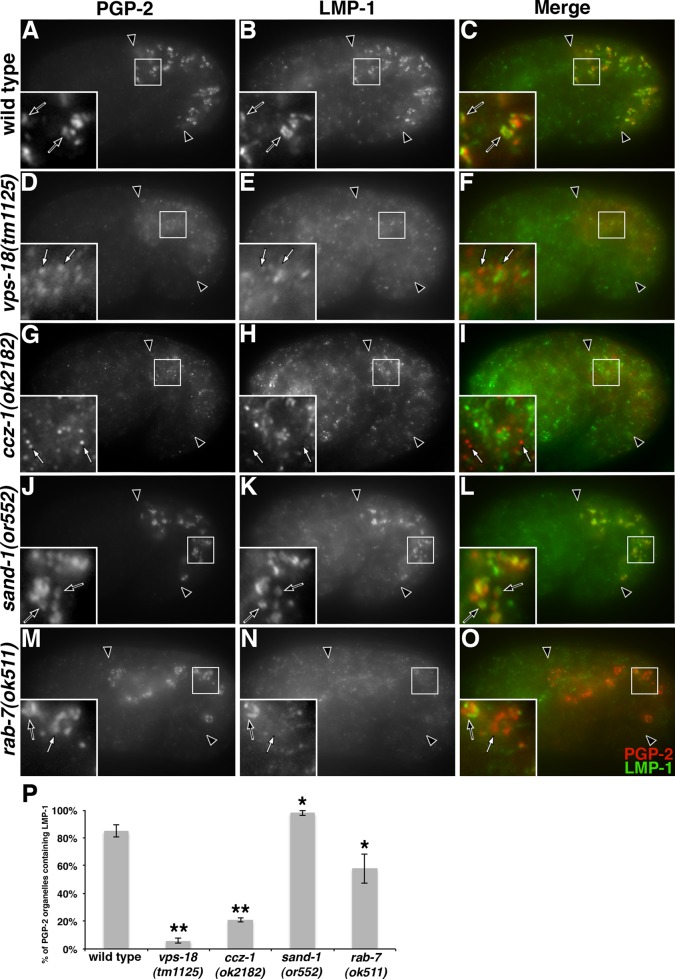
As early endosomes mature, the SAND-1/CCZ-1 complex acts as a guanine nucleotide exchange factor (GEF) for RAB-7 to promote the activity of its effector, HOPS, which facilitates late endosome-lysosome fusion and the consumption of AP-3-containing vesicles. We show that CCZ-1 and the HOPS complex are essential for the biogenesis of gut granules, cell type-specific, lysosome-related organelles (LROs) that coexist with conventional lysosomes in Caenorhabditis elegans intestinal cells. The HOPS subunit VPS-18 promotes the trafficking of gut granule proteins away from lysosomes and functions downstream of or in parallel to the AP-3 adaptor. CCZ-1 also acts independently of AP-3, and ccz-1 mutants mistraffic gut granule proteins. Our results indicate that SAND-1 does not participate in the formation of gut granules. In the absence of RAB-7 activity, gut granules are generated; however, their size and protein composition are subtly altered. These observations suggest that CCZ-1 acts in partnership with a protein other than SAND-1 as a GEF for an alternate Rab to promote gut granule biogenesis. Point mutations in GLO-1, a Rab32/38-related protein, predicted to increase spontaneous guanine nucleotide exchange, specifically suppress the loss of gut granules by ccz-1 and glo-3 mutants. GLO-3 is known to be required for gut granule formation and has homology to SAND-1/Mon1-related proteins, suggesting that CCZ-1 functions with GLO-3 upstream of the GLO-1 Rab, possibly as a GLO-1 GEF. These results support LRO formation occurring via processes similar to conventional lysosome biogenesis, albeit with key molecular differences.
随着早期内体的成熟,SAND-1/CCZ-1复合物作为RAB-7的鸟嘌呤核苷酸交换因子(GEF),促进其效应器HOPS的活性,这有助于晚期内体与溶酶体的融合以及含AP-3囊泡的消耗。我们发现CCZ-1和HOPS复合物对于肠道颗粒(一种与秀丽隐杆线虫肠道细胞中的常规溶酶体共存的细胞类型特异性溶酶体相关细胞器,即LRO)的生物发生至关重要。HOPS亚基VPS-18促进肠道颗粒蛋白从溶酶体的转运,并在AP-3衔接蛋白的下游或与其平行发挥作用。CCZ-1也独立于AP-3发挥作用,ccz-1突变体会导致肠道颗粒蛋白的运输错误。我们的结果表明SAND-1不参与肠道颗粒的形成。在缺乏RAB-7活性的情况下,肠道颗粒仍然能够产生;然而,它们的大小和蛋白质组成会发生细微变化。这些观察结果表明,CCZ-1与SAND-1以外的一种蛋白质协同作用,作为另一种Rab的GEF,以促进肠道颗粒的生物发生。GLO-1(一种与Rab32/38相关的蛋白质)中的点突变预计会增加自发鸟嘌呤核苷酸交换,它能特异性地抑制ccz-1和glo-3突变体中肠道颗粒的缺失。已知GLO-3是肠道颗粒形成所必需的,并且与SAND-1/Mon1相关蛋白具有同源性,这表明CCZ-1与GLO-3在GLO-1 Rab的上游发挥作用,可能作为一种GLO-1 GEF。这些结果支持LRO的形成过程与传统溶酶体生物发生过程相似,尽管存在关键的分子差异。