1] Department of Biological Physics, Eötvös University, Pázmány P. stny. 1/A, H-1117 Budapest, Hungary [2] Hungarian Academy of Sciences, Research Centre for Natural Sciences, Institute for Technical Physics and Materials Science, Konkoly-Thege út 29-33, H-1120 Budapest, Hungary.
1] Hungarian Academy of Sciences, Research Centre for Natural Sciences, Institute for Technical Physics and Materials Science, Konkoly-Thege út 29-33, H-1120 Budapest, Hungary [2] Doctoral School of Molecular- and Nanotechnologies, Faculty of Information Technology, University of Pannonia, H-8200 Egyetem u.10, Veszprém, Hungary.
Sci Rep. 2014 Feb 7;4:4034. doi: 10.1038/srep04034.
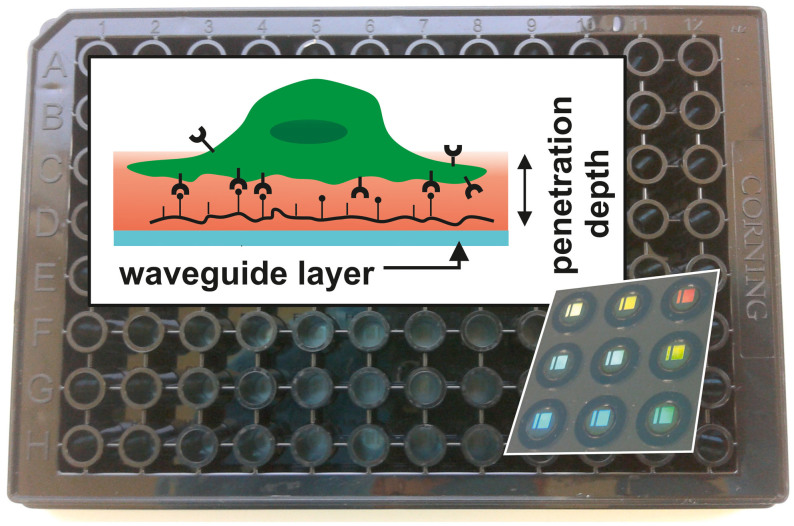
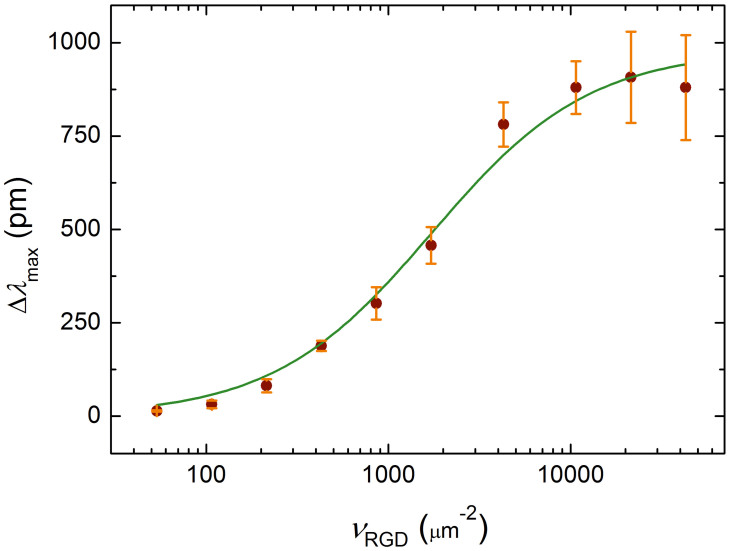
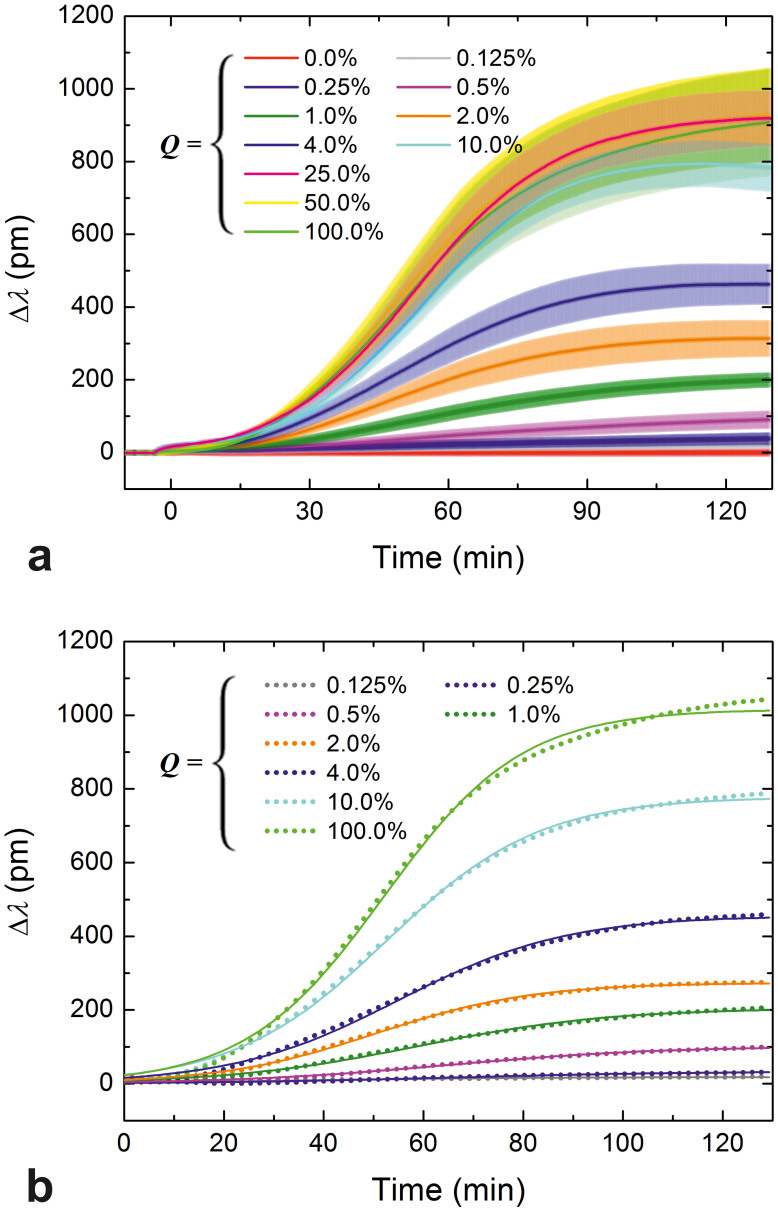
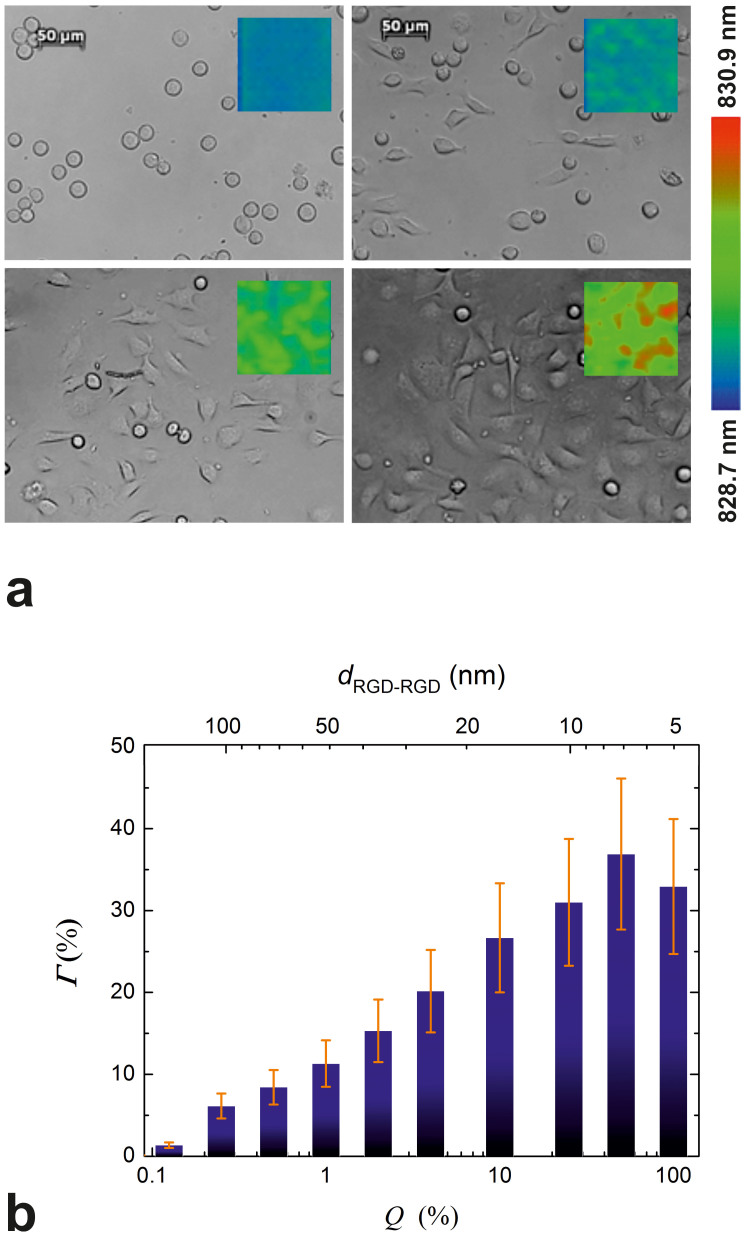
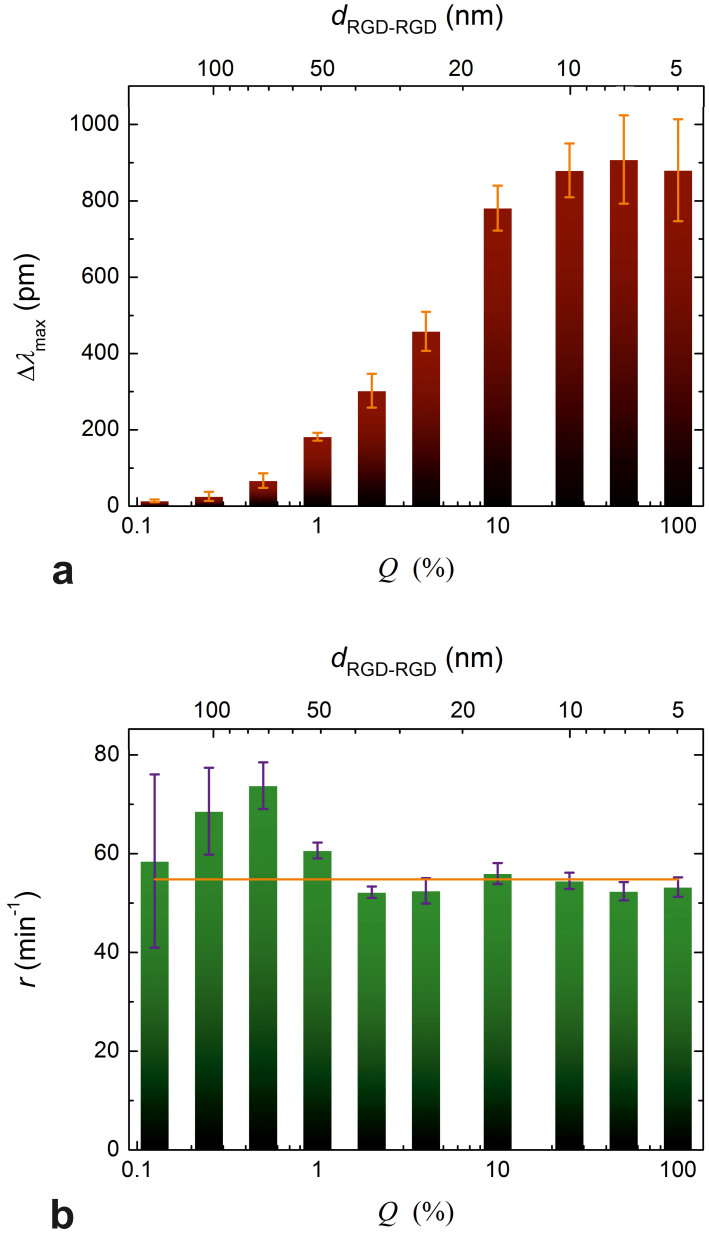
A novel high-throughput label-free resonant waveguide grating (RWG) imager biosensor, the Epic® BenchTop (BT), was utilized to determine the dependence of cell spreading kinetics on the average surface density (v(RGD)) of integrin ligand RGD-motifs. v(RGD) was tuned over four orders of magnitude by co-adsorbing the biologically inactive PLL-g-PEG and the RGD-functionalized PLL-g-PEG-RGD synthetic copolymers from their mixed solutions onto the sensor surface. Using highly adherent human cervical tumor (HeLa) cells as a model system, cell adhesion kinetic data of unprecedented quality were obtained. Spreading kinetics were fitted with the logistic equation to obtain the spreading rate constant (r) and the maximum biosensor response (Δλmax), which is assumed to be directly proportional to the maximum spread contact area (Amax). r was found to be independent of the surface density of integrin ligands. In contrast, Δλmax increased with increasing RGD surface density until saturation at high densities. Interpreting the latter behavior with a simple kinetic mass action model, a 2D dissociation constant of 1753 ± 243 μm(-2) (corresponding to a 3D dissociation constant of ~30 μM) was obtained for the binding between RGD-specific integrins embedded in the cell membrane and PLL-g-PEG-RGD. All of these results were obtained completely noninvasively without using any labels.
一种新型高通量无标记谐振波导光栅(RWG)生物传感器 Epic® BenchTop(BT)被用于研究细胞扩展动力学与整合素配体 RGD 基序平均表面密度(v(RGD))的关系。通过将生物惰性 PLL-g-PEG 和 RGD 功能化的 PLL-g-PEG-RGD 合成共聚物从其混合溶液中共同吸附到传感器表面,v(RGD)在四个数量级范围内进行调节。使用高粘附性的人宫颈肿瘤(HeLa)细胞作为模型系统,获得了前所未有的高质量细胞粘附动力学数据。扩展动力学用逻辑方程拟合以获得扩展速率常数(r)和最大生物传感器响应(Δλmax),假设其与最大扩展接触面积(Amax)直接成正比。r 与整合素配体的表面密度无关。相比之下,随着 RGD 表面密度的增加,Δλmax 增加,直到高密度时达到饱和。用简单的动力学质量作用模型解释后者的行为,得到细胞膜中嵌入的 RGD 特异性整合素与 PLL-g-PEG-RGD 之间的 2D 离解常数为 1753 ± 243 μm(-2)(相当于 3D 离解常数约为 30 μM)。所有这些结果都是完全非侵入性的,无需使用任何标记。