Department of Health Policy and Management, Harvard T.H. Chan School of Public Health, Boston, Massachusetts.
Research, Evaluation, and Learning Unit, Robert Wood Johnson Foundation, Princeton, New Jersey.
Health Serv Res. 2019 Dec;54 Suppl 2(Suppl 2):1399-1408. doi: 10.1111/1475-6773.13220. Epub 2019 Oct 29.
To examine experiences of racial discrimination among black adults in the United States, which broadly contribute to their poor health outcomes.
Data come from a nationally representative, probability-based telephone survey including 802 non-Hispanic black and a comparison group of 902 non-Hispanic white US adults, conducted January-April 2017.
We calculated the percent of blacks reporting discrimination in several domains, including health care. We used logistic regression to compare the black-white difference in odds of discrimination, and among blacks only to examine variation by socioeconomic status, gender, and neighborhood racial composition.
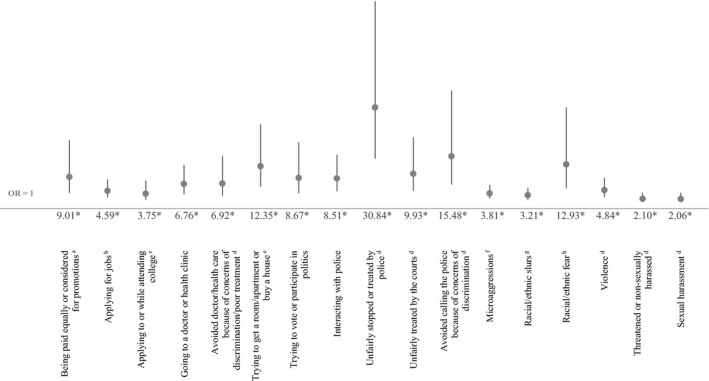
About one-third of blacks (32 percent) reported experiencing discrimination in clinical encounters, while 22 percent avoided seeking health care for themselves or family members due to anticipated discrimination. A majority of black adults reported experiencing discrimination in employment (57 percent in obtaining equal pay/promotions; 56 percent in applying for jobs), police interactions (60 percent reported being stopped/unfairly treated by police), and hearing microaggressions (52 percent) and racial slurs (51 percent). In adjusted models, blacks had significantly higher odds than whites of reporting discrimination in every domain. Among blacks, having a college degree was associated with higher odds of experiencing overall institutional discrimination.
The extent of reported discrimination across several areas of life suggests a broad pattern of discrimination against blacks in America, beyond isolated experiences. Black-white disparities exist on nearly all dimensions of experiences with public and private institutions, including health care and the police. Evidence of systemic discrimination suggests a need for more active institutional interventions to address racism in policy and practice.
考察美国黑人成年人经历种族歧视的情况,这些经历广泛导致他们健康状况不佳。
数据来自于一项全国代表性的、基于概率的电话调查,包括 802 名非西班牙裔黑人以及一个由 902 名非西班牙裔白人美国成年人组成的对照组,调查于 2017 年 1 月至 4 月进行。
我们计算了在几个领域报告遭受歧视的黑人比例,包括医疗保健。我们使用逻辑回归比较了黑人与白人之间在遭受歧视的可能性上的差异,并在黑人中仅检查了社会经济地位、性别和社区种族构成的差异。
约三分之一的黑人(32%)报告在临床接触中经历了歧视,而 22%的黑人因为预计会受到歧视而避免为自己或家人寻求医疗保健。大多数黑人成年人报告在就业中经历了歧视(57%的人在获得同工同酬/晋升方面;56%的人在申请工作方面)、警察互动(60%的人报告被警察拦下/受到不公正待遇)、听到微攻击(52%)和种族侮辱(51%)。在调整后的模型中,黑人报告在每个领域遭受歧视的可能性都明显高于白人。在黑人中,拥有大学学位与经历总体机构歧视的可能性较高有关。
在生活的几个领域报告的歧视程度表明,在美国,黑人普遍受到歧视,而不仅仅是孤立的经历。在与公共和私人机构的几乎所有方面的经历上,都存在着黑人与白人之间的差距,包括医疗保健和警察。有系统歧视的证据表明,需要更积极地进行机构干预,以解决政策和实践中的种族主义问题。