Pragmatic Clinical Trials Unit, Queen Mary University of London, 58 Turner Street, London E1 2AB, UK.
BMC Med Res Methodol. 2014 Feb 10;14:20. doi: 10.1186/1471-2288-14-20.
It is often desirable to account for centre-effects in the analysis of multicentre randomised trials, however it is unclear which analysis methods are best in trials with a binary outcome.
We compared the performance of four methods of analysis (fixed-effects models, random-effects models, generalised estimating equations (GEE), and Mantel-Haenszel) using a re-analysis of a previously reported randomised trial (MIST2) and a large simulation study.
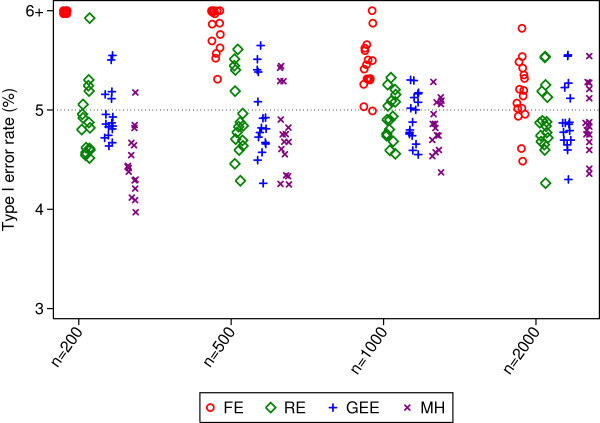
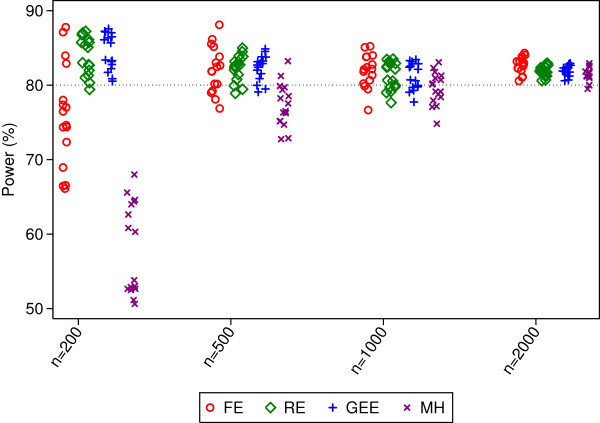
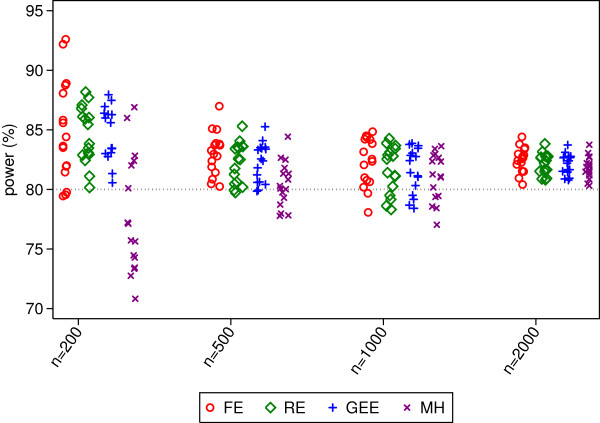
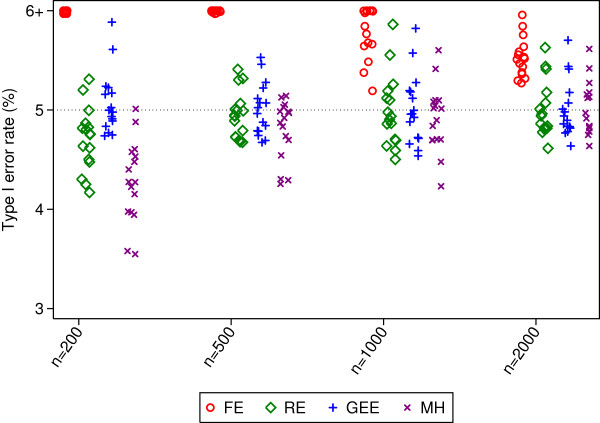
The re-analysis of MIST2 found that fixed-effects and Mantel-Haenszel led to many patients being dropped from the analysis due to over-stratification (up to 69% dropped for Mantel-Haenszel, and up to 33% dropped for fixed-effects). Conversely, random-effects and GEE included all patients in the analysis, however GEE did not reach convergence. Estimated treatment effects and p-values were highly variable across different analysis methods.The simulation study found that most methods of analysis performed well with a small number of centres. With a large number of centres, fixed-effects led to biased estimates and inflated type I error rates in many situations, and Mantel-Haenszel lost power compared to other analysis methods in some situations. Conversely, both random-effects and GEE gave nominal type I error rates and good power across all scenarios, and were usually as good as or better than either fixed-effects or Mantel-Haenszel. However, this was only true for GEEs with non-robust standard errors (SEs); using a robust 'sandwich' estimator led to inflated type I error rates across most scenarios.
With a small number of centres, we recommend the use of fixed-effects, random-effects, or GEE with non-robust SEs. Random-effects and GEE with non-robust SEs should be used with a moderate or large number of centres.
在分析多中心随机试验时,通常需要考虑中心效应,然而对于二分类结局的试验,哪种分析方法最好尚不清楚。
我们通过重新分析一项已发表的随机试验(MIST2)和一项大型模拟研究,比较了四种分析方法(固定效应模型、随机效应模型、广义估计方程(GEE)和 Mantel-Haenszel)的性能。
对 MIST2 的重新分析发现,固定效应和 Mantel-Haenszel 由于过度分层而导致许多患者被排除在分析之外(Mantel-Haenszel 最多排除 69%的患者,固定效应最多排除 33%的患者)。相反,随机效应和 GEE 将所有患者纳入分析,但 GEE 未收敛。不同分析方法的治疗效果估计值和 p 值差异很大。模拟研究发现,大多数分析方法在中心数量较少的情况下表现良好。在中心数量较多的情况下,固定效应在许多情况下会导致有偏估计和膨胀的Ⅰ类错误率,并且在某些情况下 Mantel-Haenszel 比其他分析方法丧失了效能。相反,随机效应和 GEE 在所有情况下均给出了名义Ⅰ类错误率和良好的效能,并且通常与固定效应或 Mantel-Haenszel 一样好或更好。但这仅适用于非稳健标准误(SE)的 GEE;使用稳健的“夹层”估计器会导致大多数情况下的Ⅰ类错误率膨胀。
在中心数量较少的情况下,我们建议使用固定效应、随机效应或非稳健 SE 的 GEE。对于中等或大量中心,应使用随机效应和非稳健 SE 的 GEE。