Oiki S, Danho W, Montal M
Department of Neurosciences, Roche Institute of Molecular Biology, Nutley, NJ.
Proc Natl Acad Sci U S A. 1988 Apr;85(7):2393-7. doi: 10.1073/pnas.85.7.2393.
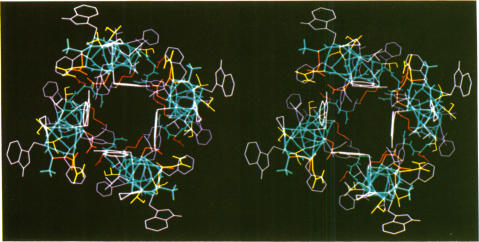
A synthetic 22-mer peptide that mimics the sequence of a putative pore segment of the voltage-dependent sodium channel forms transmembrane ionic channels in lipid bilayers. Several features of the authentic sodium channel are exhibited by the synthetic peptide: (i) The single channel conductance of the most frequent event is 20 pS in 0.5 M NaCl. (ii) The single channel open and closed lifetimes are in the ms time range. (iii) The synthetic channel discriminates cations over anions but is nonselective between Na+ and K+. However, the synthetic channel displays no significant voltage dependence. Energetic considerations suggest a bundle of four parallel amphipathic alpha-helices as the most plausible channel structure. The synthetic 22-mer channel-forming peptide allows study of the mechanisms of ion permeation through sodium channels by protein engineering techniques.
一种模拟电压依赖性钠通道假定孔道片段序列的合成22肽在脂质双层中形成跨膜离子通道。合成肽展现出了天然钠通道的几个特征:(i)在0.5 M NaCl中,最常见事件的单通道电导为20 pS。(ii)单通道的开放和关闭寿命在毫秒时间范围内。(iii)合成通道对阳离子的选择性高于阴离子,但对Na+和K+没有选择性。然而,合成通道没有显示出明显的电压依赖性。能量考量表明,由四个平行两亲性α螺旋组成的束状结构是最合理的通道结构。这种合成的22肽通道形成肽使得通过蛋白质工程技术研究离子通过钠通道的渗透机制成为可能。