Zhang Xingwang, Wang Yisheng, Qian Yifan, Wu Xin, Zhang Zejian, Liu Xijun, Zhao Ran, Zhou Lei, Ruan Yuanyuan, Xu Jiejie, Liu Haiou, Ren Shifang, Xu Congjian, Gu Jianxin
Key Laboratory of Glycoconjugate Research Ministry of Public Health, Department of Biochemistry and Molecular Biology, School of Basic Medical Sciences, Fudan University, Shanghai, China.
Obstetrics and Gynecology Hospital, Fudan University, Shanghai, China.
PLoS One. 2014 Feb 6;9(2):e87978. doi: 10.1371/journal.pone.0087978. eCollection 2014.
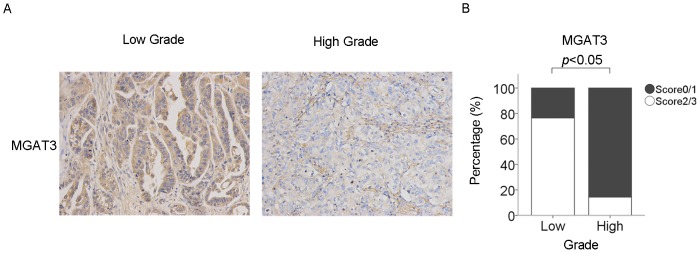
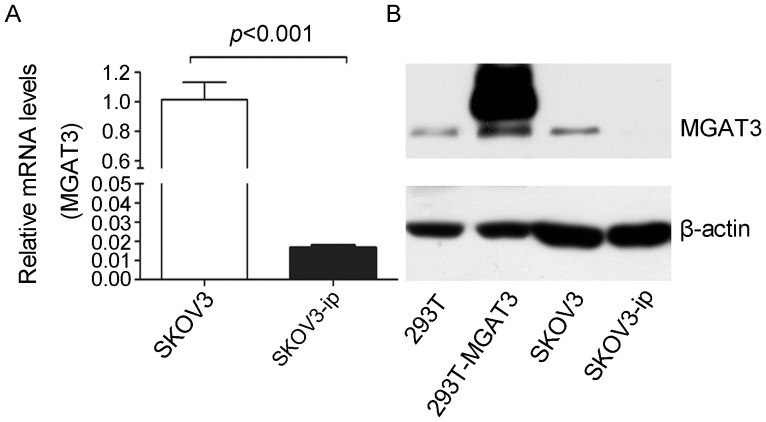
Generally, most of ovarian cancer cannot be detected until large scale and remote metastasis occurs, which is the major cause of high mortality in ovarian cancer. Therefore, it is urgent to discover metastasis-related biomarkers for the detection of ovarian cancer in its occult metastasis stage. Altered glycosylation is a universal feature of malignancy and certain types of glycan structures are well-known markers for tumor progressions. Thus, this study aimed to reveal specific changes of N-glycans in the secretome of the metastatic ovarian cancer. We employed a quantitative glycomics approach based on metabolic stable isotope labeling to compare the differential N-glycosylation of secretome between an ovarian cancer cell line SKOV3 and its high metastatic derivative SKOV3-ip. Intriguingly, among total 17 N-glycans identified, the N-glycans with bisecting GlcNAc were all significantly decreased in SKOV3-ip in comparison to SKOV3. This alteration in bisecting GlcNAc glycoforms as well as its corresponding association with ovarian cancer metastatic behavior was further validated at the glycotransferase level with multiple techniques including real-time PCR, western blotting, transwell assay, lectin blotting and immunohistochemistry analysis. This study illustrated metastasis-related N-glycan alterations in ovarian cancer secretome in vitro for the first time, which is a valuable source for biomarker discovery as well. Moreover, N-glycans with bisecting GlcNAc shed light on the detection of ovarian cancer in early peritoneal metastasis stage which may accordingly improve the prognosis of ovarian cancer patients.
一般来说,大多数卵巢癌在发生大规模远处转移之前无法被检测到,这是卵巢癌死亡率高的主要原因。因此,迫切需要发现与转移相关的生物标志物,用于检测处于隐匿转移阶段的卵巢癌。糖基化改变是恶性肿瘤的一个普遍特征,某些类型的聚糖结构是肿瘤进展的著名标志物。因此,本研究旨在揭示转移性卵巢癌分泌组中N-聚糖的特定变化。我们采用基于代谢稳定同位素标记的定量糖组学方法,比较卵巢癌细胞系SKOV3及其高转移衍生物SKOV3-ip分泌组的差异N-糖基化。有趣的是,在总共鉴定出的17种N-聚糖中,与SKOV3相比,带有平分型N-乙酰葡糖胺的N-聚糖在SKOV3-ip中均显著减少。通过实时PCR、蛋白质印迹、Transwell实验、凝集素印迹和免疫组织化学分析等多种技术,在糖基转移酶水平进一步验证了平分型N-乙酰葡糖胺糖型的这种改变及其与卵巢癌转移行为的相应关联。本研究首次阐明了体外卵巢癌分泌组中与转移相关的N-聚糖改变,这也是发现生物标志物的宝贵来源。此外,带有平分型N-乙酰葡糖胺的N-聚糖为早期腹膜转移阶段卵巢癌的检测提供了线索,这可能相应地改善卵巢癌患者的预后。