Lin Tzu-Yu, Huang Wei-Jan, Wu Chia-Chan, Lu Cheng-Wei, Wang Su-Jane
Department of Anesthesiology, Far-Eastern Memorial Hospital, New Taipei, Taiwan ; Department of Mechanical Engineering, Yuan Ze University, New Taipei, Taiwan.
Graduate Institute of Pharmacognosy, Taipei Medical University, Taipei, Taiwan.
PLoS One. 2014 Feb 10;9(2):e88644. doi: 10.1371/journal.pone.0088644. eCollection 2014.
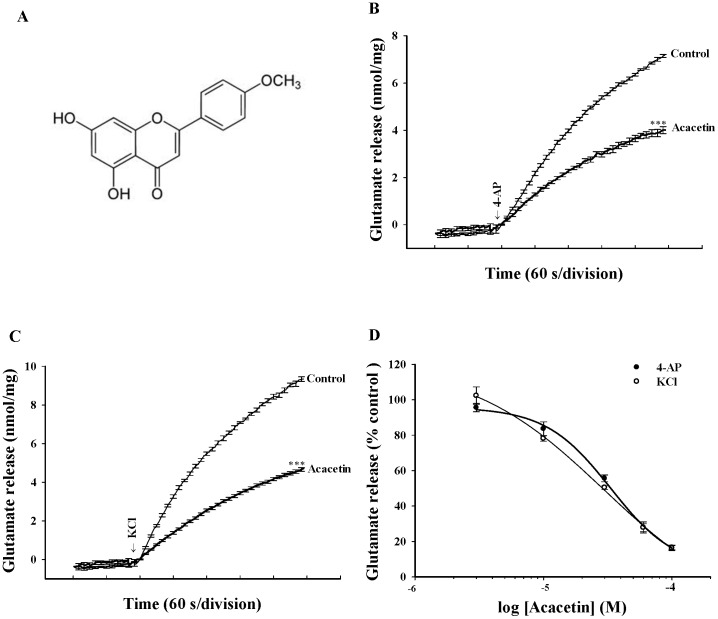
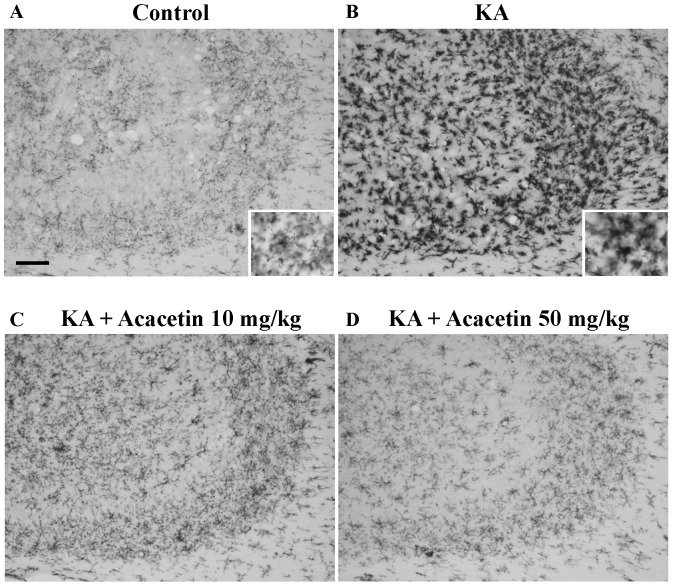
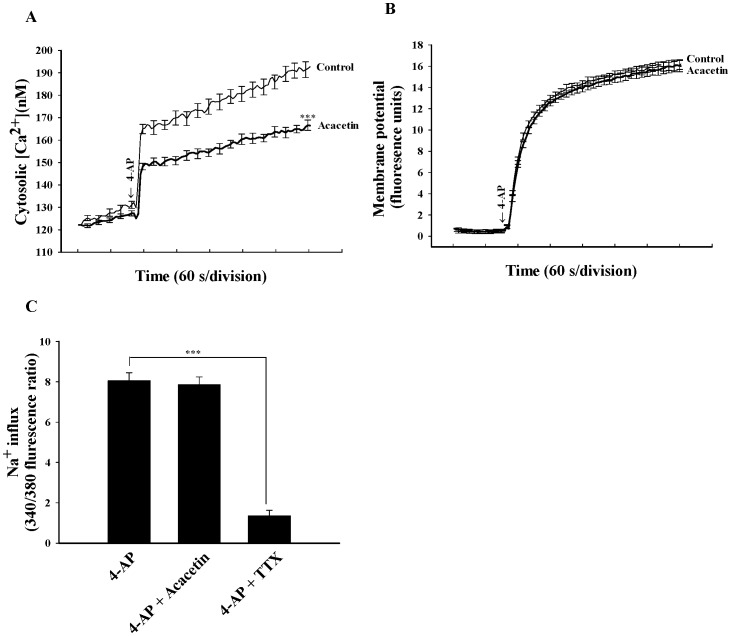
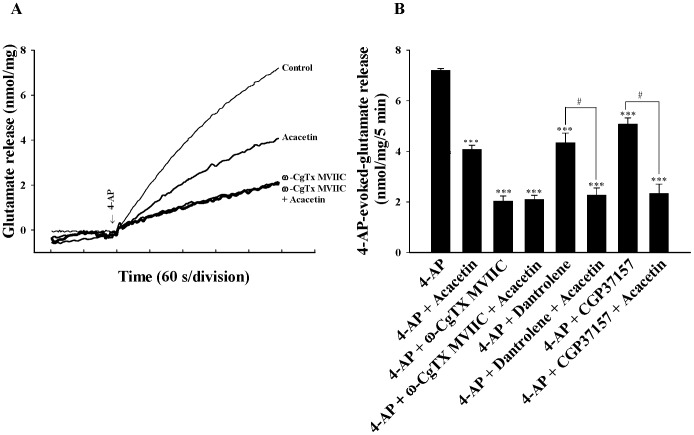
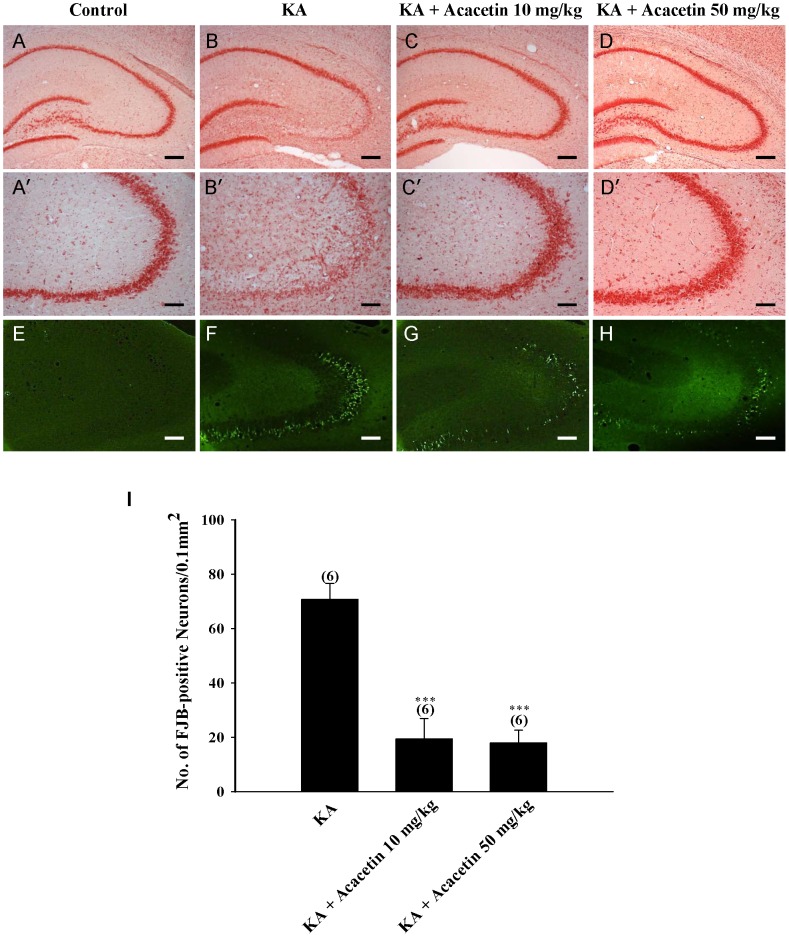
An excessive release of glutamate is considered to be a molecular mechanism associated with several neurological diseases that causes neuronal damage. Therefore, searching for compounds that reduce glutamate neurotoxicity is necessary. In this study, the possibility that the natural flavone acacetin derived from the traditional Chinese medicine Clerodendrum inerme (L.) Gaertn is a neuroprotective agent was investigated. The effect of acacetin on endogenous glutamate release in rat hippocampal nerve terminals (synaptosomes) was also investigated. The results indicated that acacetin inhibited depolarization-evoked glutamate release and cytosolic free Ca(2+) concentration ([Ca(2+)]C) in the hippocampal nerve terminals. However, acacetin did not alter synaptosomal membrane potential. Furthermore, the inhibitory effect of acacetin on evoked glutamate release was prevented by the Cav2.2 (N-type) and Cav2.1 (P/Q-type) channel blocker known as ω-conotoxin MVIIC. In a kainic acid (KA) rat model, an animal model used for excitotoxic neurodegeneration experiments, acacetin (10 or 50 mg/kg) was administrated intraperitoneally to the rats 30 min before the KA (15 mg/kg) intraperitoneal injection, and subsequently induced the attenuation of KA-induced neuronal cell death and microglia activation in the CA3 region of the hippocampus. The present study demonstrates that the natural compound, acacetin, inhibits glutamate release from hippocampal synaptosomes by attenuating voltage-dependent Ca(2+) entry and effectively prevents KA-induced in vivo excitotoxicity. Collectively, these data suggest that acacetin has the therapeutic potential for treating neurological diseases associated with excitotoxicity.
谷氨酸的过度释放被认为是与几种导致神经元损伤的神经疾病相关的分子机制。因此,寻找能够降低谷氨酸神经毒性的化合物是必要的。在本研究中,对源自传统中药假茉莉(Clerodendrum inerme (L.) Gaertn)的天然黄酮刺槐素作为神经保护剂的可能性进行了研究。还研究了刺槐素对大鼠海马神经末梢(突触体)内源性谷氨酸释放的影响。结果表明,刺槐素抑制海马神经末梢去极化诱发的谷氨酸释放以及胞质游离钙浓度([Ca(2+)]C)。然而,刺槐素并未改变突触体膜电位。此外,刺槐素对诱发的谷氨酸释放的抑制作用被称为ω-芋螺毒素MVIIC的Cav2.2(N型)和Cav2.1(P/Q型)通道阻滞剂所阻断。在用于兴奋性毒性神经退行性变实验的动物模型—— kainic acid(KA)大鼠模型中,在腹腔注射KA(15 mg/kg)前30分钟给大鼠腹腔注射刺槐素(10或50 mg/kg),随后可减轻KA诱导的海马CA3区神经元细胞死亡和小胶质细胞活化。本研究表明,天然化合物刺槐素通过减弱电压依赖性Ca(2+)内流来抑制海马突触体释放谷氨酸,并有效预防KA诱导的体内兴奋性毒性。总体而言,这些数据表明刺槐素具有治疗与兴奋性毒性相关神经疾病的潜力。