Schwartz Robert P, Gryczynski Jan, Mitchell Shannon Gwin, Gonzales Arturo, Moseley Ana, Peterson Thomas R, Ondersma Steven J, O'Grady Kevin E
Friends Research Institute, Baltimore, MD, USA.
Addiction. 2014 Jul;109(7):1091-8. doi: 10.1111/add.12502. Epub 2014 Mar 10.
Several studies have found that brief interventions (BIs) for drug misuse have superior effectiveness to no-treatment controls. However, many health centers do not provide BIs for drug use consistently due to insufficient behavioral health staff capacity. Computerized BIs for drug use are a promising approach, but their effectiveness compared with in-person BIs has not been established. This study compared the effectiveness of a computerized brief intervention (CBI) to an in-person brief intervention (IBI) delivered by a behavioral health counselor.
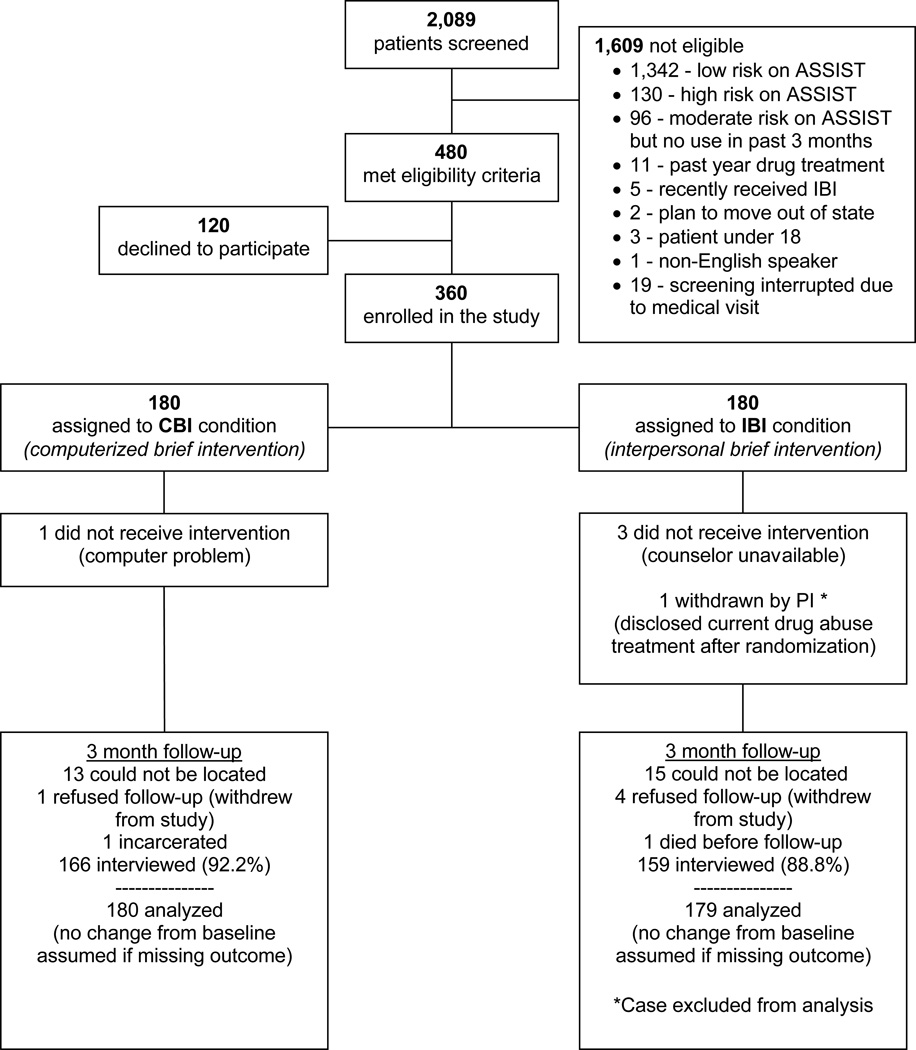
Two-arm randomized clinical trial, conducted in two health centers in New Mexico, United States. Participants were 360 adult primary care patients with moderate-risk drug scores on the Alcohol, Smoking, and Substance Involvement Screening Test (ASSIST) who were randomly assigned on a 1 : 1 basis to a computerized brief intervention (CBI) or to an in-person brief intervention (IBI) delivered by a behavioral health counselor. Assessments were conducted at baseline and 3-month follow-up, and included the ASSIST and drug testing on hair samples.
The IBI and CBI conditions did not differ at 3 months on global ASSIST drug scores [b = -1.79; 95% confidence interval (CI) = -4.37, 0.80] or drug-positive hair tests [odds ratio (OR) = 0.97; 95% CI = 0.47, 2.02]. There was a statistically significant advantage of CBI over IBI in substance-specific ASSIST scores for marijuana (b = -1.73; 95% CI = -2.91, -0.55; Cohen's d = 0.26; P = 0.004) and cocaine (b = -4.48; 95% CI = -8.26, -0.71; Cohen's d = 0.50; P = 0.021) at 3 months.
Computerized brief intervention can be an effective alternative to in-person brief intervention for addressing moderate drug use in primary care.
多项研究发现,针对药物滥用的简短干预(BIs)比无治疗对照组具有更高的有效性。然而,由于行为健康工作人员能力不足,许多健康中心并未持续提供针对药物使用的简短干预。针对药物使用的计算机化简短干预是一种很有前景的方法,但与面对面简短干预相比,其有效性尚未得到证实。本研究比较了计算机化简短干预(CBI)与行为健康顾问提供的面对面简短干预(IBI)的有效性。
在美国新墨西哥州的两个健康中心进行双臂随机临床试验。参与者为360名成年初级保健患者,他们在酒精、吸烟和物质使用筛查测试(ASSIST)中药物风险评分为中度,这些患者按1∶1的比例随机分配接受计算机化简短干预(CBI)或行为健康顾问提供的面对面简短干预(IBI)。在基线和3个月随访时进行评估,包括ASSIST和头发样本药物检测。
在3个月时,IBI组和CBI组在ASSIST总体药物评分上没有差异[b = -1.79;95%置信区间(CI)= -4.37,0.80],在药物阳性头发检测方面也没有差异[优势比(OR)= 0.97;95%CI = 0.47,2.02]。在3个月时,CBI组在大麻(b = -1.73;95%CI = -2.91,-0.55;科恩d值 = 0.26;P = 0.004)和可卡因(b = -4.48;95%CI = -8.26,-0.71;科恩d值 = 0.50;P = 0.021)的特定物质ASSIST评分上比IBI组具有统计学上的显著优势。
对于解决初级保健中的中度药物使用问题,计算机化简短干预可以作为面对面简短干预的有效替代方案。