Cancer Epidemiology and Health Services Research Group, Centre for Public Health, Queen's University Belfast, Belfast, Northern Ireland.
BMC Med. 2014 Feb 13;12:28. doi: 10.1186/1741-7015-12-28.
Angiotensin-converting enzyme inhibitors (ACEIs) and angiotensin II receptor blockers (ARBs) are commonly prescribed to the growing number of cancer patients (more than two million in the UK alone) often to treat hypertension. However, increased fatal cancer in ARB users in a randomized trial and increased breast cancer recurrence rates in ACEI users in a recent observational study have raised concerns about their safety in cancer patients. We investigated whether ACEI or ARB use after breast, colorectal or prostate cancer diagnosis was associated with increased risk of cancer-specific mortality.
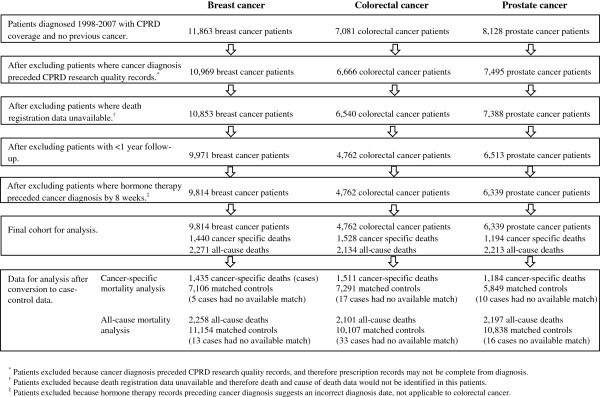
Population-based cohorts of 9,814 breast, 4,762 colorectal and 6,339 prostate cancer patients newly diagnosed from 1998 to 2006 were identified in the UK Clinical Practice Research Datalink and confirmed by cancer registry linkage. Cancer-specific and all-cause mortality were identified from Office of National Statistics mortality data in 2011 (allowing up to 13 years of follow-up). A nested case-control analysis was conducted to compare ACEI/ARB use (from general practitioner prescription records) in cancer patients dying from cancer with up to five controls (not dying from cancer). Conditional logistic regression estimated the risk of cancer-specific, and all-cause, death in ACEI/ARB users compared with non-users.
The main analysis included 1,435 breast, 1,511 colorectal and 1,184 prostate cancer-specific deaths (and 7,106 breast, 7,291 colorectal and 5,849 prostate cancer controls). There was no increase in cancer-specific mortality in patients using ARBs after diagnosis of breast (adjusted odds ratio (OR) = 1.06 95% confidence interval (CI) 0.84, 1.35), colorectal (adjusted OR = 0.82 95% CI 0.64, 1.07) or prostate cancer (adjusted OR = 0.79 95% CI 0.61, 1.03). There was also no evidence of increases in cancer-specific mortality with ACEI use for breast (adjusted OR = 1.06 95% CI 0.89, 1.27), colorectal (adjusted OR = 0.78 95% CI 0.66, 0.92) or prostate cancer (adjusted OR = 0.78 95% CI 0.66, 0.92).
Overall, we found no evidence of increased risks of cancer-specific mortality in breast, colorectal or prostate cancer patients who used ACEI or ARBs after diagnosis. These results provide some reassurance that these medications are safe in patients diagnosed with these cancers.
血管紧张素转换酶抑制剂(ACEI)和血管紧张素 II 受体阻滞剂(ARB)常用于治疗高血压,越来越多的癌症患者(仅在英国就超过 200 万例)也经常使用这些药物。然而,一项随机试验显示 ARB 使用者的致命癌症增加,以及最近一项观察性研究显示 ACEI 使用者的乳腺癌复发率增加,这引起了人们对这些药物在癌症患者中的安全性的关注。我们研究了 ACEI 或 ARB 在乳腺癌、结直肠癌或前列腺癌诊断后的使用是否与癌症特异性死亡率的增加相关。
在英国临床实践研究数据链接中确定了 9814 例新诊断的乳腺癌、4762 例结直肠癌和 6339 例前列腺癌患者的基于人群的队列,并通过癌症登记处的链接进行了确认。2011 年,通过国家统计局的死亡率数据确定了癌症特异性和全因死亡率(允许进行长达 13 年的随访)。通过巢式病例对照分析,将 ACEI/ARB (来自全科医生的处方记录)在癌症患者中的使用情况与最多 5 名对照(未死于癌症)进行了比较。条件逻辑回归估计了 ACEI/ARB 使用者与非使用者的癌症特异性和全因死亡风险。
主要分析包括 1435 例乳腺癌、1511 例结直肠癌和 1184 例前列腺癌特异性死亡病例(以及 7106 例乳腺癌、7291 例结直肠癌和 5849 例前列腺癌对照)。在诊断为乳腺癌(调整后的优势比(OR)=1.06,95%置信区间(CI)0.84,1.35)、结直肠癌(调整后的 OR=0.82,95%CI 0.64,1.07)或前列腺癌(调整后的 OR=0.79,95%CI 0.61,1.03)后使用 ARB 的患者中,癌症特异性死亡率没有增加。在乳腺癌(调整后的 OR=1.06,95%CI 0.89,1.27)、结直肠癌(调整后的 OR=0.78,95%CI 0.66,0.92)或前列腺癌(调整后的 OR=0.78,95%CI 0.66,0.92)后使用 ACEI 的患者中,也没有证据表明癌症特异性死亡率增加。
总体而言,我们没有发现 ACEI 或 ARB 在诊断后使用与乳腺癌、结直肠癌或前列腺癌患者的癌症特异性死亡率增加相关的证据。这些结果为这些药物在诊断出这些癌症的患者中是安全的提供了一些保证。