Albrecht Urs-Vito, von Jan Ute, Kuebler Joachim, Zoeller Christoph, Lacher Martin, Muensterer Oliver J, Ettinger Max, Klintschar Michael, Hagemeier Lars
PL Reichertz Institute for Medical Informatics, Hannover Medical School, Hannover, Germany.
J Med Internet Res. 2014 Feb 12;16(2):e53. doi: 10.2196/jmir.3225.
Google Glass is a promising premarket device that includes an optical head-mounted display. Several proof of concept reports exist, but there is little scientific evidence regarding its use in a medical setting.
The objective of this study was to empirically determine the feasibility of deploying Glass in a forensics setting.
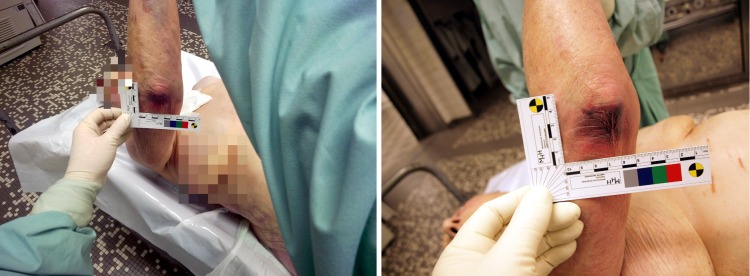
Glass was used in combination with a self-developed app that allowed for hands-free operation during autopsy and postmortem examinations of 4 decedents performed by 2 physicians. A digital single-lens reflex (DSLR) camera was used for image comparison. In addition, 6 forensic examiners (3 male, 3 female; age range 23-48 years, age mean 32.8 years, SD 9.6; mean work experience 6.2 years, SD 8.5) were asked to evaluate 159 images for image quality on a 5-point Likert scale, specifically color discrimination, brightness, sharpness, and their satisfaction with the acquired region of interest. Statistical evaluations were performed to determine how Glass compares with conventionally acquired digital images.
All images received good (median 4) and very good ratings (median 5) for all 4 categories. Autopsy images taken by Glass (n=32) received significantly lower ratings than those acquired by DSLR camera (n=17) (region of interest: z=-5.154, P<.001; sharpness: z=-7.898, P<.001; color: z=-4.407, P<.001, brightness: z=-3.187, P=.001). For 110 images of postmortem examinations (Glass: n=54, DSLR camera: n=56), ratings for region of interest (z=-8.390, P<.001) and brightness (z=-540, P=.007) were significantly lower. For interrater reliability, intraclass correlation (ICC) values were good for autopsy (ICC=.723, 95% CI .667-.771, P<.001) and postmortem examination (ICC=.758, 95% CI .727-.787, P<.001). Postmortem examinations performed using Glass took 42.6 seconds longer than those done with the DSLR camera (z=-2.100, P=.04 using Wilcoxon signed rank test). The battery charge of Glass quickly decreased; an average 5.5% (SD 1.85) of its battery capacity was spent per postmortem examination (0.81% per minute or 0.79% per picture).
Glass was efficient for acquiring images for documentation in forensic medicine, but the image quality was inferior compared to a DSLR camera. Images taken with Glass received significantly lower ratings for all 4 categories in an autopsy setting and for region of interest and brightness in postmortem examination. The effort necessary for achieving the objectives was higher when using the device compared to the DSLR camera thus extending the postmortem examination duration. Its relative high power consumption and low battery capacity is also a disadvantage. At the current stage of development, Glass may be an adequate tool for education. For deployment in clinical care, issues such as hygiene, data protection, and privacy need to be addressed and are currently limiting chances for professional use.

谷歌眼镜是一种很有前景的上市前设备,包括一个光学头戴式显示器。已有多篇概念验证报告,但关于其在医疗环境中的应用,科学证据很少。
本研究的目的是通过实证确定在法医环境中部署谷歌眼镜的可行性。
将谷歌眼镜与一个自行开发的应用程序结合使用,该应用程序允许两名医生在对4名死者进行尸检和尸体检查时进行免提操作。使用数码单反(DSLR)相机进行图像比较。此外,6名法医检验员(3名男性,3名女性;年龄范围23 - 48岁,平均年龄32.8岁,标准差9.6;平均工作经验6.2年,标准差8.5)被要求使用5分李克特量表对159张图像的图像质量进行评估,具体包括颜色辨别、亮度、清晰度以及他们对所获取感兴趣区域的满意度。进行统计评估以确定谷歌眼镜与传统获取的数字图像相比如何。
所有图像在所有4个类别中均获得了良好(中位数4)和非常好的评分(中位数5)。谷歌眼镜拍摄的尸检图像(n = 32)的评分显著低于数码单反相机拍摄的图像(n = 17)(感兴趣区域:z = -5.154,P <.001;清晰度:z = -7.898,P <.001;颜色:z = -4.407,P <.001,亮度:z = -3.187,P =.001)。对于110张尸体检查图像(谷歌眼镜:n = 54,数码单反相机:n = 56),感兴趣区域(z = -8.390,P <.001)和亮度(z = -540,P =.007)的评分显著较低。对于评分者间信度,组内相关系数(ICC)值在尸检时良好(ICC =.723,95%可信区间.667 -.771,P <.001),在尸体检查时也良好(ICC =.758,95%可信区间.727 -.787,P <.001)。使用谷歌眼镜进行尸体检查比使用数码单反相机花费的时间长42.6秒(使用Wilcoxon符号秩检验,z = -2.100,P =.04)。谷歌眼镜的电池电量迅速下降;每次尸体检查平均消耗其电池容量的5.5%(标准差1.85)(每分钟0.81%或每张图片0.79%)。
谷歌眼镜在获取法医学记录图像方面是有效的,但图像质量不如数码单反相机。在尸检环境中,谷歌眼镜拍摄的图像在所有4个类别中的评分显著较低,在尸体检查中,感兴趣区域和亮度的评分也显著较低。与数码单反相机相比,使用该设备实现目标所需的工作量更大,从而延长了尸体检查时间。其相对较高的功耗和较低的电池容量也是一个缺点。在当前的发展阶段,谷歌眼镜可能是一种合适的教育工具。对于在临床护理中的部署,卫生、数据保护和隐私等问题需要得到解决,目前这些问题限制了其专业使用的机会。