Tan Xiao-ping, Dong Wei-guo, Zhang Qing, Yang Zi-rong, Lei Xiao-fei, Ai Ming-hua
Department of Gastroenterology, No. 1 Hospital, Yangtze University, Jingzhou, 434000, Hubei, People's Republic of China,
Cell Biochem Biophys. 2014 Jul;69(3):619-25. doi: 10.1007/s12013-014-9841-7.
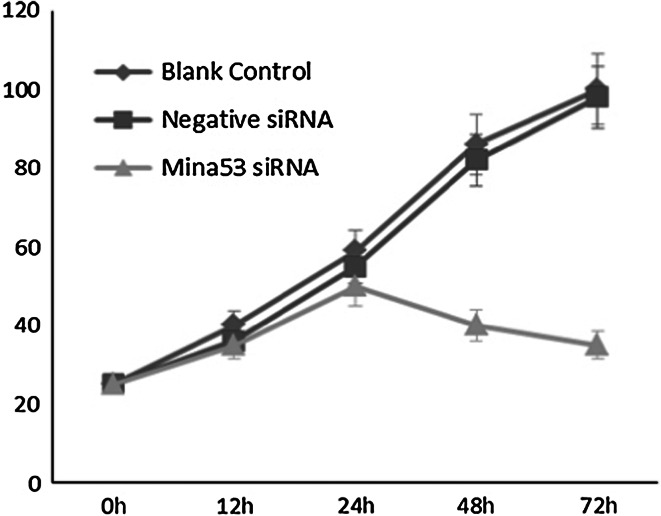
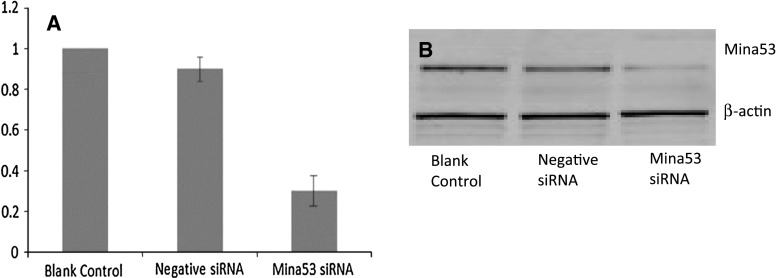
Myc-induced nuclear antigen (Mina53) is a protein with a molecular weight of 53 kDa expression of which is induced by c-Myc. Increased expression of Mina53 is documented in some human carcinomas. In this study, we found markedly increased Mina53 expression in pancreatic cancer tissue specimens. This expression did not correlate with clinicopathological characteristics, such as sex, age, and presence of distant metastasis. However, there was a statistically significant association with histological differentiation, TNM stage, and lymph node metastases. To study functional role of Mina53, we silenced its expression by siRNA in PANC-1 cells. These cells were arrested in the G2/M phase, and apoptosis rates were increased. In conclusion, increased expression of Mina53 may play an important role in the development of human pancreatic cancer. Mina53 can be used as a marker for pancreatic cancer and may potentially be exploited as a target for treatment of pancreatic cancer.
Myc诱导的核抗原(Mina53)是一种分子量为53 kDa的蛋白质,其表达由c-Myc诱导。在一些人类癌症中,Mina53的表达增加。在本研究中,我们发现胰腺癌组织标本中Mina53的表达明显增加。这种表达与临床病理特征,如性别、年龄和远处转移的存在无关。然而,与组织学分化、TNM分期和淋巴结转移存在统计学上的显著关联。为了研究Mina53的功能作用,我们通过小干扰RNA(siRNA)在PANC-1细胞中使其表达沉默。这些细胞停滞在G2/M期,凋亡率增加。总之,Mina53表达增加可能在人类胰腺癌的发生发展中起重要作用。Mina53可作为胰腺癌的标志物,并且有可能被开发为胰腺癌治疗的靶点。