Bast Felix, Rani Pooja, Meena Devendra
Centre for Biosciences, Central University of Punjab, City Campus, Mansa Road, Bathinda, Punjab 151001, India.
Centre for Biosciences, Central University of Punjab, City Campus, Mansa Road, Bathinda, Punjab 151001, India ; Department of Oncology, University of Oxford, Old Road Campus Research Building, Roosevelt Drive, Oxford OX3 7DQ, UK.
ScientificWorldJournal. 2014 Jan 2;2014:847482. doi: 10.1155/2014/847482. eCollection 2014.
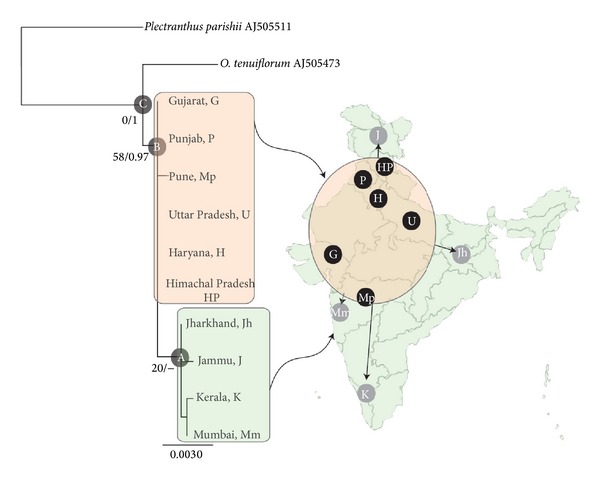
Ocimum tenuiflorum L., holy basil "Tulsi", is an important medicinal plant that is being grown and traditionally revered throughout Indian Subcontinent for thousands of years; however, DNA sequence-based genetic diversity of this aromatic herb is not yet known. In this report, we present our studies on the phylogeography of this species using trnL-trnF intergenic spacer of plastid genome as the DNA barcode for isolates from Indian subcontinent. Our pairwise distance analyses indicated that genetic heterogeneity of isolates remained quite low, with overall mean nucleotide p-distance of 5 × 10(-4). However, our sensitive phylogenetic analysis using maximum likelihood framework was able to reveal subtle intraspecific molecular evolution of this species within the subcontinent. All isolates except that from North-Central India formed a distinct phylogenetic clade, notwithstanding low bootstrap support and collapse of the clade in Bayesian Inference. North-Central isolates occupied more basal position compared to other isolates, which is suggestive of its evolutionarily primitive status. Indian isolates formed a monophyletic and well-supported clade within O. tenuiflorum clade, which indicates a distinct haplotype. Given the vast geographical area of more than 3 million km(2) encompassing many exclusive biogeographical and ecological zones, relatively low rate of evolution of this herb at this locus in India is particularly interesting.
罗勒(Ocimum tenuiflorum L.),即神圣罗勒“图尔西”,是一种重要的药用植物,在印度次大陆已有数千年的种植历史且一直受到传统尊崇;然而,这种芳香草本植物基于DNA序列的遗传多样性尚不清楚。在本报告中,我们利用质体基因组的trnL-trnF基因间隔区作为来自印度次大陆分离株的DNA条形码,展示了我们对该物种系统地理学的研究。我们的成对距离分析表明,分离株的遗传异质性仍然相当低,总体平均核苷酸p距离为5×10⁻⁴。然而,我们使用最大似然框架进行的灵敏系统发育分析能够揭示该物种在次大陆内微妙的种内分子进化。除了来自印度中北部的分离株外,所有分离株形成了一个独特的系统发育分支,尽管贝叶斯推断中的分支自展支持度较低且该分支崩溃。与其他分离株相比,印度中北部的分离株占据了更基部的位置,这表明其具有进化上的原始状态。印度分离株在罗勒分支内形成了一个单系且得到充分支持的分支,这表明存在一个独特的单倍型。鉴于印度这片超过300万平方公里的广阔地理区域包含许多独特的生物地理和生态区域,这种草本植物在印度该位点相对较低的进化速率尤其令人感兴趣。