Department of Respiratory Medicine, Croydon University Hospital, Croydon Health Services NHS Trust, London, UK.
Department of Respiratory Medicine, Nuffield Department of Clinical Medicine, University of Oxford, Old Road Campus, Oxford, UK.
Int J Chron Obstruct Pulmon Dis. 2014 Feb 7;9:179-86. doi: 10.2147/COPD.S55419. eCollection 2014.
Airway inflammation persists after smoking cessation in established chronic obstructive pulmonary disease (COPD), suggesting that other factors drive the airway inflammatory response.
We tested the hypothesis that high levels of bacterial colonization are associated with increased levels of neutrophilic airway inflammation in stable COPD by examining the cross-sectional relationship between these measurements and by conducting a randomized, double-blind, placebo-controlled study of the effect of levofloxacin in patients with stable COPD.
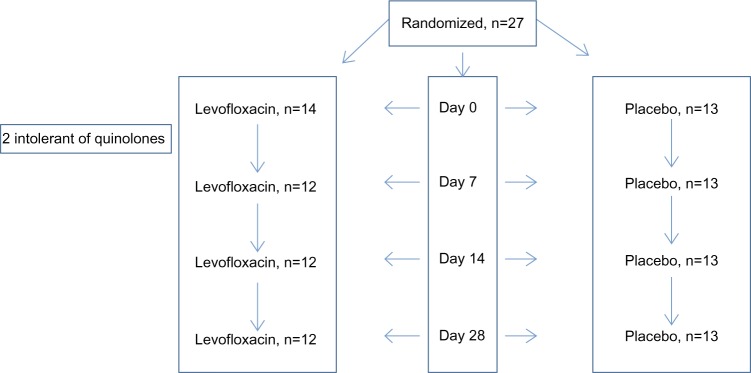
Patients were randomized to receive either levofloxacin 500 mg daily or placebo for 7 days and underwent sputum induction for a differential cell count and quantitative bacterial analysis at baseline and at days 7, 14, and 28.
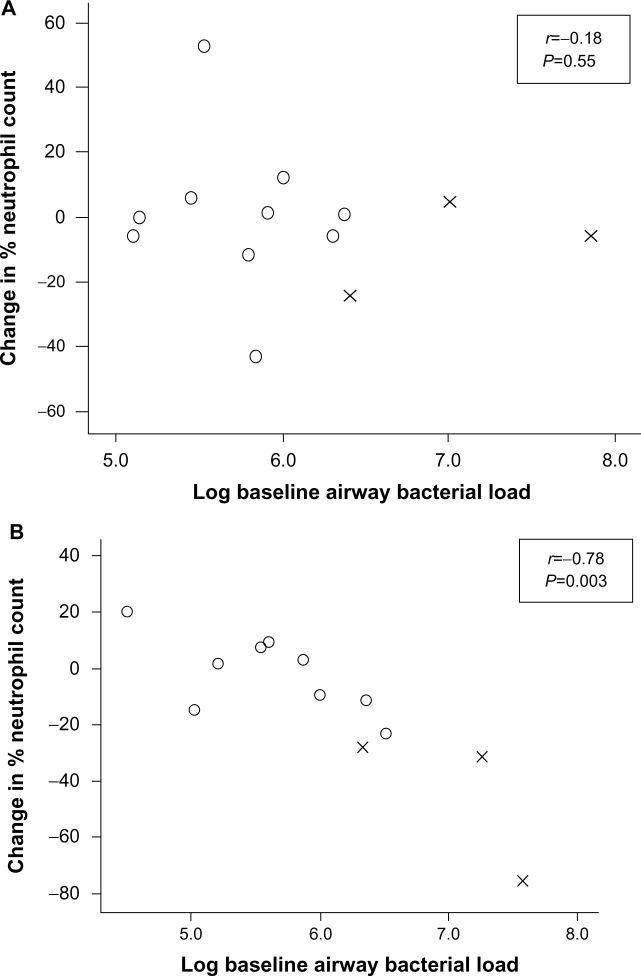
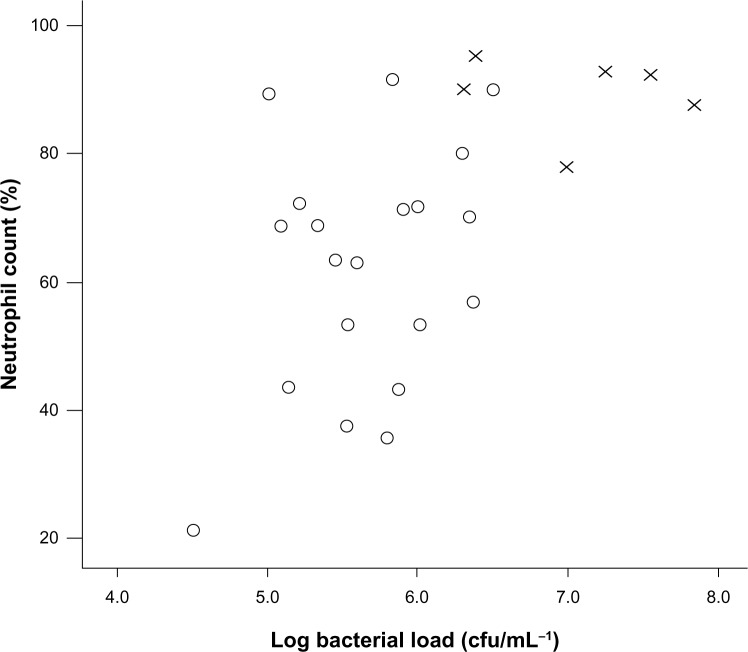
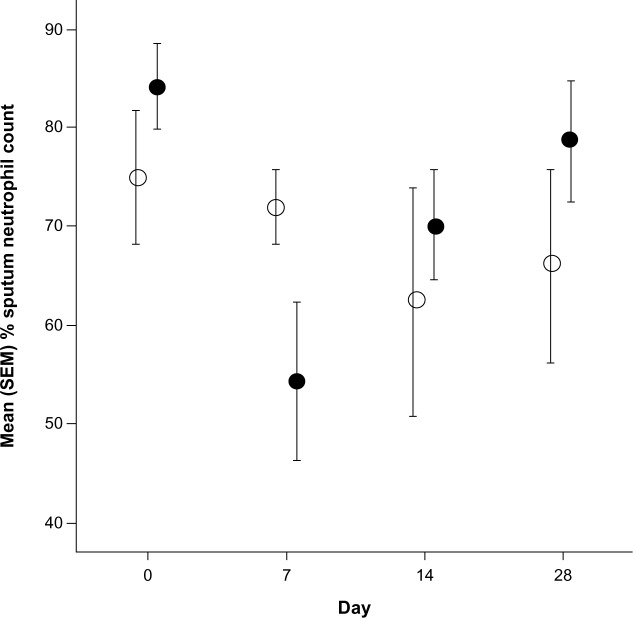
Sputum percentage neutrophil count correlated with airway bacterial load at baseline (r=0.56; P=0.003). Levofloxacin reduced bacterial load compared with placebo by 4.9-fold (95% confidence interval, 1.4-25.7; P=0.02) at day 7 but had no effect at any point on any marker of neutrophilic airway inflammation. In patients with a baseline bacterial load of more than 10(6) cfu/mL, levofloxacin treatment was associated with a 26.5% (95% confidence interval, 1.8%-51.3%; P=0.04) greater reduction in the percentage neutrophil count compared with placebo at day 7. Change in percentage neutrophil count correlated significantly with baseline airway bacterial load and change in airway bacterial load.
In stable COPD, levofloxacin treatment causes a short-term reduction in bacterial load. This is associated with a reduction in neutrophilic airway inflammation in patients with high bacterial loads. Further studies are required to investigate whether this effect is clinically advantageous.
在已确诊的慢性阻塞性肺疾病(COPD)患者中,戒烟后气道炎症仍然存在,这表明其他因素驱动气道炎症反应。
我们通过检查这些测量值之间的横断面关系,并对稳定 COPD 患者进行左氧氟沙星的随机、双盲、安慰剂对照研究,来检验气道高细菌定植水平与稳定 COPD 患者中性粒细胞性气道炎症水平升高相关的假设。
患者被随机分为左氧氟沙星 500mg 每日组或安慰剂组,共 7 天,并在基线和第 7、14 和 28 天进行痰诱导以进行差异细胞计数和定量细菌分析。
基线时痰中性粒细胞百分比与气道细菌负荷呈正相关(r=0.56;P=0.003)。与安慰剂相比,左氧氟沙星在第 7 天使细菌负荷降低了 4.9 倍(95%置信区间,1.4-25.7;P=0.02),但在任何时间点对任何中性粒细胞性气道炎症标志物均无影响。在基线细菌负荷超过 10(6)cfu/mL 的患者中,与安慰剂相比,左氧氟沙星治疗在第 7 天使中性粒细胞百分比降低了 26.5%(95%置信区间,1.8%-51.3%;P=0.04)。中性粒细胞百分比的变化与基线气道细菌负荷和气道细菌负荷的变化显著相关。
在稳定的 COPD 中,左氧氟沙星治疗可导致短期内细菌负荷降低。这与高细菌负荷患者中性粒细胞性气道炎症的减少相关。需要进一步的研究来探讨这种影响是否具有临床优势。