Parr Evelyn B, Camera Donny M, Areta José L, Burke Louise M, Phillips Stuart M, Hawley John A, Coffey Vernon G
Exercise and Nutrition Research Group, School of Medical Sciences, RMIT University, Bundoora, Victoria, Australia.
Department of Sports Nutrition, Australian Institute of Sport, Canberra, ACT, Australia.
PLoS One. 2014 Feb 12;9(2):e88384. doi: 10.1371/journal.pone.0088384. eCollection 2014.
The culture in many team sports involves consumption of large amounts of alcohol after training/competition. The effect of such a practice on recovery processes underlying protein turnover in human skeletal muscle are unknown. We determined the effect of alcohol intake on rates of myofibrillar protein synthesis (MPS) following strenuous exercise with carbohydrate (CHO) or protein ingestion.
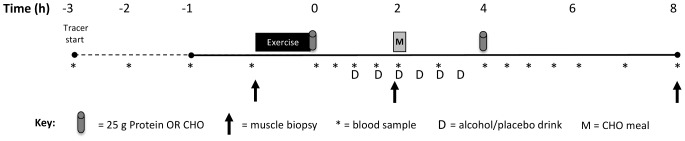
In a randomized cross-over design, 8 physically active males completed three experimental trials comprising resistance exercise (8×5 reps leg extension, 80% 1 repetition maximum) followed by continuous (30 min, 63% peak power output (PPO)) and high intensity interval (10×30 s, 110% PPO) cycling. Immediately, and 4 h post-exercise, subjects consumed either 500 mL of whey protein (25 g; PRO), alcohol (1.5 g·kg body mass⁻¹), 12±2 standard drinks) co-ingested with protein (ALC-PRO), or an energy-matched quantity of carbohydrate also with alcohol (25 g maltodextrin; ALC-CHO). Subjects also consumed a CHO meal (1.5 g CHO·kg body mass⁻¹) 2 h post-exercise. Muscle biopsies were taken at rest, 2 and 8 h post-exercise.
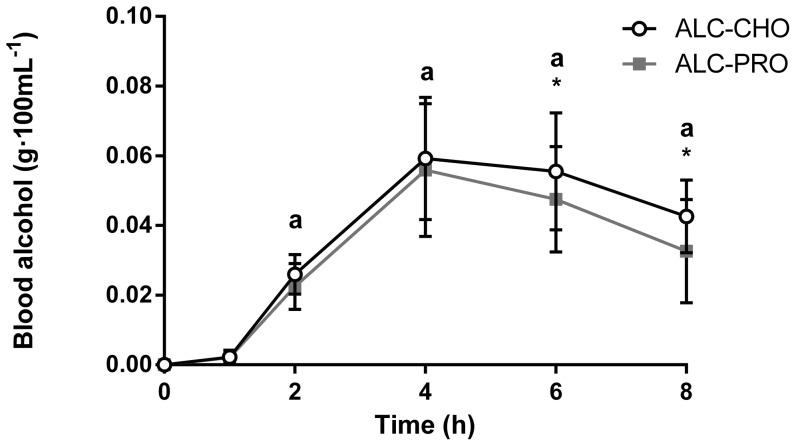
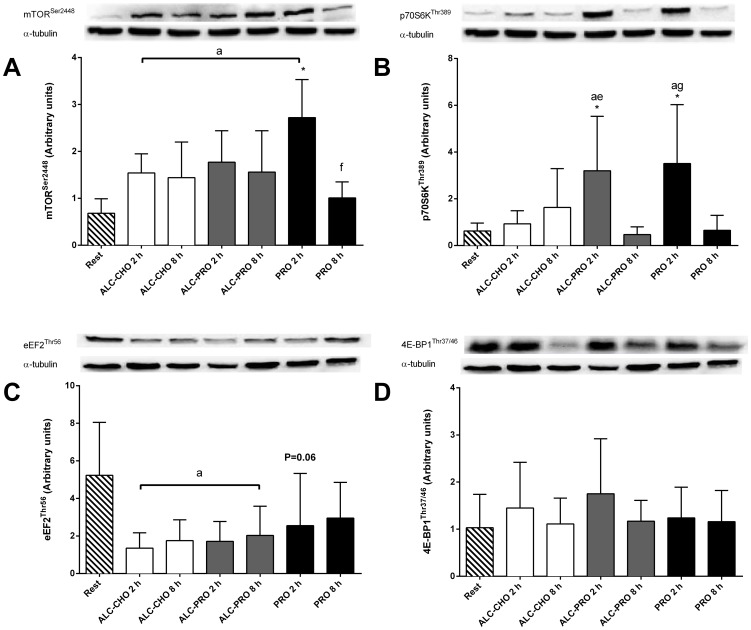
Blood alcohol concentration was elevated above baseline with ALC-CHO and ALC-PRO throughout recovery (P<0.05). Phosphorylation of mTOR(Ser2448) 2 h after exercise was higher with PRO compared to ALC-PRO and ALC-CHO (P<0.05), while p70S6K phosphorylation was higher 2 h post-exercise with ALC-PRO and PRO compared to ALC-CHO (P<0.05). Rates of MPS increased above rest for all conditions (∼29-109%, P<0.05). However, compared to PRO, there was a hierarchical reduction in MPS with ALC-PRO (24%, P<0.05) and with ALC-CHO (37%, P<0.05).
We provide novel data demonstrating that alcohol consumption reduces rates of MPS following a bout of concurrent exercise, even when co-ingested with protein. We conclude that alcohol ingestion suppresses the anabolic response in skeletal muscle and may therefore impair recovery and adaptation to training and/or subsequent performance.
许多团队运动的文化包括在训练/比赛后大量饮酒。这种做法对人体骨骼肌蛋白质周转潜在恢复过程的影响尚不清楚。我们确定了饮酒对剧烈运动后摄入碳水化合物(CHO)或蛋白质后肌原纤维蛋白合成(MPS)速率的影响。
在一项随机交叉设计中,8名身体活跃的男性完成了三项实验试验,包括阻力运动(8组,每组5次腿部伸展,80%的1次最大重复量),随后进行持续(30分钟,63%峰值功率输出(PPO))和高强度间歇(10组,每组30秒,110%PPO)骑行。运动后立即以及4小时后,受试者分别饮用500毫升乳清蛋白(25克;PRO)、酒精(1.5克·千克体重⁻¹,12±2标准杯)与蛋白质同时摄入(ALC-PRO),或能量匹配量的碳水化合物与酒精同时摄入(25克麦芽糊精;ALC-CHO)。受试者在运动后2小时还食用了一顿CHO餐(1.5克CHO·千克体重⁻¹)。在运动前、运动后2小时和8小时采集肌肉活检样本。
在整个恢复过程中,ALC-CHO和ALC-PRO组的血酒精浓度均高于基线水平(P<0.05)。与ALC-PRO和ALC-CHO相比,运动后2小时PRO组的mTOR(Ser2448)磷酸化水平更高(P<0.05),而与ALC-CHO相比,运动后2小时ALC-PRO和PRO组的p70S6K磷酸化水平更高(P<0.05)。所有条件下MPS速率均高于运动前水平(约29%-109%,P<0.05)。然而,与PRO相比,ALC-PRO组的MPS降低了24%(P<0.05),ALC-CHO组降低了37%(P<0.05)。
我们提供了新的数据表明,即使与蛋白质同时摄入,饮酒也会降低一次同时进行运动后的MPS速率。我们得出结论,饮酒会抑制骨骼肌的合成代谢反应,因此可能会损害恢复以及对训练和/或后续表现的适应。