Gawlik Katarzyna, Baugh James, Chatterji Udayan, Lim Precious J, Bobardt Michael D, Gallay Philippe A
Department of Immunology and Microbial Science, The Scripps Research Institute, La Jolla, California, United States of America.
PLoS One. 2014 Feb 12;9(2):e88866. doi: 10.1371/journal.pone.0088866. eCollection 2014.
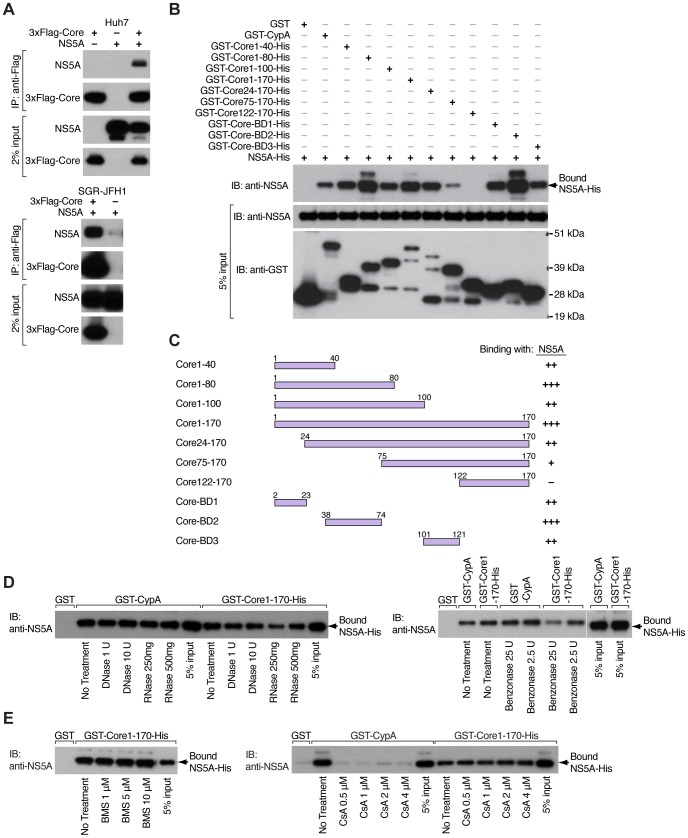
Hepatitis C virus (HCV) infection is a major cause of liver disease. The molecular machinery of HCV assembly and particle release remains obscure. A better understanding of the assembly events might reveal new potential antiviral strategies. It was suggested that the nonstructural protein 5A (NS5A), an attractive recent drug target, participates in the production of infectious particles as a result of its interaction with the HCV core protein. However, prior to the present study, the NS5A-binding site in the viral core remained unknown. We found that the D1 domain of core contains the NS5A-binding site with the strongest interacting capacity in the basic P38-K74 cluster. We also demonstrated that the N-terminal basic residues of core at positions 50, 51, 59 and 62 were required for NS5A binding. Analysis of all substitution combinations of R50A, K51A, R59A, and R62A, in the context of the HCVcc system, showed that single, double, triple, and quadruple mutants were fully competent for viral RNA replication, but deficient in secretion of viral particles. Furthermore, we found that the extracellular and intracellular infectivity of all the mutants was abolished, suggesting a defect in the formation of infectious particles. Importantly, we showed that the interaction between the single and quadruple core mutants and NS5A was impaired in cells expressing full-length HCV genome. Interestingly, mutations of the four basic residues of core did not alter the association of core or NS5A with lipid droplets. This study showed for the first time that basic residues in the D1 domain of core that are critical for the formation of infectious extracellular and intracellular particles also play a role in core-NS5A interactions.
丙型肝炎病毒(HCV)感染是肝脏疾病的主要病因。HCV组装和病毒颗粒释放的分子机制仍不清楚。更好地了解组装过程可能会揭示新的潜在抗病毒策略。有人提出,非结构蛋白5A(NS5A)是近期一个有吸引力的药物靶点,由于其与HCV核心蛋白相互作用,参与了感染性颗粒的产生。然而,在本研究之前,病毒核心中NS5A的结合位点尚不清楚。我们发现核心蛋白的D1结构域在碱性P38-K74簇中含有与NS5A结合能力最强的结合位点。我们还证明核心蛋白N端第50、51、59和62位的碱性残基是NS5A结合所必需的。在HCVcc系统中对R50A、K51A、R59A和R62A的所有替代组合进行分析,结果表明单突变体、双突变体、三突变体和四突变体都完全具备病毒RNA复制能力,但病毒颗粒分泌存在缺陷。此外,我们发现所有突变体的细胞外和细胞内感染性均被消除,这表明感染性颗粒的形成存在缺陷。重要的是,我们发现全长HCV基因组表达细胞中,单核心突变体和四核心突变体与NS5A之间的相互作用受损。有趣的是,核心蛋白四个碱性残基的突变并未改变核心蛋白或NS5A与脂滴的结合。本研究首次表明,核心蛋白D1结构域中对细胞外和细胞内感染性颗粒形成至关重要的碱性残基在核心蛋白与NS5A的相互作用中也发挥作用。