Vercruysse Jozef, Albonico Marco, Behnke Jerzy M, Kotze Andrew C, Prichard Roger K, McCarthy James S, Montresor Antonio, Levecke Bruno
Ghent University, Faculty of Veterinary Medicine, Department of Virology, Parasitology and Immunology, Laboratory of Parasitology, Merelbeke, Belgium.
Ivo de Carneri Foundation, Milan, Italy.
Int J Parasitol Drugs Drug Resist. 2011 Oct 14;1(1):14-27. doi: 10.1016/j.ijpddr.2011.09.002. eCollection 2011 Dec.
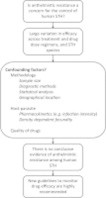
The major human soil-transmitted helminths (STH), Ascaris lumbricoides, hookworms (Necator americanus and Ancylostoma duodenale) and Trichuris trichiura have a marked impact on human health in many parts of the world. Current efforts to control these parasites rely predominantly on periodic mass administration of anthelmintic drugs to school age children and other at-risk groups. After many years of use of these same drugs for controlling roundworms in livestock, high levels of resistance have developed, threatening the sustainability of these livestock industries in some locations. Hence, the question arises as to whether this is likely to also occur in the human STH, thereby threatening our ability to control these parasites. This is particularly important because of the recent increase in mass control programmes, relying almost exclusively on benzimidazole anthelmintics. It will be important to ensure that resistance is detected as it emerges in order to allow the implementation of mitigation strategies, such as use of drug combinations, to ensure that the effectiveness of the few existing anthelmintic drugs is preserved. In this review we address these issues by firstly examining the efficacy of anthelmintics against the human STH, and assessing whether there are any indications to date that resistance has emerged. We then consider the factors that influence the effect of current drug-use patterns in selecting for resistant parasite populations. We describe the tools currently available for resistance monitoring (field-based coprological methods), and those under development (in vitro bioassays and molecular tests), and highlight confounding factors that need to be taken into account when interpreting such resistance-monitoring data. We then highlight means to ensure that the currently available tools are used correctly, particularly with regard to study design, and we set appropriate drug-efficacy thresholds. Finally, we make recommendations for monitoring drug efficacy in the field, as components of control programmes, in order to maximise the ability to detect drug resistance, and if it arises to change control strategy and prevent the spread of resistance.
主要的人体土源性蠕虫,如蛔虫、钩虫(美洲板口线虫和十二指肠钩口线虫)和鞭虫,在世界许多地区对人类健康有着显著影响。目前控制这些寄生虫的努力主要依赖于定期对学龄儿童和其他高危人群大规模施用驱虫药物。在使用这些相同药物控制家畜蛔虫多年后,已出现了高水平的抗药性,在某些地区威胁到了这些畜牧业的可持续性。因此,问题就出现了,这种情况是否也可能在人体土源性蠕虫中发生,从而威胁到我们控制这些寄生虫的能力。这一点尤为重要,因为最近大规模控制项目有所增加,且几乎完全依赖苯并咪唑类驱虫药。重要的是要确保在抗药性出现时就能被检测到,以便能够实施缓解策略,如使用联合药物,以确保现有的少数驱虫药物的有效性得以维持。在本综述中,我们通过首先研究驱虫药对人体土源性蠕虫的疗效,并评估迄今是否有任何抗药性出现的迹象来解决这些问题。然后,我们考虑影响当前用药模式在选择抗药寄生虫种群方面效果的因素。我们描述了目前可用于抗药性监测的工具(基于现场的粪便学方法)以及正在开发的工具(体外生物测定和分子检测),并强调在解释此类抗药性监测数据时需要考虑的混杂因素。然后,我们强调要确保正确使用现有工具,特别是在研究设计方面,并设定适当的药物疗效阈值。最后,我们就作为控制项目组成部分在现场监测药物疗效提出建议,以便最大限度地提高检测药物抗药性的能力,并在出现抗药性时改变控制策略,防止抗药性的传播。