Swiss Tropical and Public Health Institute, 4002 Basel, Switzerland ; University of Basel, 4000 Basel, Switzerland.
Department of Biochemistry and Molecular Biology, Bio21 Molecular Science and Biotechnology Institute, University of Melbourne, Victoria 3010, Australia.
Int J Parasitol Drugs Drug Resist. 2012 Jul 17;2:191-9. doi: 10.1016/j.ijpddr.2012.07.002. eCollection 2012 Dec.
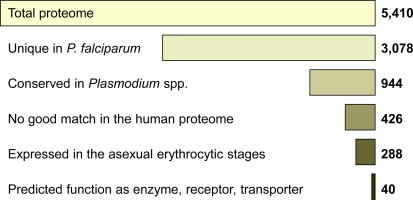
The need for new antimalarials is persistent due to the emergence of drug resistant parasites. Here we aim to identify new drug targets in Plasmodium falciparum by phylogenomics among the Plasmodium spp. and comparative genomics to Homo sapiens. The proposed target discovery pipeline is largely independent of experimental data and based on the assumption that P. falciparum proteins are likely to be essential if (i) there are no similar proteins in the same proteome and (ii) they are highly conserved across the malaria parasites of mammals. This hypothesis was tested using sequenced Saccharomycetaceae species as a touchstone. Consecutive filters narrowed down the potential target space of P. falciparum to proteins that are likely to be essential, matchless in the human proteome, expressed in the blood stages of the parasite, and amenable to small molecule inhibition. The final set of 40 candidate drug targets was significantly enriched in essential proteins and comprised proven targets (e.g. dihydropteroate synthetase or enzymes of the non-mevalonate pathway), targets currently under investigation (e.g. calcium-dependent protein kinases), and new candidates of potential interest such as phosphomannose isomerase, phosphoenolpyruvate carboxylase, signaling components, and transporters. The targets were prioritized based on druggability indices and on the availability of in vitro assays. Potential inhibitors were inferred from similarity to known targets of other disease systems. The identified candidates from P. falciparum provide insight into biochemical peculiarities and vulnerable points of the malaria parasite and might serve as starting points for rational drug discovery.
由于抗药性寄生虫的出现,对新抗疟药物的需求仍然存在。在这里,我们旨在通过疟原虫属的系统发育基因组学和与人类的比较基因组学,在疟原虫属中鉴定新的药物靶点。拟议的靶标发现管道在很大程度上独立于实验数据,基于这样的假设:如果(i)在相同的蛋白质组中没有类似的蛋白质,并且(ii)它们在哺乳动物的疟原虫中高度保守,那么疟原虫属的蛋白质很可能是必需的。这一假设使用已测序的酿酒酵母科物种作为基准进行了测试。连续的筛选将疟原虫属的潜在靶标空间缩小到那些可能是必需的、在人类蛋白质组中独一无二的、在寄生虫的血液阶段表达的、并且可以被小分子抑制的蛋白质。最终确定的 40 个候选药物靶点在必需蛋白中显著富集,包括已证实的靶标(例如二氢叶酸合成酶或非甲羟戊酸途径的酶)、目前正在研究的靶标(例如钙依赖性蛋白激酶)以及新的候选靶标,如磷酸甘露糖异构酶、磷酸烯醇丙酮酸羧激酶、信号成分和转运蛋白。这些靶点是根据药物可开发性指数和体外检测的可用性来确定优先级的。潜在抑制剂是通过与其他疾病系统的已知靶标的相似性推断出来的。从疟原虫属中鉴定出的候选药物为疟原虫的生化特性和脆弱点提供了深入了解,可能成为合理药物发现的起点。