Center for Microbial Genetics and Genomics, Northern Arizona University, Flagstaff, AZ 86011-4073, USA.
BMC Microbiol. 2014 Feb 17;14:41. doi: 10.1186/1471-2180-14-41.
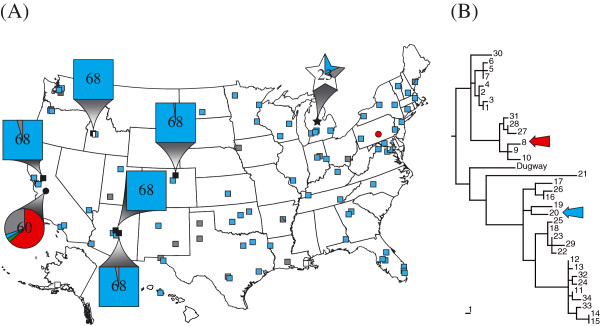
Coxiella burnetii causes Q fever in humans and Coxiellosis in animals; symptoms range from general malaise to fever, pneumonia, endocarditis and death. Livestock are a significant source of human infection as they shed C. burnetii cells in birth tissues, milk, urine and feces. Although prevalence of C. burnetii is high, few Q fever cases are reported in the U.S. and we have a limited understanding of their connectedness due to difficulties in genotyping. Here, we develop canonical SNP genotyping assays to evaluate spatial and temporal relationships among C. burnetii environmental samples and compare them across studies. Given the genotypic diversity of historical collections, we hypothesized that the current enzootic of Coxiellosis is caused by multiple circulating genotypes. We collected A) 23 milk samples from a single bovine herd, B) 134 commercial bovine and caprine milk samples from across the U.S., and C) 400 bovine and caprine samples from six milk processing plants over three years.
We detected C. burnetii DNA in 96% of samples with no variance over time. We genotyped 88.5% of positive samples; bovine milk contained only a single genotype (ST20) and caprine milk was dominated by a second type (mostly ST8).
The high prevalence and lack of genotypic diversity is consistent with a model of rapid spread and persistence. The segregation of genotypes between host species is indicative of species-specific adaptations or dissemination barriers and may offer insights into the relative lack of human cases and characterizing genotypes.
贝氏考克斯氏体引起人类的 Q 热和动物的柯克斯氏体病;症状范围从全身不适到发热、肺炎、心内膜炎和死亡。牲畜是人类感染的重要来源,因为它们在分娩组织、牛奶、尿液和粪便中排出贝氏考克斯氏体细胞。尽管贝氏考克斯氏体的流行率很高,但在美国报告的 Q 热病例很少,由于基因分型困难,我们对它们的关联性了解有限。在这里,我们开发了规范的单核苷酸多态性基因分型检测方法,以评估环境样本中贝氏考克斯氏体的时空关系,并在研究之间进行比较。鉴于历史样本的基因多样性,我们假设当前柯克斯氏体病的地方病是由多种循环基因型引起的。我们收集了 A)来自单个牛群的 23 份牛奶样本,B)来自美国各地的 134 份商业牛和山羊奶样本,以及 C)来自六个牛奶加工厂的 400 份牛和山羊样本,历时三年。
我们在 96%的样本中检测到了贝氏考克斯氏体 DNA,且时间上没有变化。我们对 88.5%的阳性样本进行了基因分型;牛奶奶中只含有单一基因型(ST20),山羊奶奶中主要是第二种类型(主要是 ST8)。
高流行率和基因型多样性缺乏一致的快速传播和持续模式。宿主物种之间基因型的分离表明存在物种特异性适应或传播障碍,这可能为相对缺乏人类病例和特征基因型提供见解。