Vieira Ana Luísa, Vieira Maria João, Oliveira João Manuel, Simões Ana Rita, Diez-Baños Pablo, Gestal Juan
Clinicão - Hospital Veterinário, 3080 Figueira da Foz, Portugal - EUVG - Escola Universitária Vasco da Gama, 3000 Coimbra, Portugal.
Clinicão - Hospital Veterinário, 3080 Figueira da Foz, Portugal.
Parasite. 2014;21:5. doi: 10.1051/parasite/2014003. Epub 2014 Feb 19.
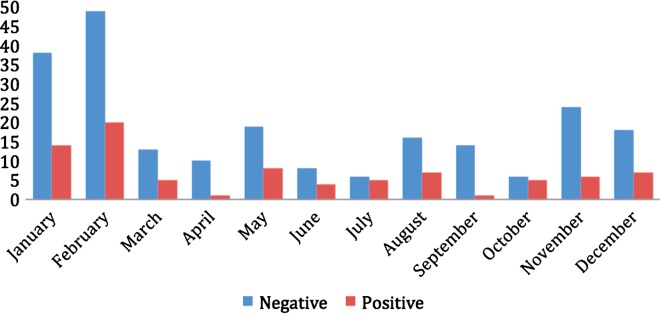
The aim of the present study was to determine the prevalence and risk factors concerning Dirofilaria immitis infection in dogs from Figueira da Foz, located in the central region of Portugal. In the period between November 2009 and January 2011, 304 blood samples were obtained from dogs over 1 year of age, with no previous history of heartworm prevention or diagnosis. Every blood sample was analyzed using varied laboratory techniques (direct microscopic evaluation of a fresh blood sample, the modified Knott technique, and the ELISA antigen detection test - IDEXX Snapp®). In the samples in which microfilaremia was detected, a histochemical technique using acid phosphatase staining was applied to identify the species of microfilariae. A total prevalence of 27.3% (83 out of 304) was found. We also found that 73.5% of all positive cases (61 out of 83) were microfilaremic, and 26.5% were occult infections (22 out of 83). By means of a histochemical technique Dirofilaria immitis was identified in 96.7% of microfilaremic samples. A multivariate model allowed us to identify the following risk factors for the presence of heartworm disease: age between 4 and 9 years, dogs living in a rural environment, large breed dogs, and living outdoors. This study shows for the first time the high prevalence of heartworm disease in a central area of Portugal and emphasizes the importance of systematic screening for this disease, as well as the need to prevent it in dogs in this area.
本研究的目的是确定位于葡萄牙中部地区菲盖拉达福什的犬类感染犬恶丝虫的患病率及风险因素。在2009年11月至2011年1月期间,从1岁以上且无预防或诊断心丝虫病史的犬只身上采集了304份血样。每份血样都采用了多种实验室技术进行分析(新鲜血样的直接显微镜评估、改良Knott技术以及ELISA抗原检测试验——IDEXX Snapp®)。在检测到微丝蚴血症的样本中,采用酸性磷酸酶染色的组织化学技术来鉴定微丝蚴的种类。发现总体患病率为27.3%(304份样本中有83份呈阳性)。我们还发现,所有阳性病例中有73.5%(83份中有61份)存在微丝蚴血症,26.5%为隐性感染(83份中有22份)。通过组织化学技术,在96.7%的微丝蚴血症样本中鉴定出了犬恶丝虫。多变量模型使我们能够确定心丝虫病存在的以下风险因素:年龄在4至9岁之间、生活在农村环境中的犬只、大型犬以及户外生活。本研究首次表明葡萄牙中部地区心丝虫病的高患病率,并强调了对该病进行系统筛查的重要性,以及在该地区对犬只进行预防的必要性。