Liu Dong-Dong, Ren Zhen, Yang Guang, Zhao Qian-Ru, Mei Yan-Ai
School of Life Sciences, Institutes of Brain Science and State Key Laboratory of Medical Neurobiology, Fudan University, Shanghai, China.
J Cell Mol Med. 2014 Jun;18(6):1060-70. doi: 10.1111/jcmm.12250. Epub 2014 Feb 18.
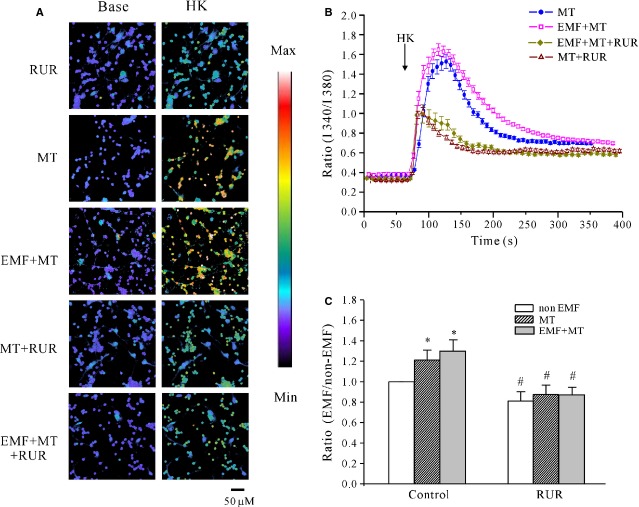
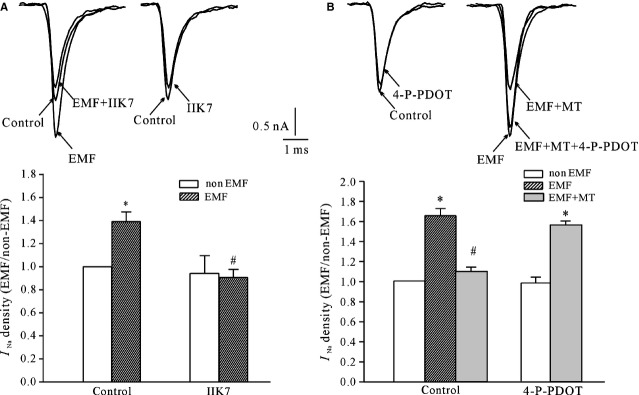
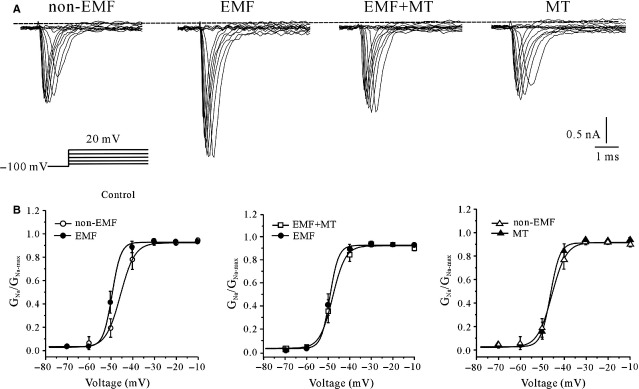
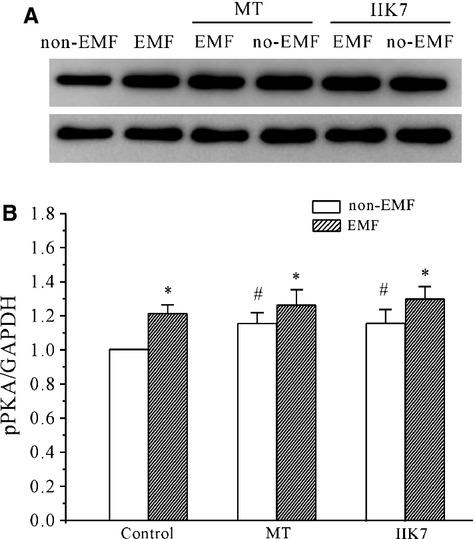
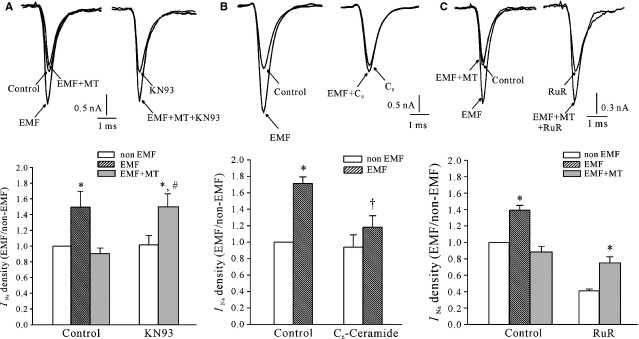
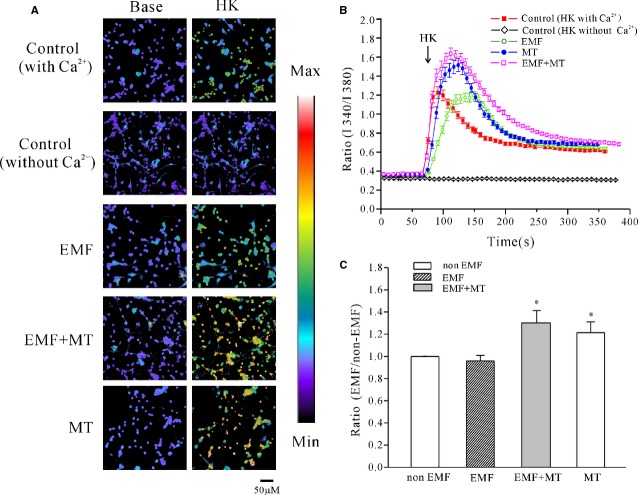
Although melatonin (MT) has been reported to protect cells against oxidative damage induced by electromagnetic radiation, few reports have addressed whether there are other protective mechanisms. Here, we investigated the effects of MT on extremely low-frequency electromagnetic field (ELF-EMF)-induced Nav activity in rat cerebellar granule cells (GCs). Exposing cerebellar GCs to ELF-EMF for 60 min. significantly increased the Nav current (INa ) densities by 62.5%. MT (5 μM) inhibited the ELF-EMF-induced INa increase. This inhibitory effect of MT is mimicked by an MT2 receptor agonist and was eliminated by an MT2 receptor antagonist. The Nav channel steady-state activation curve was significantly shifted towards hyperpolarization by ELF-EMF stimulation but remained unchanged by MT in cerebellar GC that were either exposed or not exposed to ELF-EMF. ELF-EMF exposure significantly increased the intracellular levels of phosphorylated PKA in cerebellar GCs, and both MT and IIK-7 did not reduce the ELF-EMF-induced increase in phosphorylated PKA. The inhibitory effects of MT on ELF-EMF-induced Nav activity was greatly reduced by the calmodulin inhibitor KN93. Calcium imaging showed that MT did not increase the basal intracellular Ca(2+) level, but it significantly elevated the intracellular Ca(2+) level evoked by the high K(+) stimulation in cerebellar GC that were either exposed or not exposed to ELF-EMF. In the presence of ruthenium red, a ryanodine-sensitive receptor blocker, the MT-induced increase in intracellular calcium levels was reduced. Our data show for the first time that MT protects against neuronal INa that result from ELF-EMF exposure through Ca(2+) influx-induced Ca(2+) release.
尽管已有报道称褪黑素(MT)可保护细胞免受电磁辐射诱导的氧化损伤,但很少有报告探讨是否存在其他保护机制。在此,我们研究了MT对大鼠小脑颗粒细胞(GCs)中极低频电磁场(ELF-EMF)诱导的Nav活性的影响。将小脑GCs暴露于ELF-EMF 60分钟,Nav电流(INa)密度显著增加了62.5%。MT(5μM)可抑制ELF-EMF诱导的INa增加。MT2受体激动剂可模拟MT的这种抑制作用,而MT2受体拮抗剂可消除这种作用。在暴露或未暴露于ELF-EMF的小脑GCs中,ELF-EMF刺激使Nav通道稳态激活曲线显著向超极化方向移动,但MT对其无影响。ELF-EMF暴露显著增加了小脑GCs中磷酸化PKA的细胞内水平,MT和IIK-7均未降低ELF-EMF诱导的磷酸化PKA增加。钙调蛋白抑制剂KN93可大大降低MT对ELF-EMF诱导的Nav活性的抑制作用。钙成像显示,MT不会增加基础细胞内Ca(2+)水平,但可显著提高暴露或未暴露于ELF-EMF的小脑GCs中高钾刺激诱发的细胞内Ca(2+)水平。在存在钌红(一种ryanodine敏感受体阻滞剂)的情况下,MT诱导的细胞内钙水平增加会降低。我们的数据首次表明,MT可通过Ca(2+)内流诱导的Ca(2+)释放来保护神经元免受ELF-EMF暴露导致的INa增加。