Institute of Virology, University of Veterinary Medicine Hannover, Hannover, Germany.
Vet Res. 2014 Feb 18;45(1):20. doi: 10.1186/1297-9716-45-20.
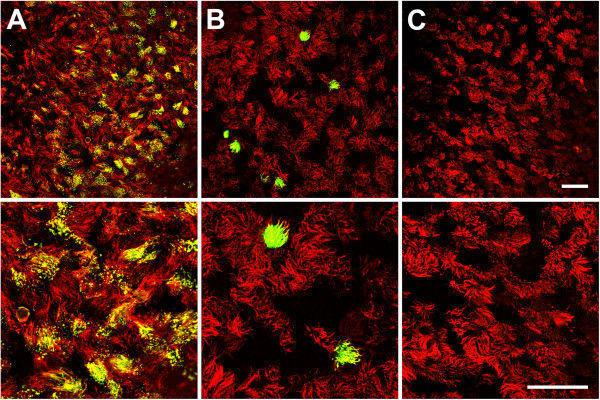
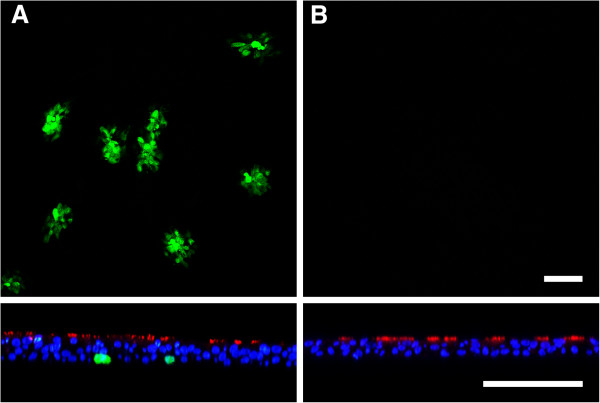
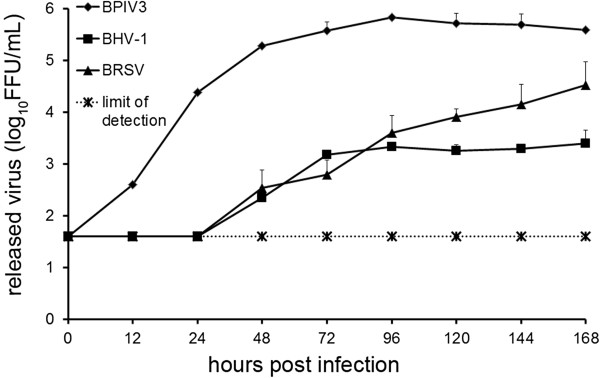
Bovine respiratory disease complex (BRDC) is the major cause of serious respiratory tract infections in calves. The disease is multifactorial, with either stress or reduced immunity allowing several pathogens to emerge. We investigated the susceptibility of bovine airway epithelial cells (BAEC) to infection by the three major viruses associated with the BRDC: bovine respiratory syncytial virus (BRSV), bovine herpesvirus type 1 (BHV-1) and bovine parainfluenza virus type 3 (BPIV3). For this purpose, two culture systems for well-differentiated BAEC were used: the air-liquid interface (ALI) system, where filter-grown BAEC differentiate into a pseudostratified respiratory epithelium and precision-cut lung slices (PCLS) where BAEC are maintained in the original tissue organisation. Comparative infection studies demonstrated that entry and release of BPIV3 occurred specifically via the apical membrane with ciliated cells being the major target cells. By contrast, airway epithelial cells were largely resistant to infection by BHV-1. When the epithelial barrier was abolished by opening tight junctions or by injuring the cell monolayer, BHV-1 infected mainly basal cells. Respiratory epithelial cells were also refractory to infection by BRSV. However, this virus infected neither differentiated epithelial cells nor basal cells when the integrity of the epithelial barrier was destroyed. In contrast to cells of the airway epithelium, subepithelial cells were susceptible to infection by BRSV. Altogether, these results indicate that the three viruses of the same disease complex follow different strategies to interact with the airway epithelium. Possible entry mechanisms are discussed.
牛呼吸道疾病复合症(BRDC)是导致犊牛严重呼吸道感染的主要原因。该疾病是多因素的,无论是应激还是免疫力下降,都会使几种病原体出现。我们研究了牛呼吸道上皮细胞(BAEC)对与 BRDC 相关的三种主要病毒(牛呼吸道合胞体病毒(BRSV)、牛疱疹病毒 1 型(BHV-1)和牛副流感病毒 3 型(BPIV3))感染的易感性。为此,我们使用了两种用于分化良好的 BAEC 的培养系统:气液界面(ALI)系统,其中滤过生长的 BAEC 分化为假复层呼吸道上皮;以及精密切割肺切片(PCLS)系统,其中 BAEC 保持在原始组织组织中。比较感染研究表明,BPIV3 的进入和释放是通过顶膜特异性发生的,纤毛细胞是主要的靶细胞。相比之下,气道上皮细胞对 BHV-1 的感染具有很强的抵抗力。当上皮屏障被打开紧密连接或损伤细胞单层时,BHV-1 主要感染基底细胞。呼吸道上皮细胞也对 BRSV 的感染具有抗性。然而,当上皮屏障完整性被破坏时,该病毒既不能感染分化的上皮细胞,也不能感染基底细胞。与气道上皮细胞不同,上皮下细胞容易被 BRSV 感染。总之,这些结果表明,同一疾病复合症的三种病毒采用不同的策略与气道上皮相互作用。讨论了可能的进入机制。