Department of Psychology, New York State Institute for Basic Research in Developmental Disabilities, 1050 Forest Hill Road, Staten Island, NY 10314, USA.
Mol Autism. 2014 Feb 18;5(1):15. doi: 10.1186/2040-2392-5-15.
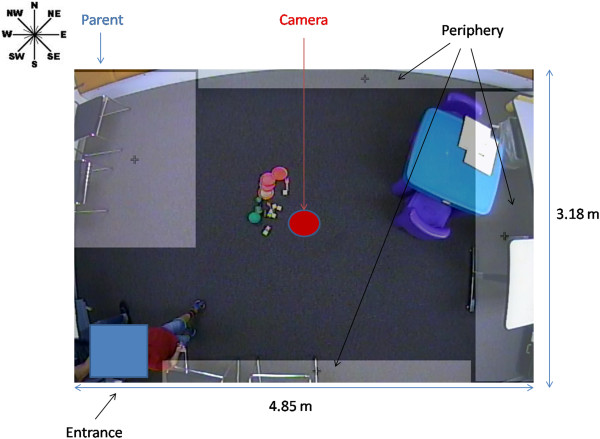
Children with Autism Spectrum Disorder (ASD) show unusual social behaviors and repetitive behaviors. Some of these behaviors, e.g., time spent in an area or turning rate/direction, can be automatically tracked. Automated tracking has several advantages over subjective ratings including reliability, amount of information provided, and consistency across laboratories, and is potentially of importance for diagnosis, animal models and objective assessment of treatment efficacy. However, its validity for ASD has not been examined. In this exploratory study, we examined associations between rating scale data with automated tracking of children's movements using the Noldus EthoVision XT system; i.e., tracking not involving a human observer. Based on our observations and previous research, we predicted that time spent in the periphery of the room would be associated with autism severity and that rate and direction of turning would be associated with stereotypies.
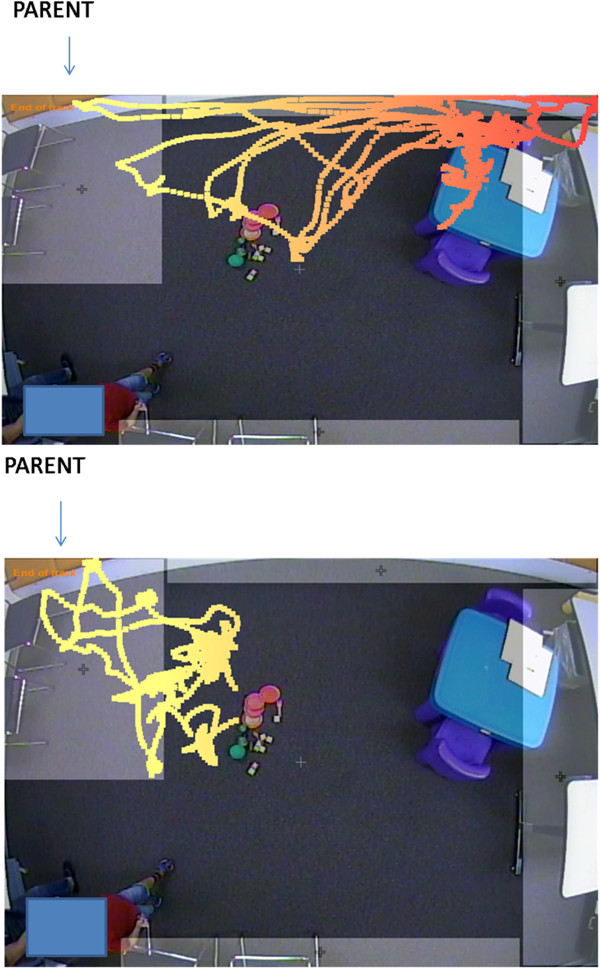
Children with and without ASD were observed in a free-play situation for 3 min before and 3 min after Autism Diagnostic Observation Scale - Generic (ADOS-G) testing. The Noldus system provided measures of the rate and direction of turning, latency to approach and time spend near the periphery or the parent.
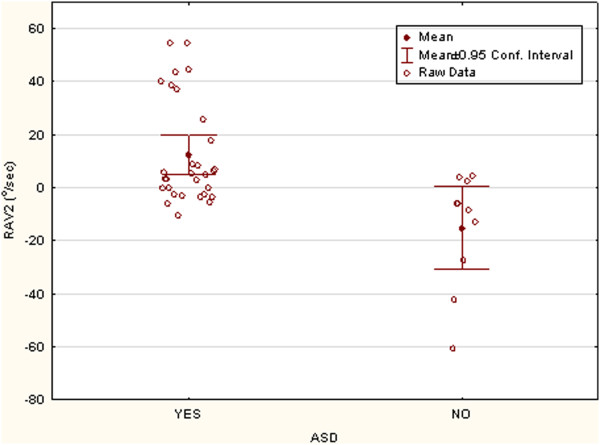
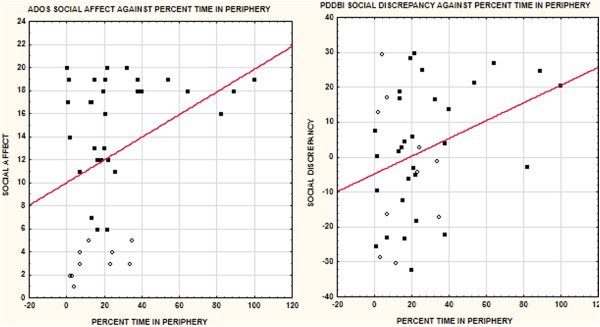
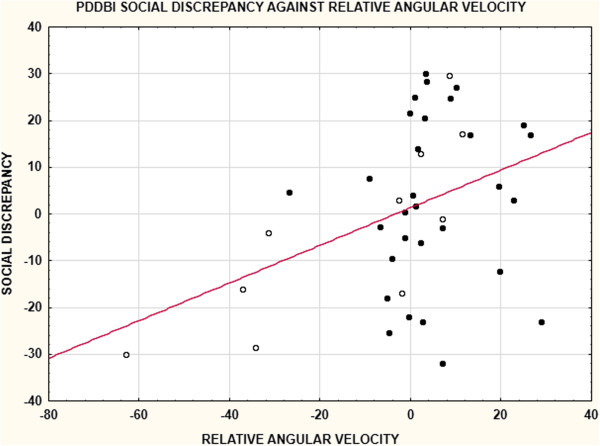
Ratings of the severity of maladaptive social behaviors, stereotypies, autism severity, and arousal problems were positively correlated with increases in percent time spent in the periphery in the total sample and in the ASD subset. Adaptive social communication skills decreased with increases in the percentage of time spent in the periphery and increases in the latency to approach the parent in the ASD group. The rate and direction of turning was linked with stereotypies only in the group without ASD (the faster the rate of a turn to the left, the worse the rating). In the ASD group, there was a shift from a neutral turning bias prior to the ADOS assessment to a strong left turn bias after the ADOS assessment. In the entire sample, this left turn bias was associated with measures of autism severity.
Results suggest that automated tracking yields valid and unbiased information for assessing children with autism. Turning bias is an interesting and unexplored measure related to autism.
自闭症谱系障碍(ASD)儿童表现出异常的社交行为和重复行为。其中一些行为,例如在某个区域停留的时间或转弯的速度/方向,可以自动跟踪。与主观评分相比,自动跟踪具有可靠性、提供的信息量以及实验室间的一致性等几个优势,对于诊断、动物模型和治疗效果的客观评估可能很重要。然而,它在 ASD 中的有效性尚未得到检验。在这项探索性研究中,我们检查了使用 Noldus EthoVision XT 系统对儿童运动进行自动跟踪的评分量表数据之间的关联;即,不涉及人类观察者的跟踪。基于我们的观察和先前的研究,我们预测房间周边停留时间与自闭症严重程度相关,而转弯速度和方向与刻板行为相关。
在进行自闭症诊断观察量表-通用(ADOS-G)测试前后,分别对 ASD 儿童和非 ASD 儿童进行 3 分钟的自由玩耍观察。Noldus 系统提供了转弯速度和方向、接近潜伏期以及靠近周边或父母附近时间的测量值。
在总样本和 ASD 子集中,适应不良的社交行为、刻板行为、自闭症严重程度和唤醒问题的严重程度评分与总外周时间百分比的增加呈正相关。在 ASD 组中,适应良好的社会沟通技能随着外周时间百分比的增加和接近父母的潜伏期的增加而减少。在非 ASD 组中,转弯速度和方向与刻板行为相关(向左转弯速度越快,评分越差)。在 ASD 组中,在 ADOS 评估之前,存在从中性转弯偏向到 ADOS 评估之后的强烈左转弯偏向的转变。在整个样本中,这种左转弯偏向与自闭症严重程度的测量值相关。
结果表明,自动跟踪为评估自闭症儿童提供了有效且无偏倚的信息。转弯偏向是一种有趣且尚未探索的与自闭症相关的测量值。