Department of Clinical Korean Medicine, Graduate School, Kyung Hee University, Seoul, Korea.
Department of Anatomy, College of Korean Medicine, Kyung Hee University, Seoul, Korea.
Acupunct Med. 2014 Jun;32(3):257-66. doi: 10.1136/acupmed-2013-010480. Epub 2014 Feb 19.
Although there is a growing interest in the use of acupuncture during pregnancy, the safety of acupuncture is yet to be rigorously investigated. The objective of this review is to identify adverse events (AEs) associated with acupuncture treatment during pregnancy.
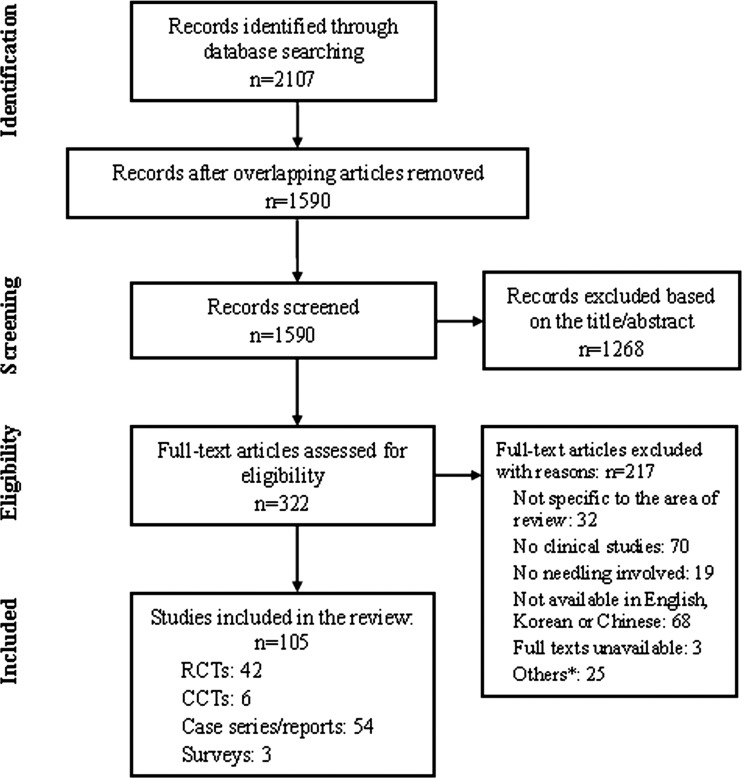
We searched Medline, Embase, Cochrane Central Register of Controlled Trials, Cumulative Index to Nursing and Allied Health Literature (CINAHL), Allied and Complementary Medicine Database (AMED) and five Korean databases up to February 2013. Reference lists of relevant articles were screened for additional reports. Studies were included regardless of their design if they reported original data and involved acupuncture needling and/or moxibustion treatment for any conditions in pregnant women. Studies of acupuncture for delivery, abortion, assisted reproduction or postpartum conditions were excluded. AE data were extracted and assessed in terms of severity and causality, and incidence was determined.
Of 105 included studies, detailed AEs were reported only in 25 studies represented by 27 articles (25.7%). AEs evaluated as certain, probable or possible in the causality assessment were all mild/moderate in severity, with needling pain being the most frequent. Severe AEs or deaths were few and all considered unlikely to have been caused by acupuncture. Total AE incidence was 1.9%, and the incidence of AEs evaluated as certainly, probably or possibly causally related to acupuncture was 1.3%.
Acupuncture during pregnancy appears to be associated with few AEs when correctly applied.
虽然人们对孕期针刺疗法的应用兴趣日益浓厚,但针刺疗法的安全性仍需严格研究。本研究旨在明确与孕期针刺治疗相关的不良事件(AE)。
我们检索了 Medline、Embase、Cochrane 对照试验中心注册库、护理学及相关健康专业文献累积索引(CINAHL)、补充与替代医学数据库(AMED)和 5 个韩国数据库,检索时限截至 2013 年 2 月。同时还对相关文章的参考文献进行筛选,以查找额外的报告。无论设计如何,只要报告了原始数据且涉及针刺或艾灸治疗孕妇任何病症的研究,我们均将其纳入。排除针刺分娩、流产、辅助生殖或产后病症的研究。我们提取了 AE 数据并根据严重程度和因果关系进行了评估,并确定了发生率。
在纳入的 105 项研究中,仅有 25 项研究(25.7%)的 27 篇文章详细报告了 AE。在因果关系评估中被评为确定、可能或很可能的 AE 均为轻度/中度严重,最常见的是针刺疼痛。严重 AE 或死亡病例很少,且均不太可能由针刺引起。总 AE 发生率为 1.9%,而被评估为与针刺有明确、可能或很可能因果关系的 AE 发生率为 1.3%。
正确应用针刺时,孕期针刺似乎很少引起 AE。