1] Department of Biomedical Engineering, Zhongshan School of Medicine, Sun Yat-Sen University, 135 Xin Gang W. Road, Guangzhou, China [2] The Key Laboratory of Molecular Biology for High Cancer Incidence Coastal Chaoshan Area, Shantou University Medical College, Shantou, China [3] Southern China Research Center of Statistical Science, Sun Yat-Sen University, Guangzhou 510275, China.
1] Southern China Research Center of Statistical Science, Sun Yat-Sen University, Guangzhou 510275, China [2] Yale University School of Public Health, New Haven, CT, USA [3] Department of Statistical Science, School of Mathematics and Computational Science, Sun Yat-Sen University, Guangzhou, China.
Br J Cancer. 2014 Apr 15;110(8):2109-15. doi: 10.1038/bjc.2014.101. Epub 2014 Feb 25.
Oesophageal squamous cell carcinoma (ESCC) is the predominant subtype of oesophageal carcinoma in China, with the overall 5-year survival rate of <10%. The current tumour-node-metastasis (TNM) staging system has become so complex that it is not easy to use in the life expectancy assessment. We aim to combine clinical variables and biomarkers to develop and validate a relative simple and reliable model, named the FENSAM, for ESCC prognosis.
To build the FENSAM, we analysed 22 potential prognostic factors from 461 patients, including 9 biomarkers (Ezrin, Fascin, desmocollin 2 (DSC2), pFascin, activating transcription factor 3 (ATF3), connective-tissue growth factor (CTGF), neutrophil gelatinase-associated lipocalin (NGAL), NGAL receptor (NGALR), and cysteine-rich angiogenic protein 61 (CYR61)) and other 13 clinical variables. We selected significant factors associated with survival of ESCC patients, and used them to build our FENSAM model. We then obtained the hazard risk score of the model to classify ESCC patients. In addition, we validated the model in an independent cohort of 290 patients from the same hospital. The predictive performance of the model was assessed by the Area under the Receiver Operating Characteristic Curve (AUC) and Kaplan-Meier survival analysis.
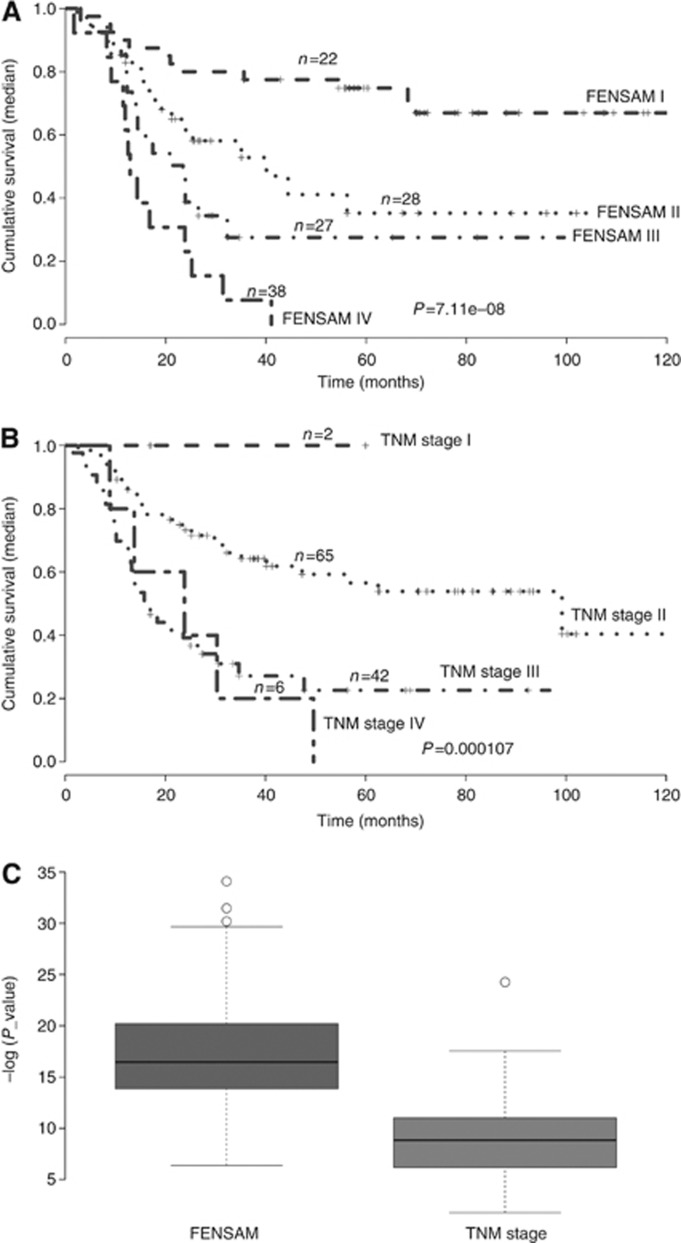
We found six markers significantly associated with survival of ESCC patients (Ezrin, Fascin, ATF3, surgery extent, N-stage, and M-stage). They were combined to create a novel four-stage FENSAM model for patients' classification. FENSAM possessed a high classification precision similar to the TNM staging system, but with a much simpler model. The efficiency of FENSAM was evaluated by different quantiles of AUC and the results of survival analysis. The validation result demonstrated the potential of the FENSAM model to improve classification accuracy for ESCC patients.
FENSAM provides an alternative classifier for ESCC patients with a high classification precision using a simple model.
食管鳞状细胞癌(ESCC)是中国食管癌的主要亚型,总体 5 年生存率<10%。目前的肿瘤-淋巴结-转移(TNM)分期系统已经变得非常复杂,在预期寿命评估中不易使用。我们旨在结合临床变量和生物标志物来开发和验证一个相对简单和可靠的模型,命名为 FENSAM,用于 ESCC 预后。
为了构建 FENSAM,我们分析了来自 461 名患者的 22 个潜在预后因素,包括 9 个生物标志物(Ezrin、Fascin、桥粒蛋白 2(DSC2)、pFascin、激活转录因子 3(ATF3)、结缔组织生长因子(CTGF)、中性粒细胞明胶酶相关脂质运载蛋白(NGAL)、NGAL 受体(NGALR)和富含半胱氨酸的血管生成蛋白 61(CYR61))和其他 13 个临床变量。我们选择了与 ESCC 患者生存相关的显著因素,并将其用于构建我们的 FENSAM 模型。然后,我们获得了模型的危险风险评分以对 ESCC 患者进行分类。此外,我们在同一医院的 290 名患者的独立队列中验证了该模型。通过接受者操作特征曲线(ROC)下面积(AUC)和 Kaplan-Meier 生存分析评估模型的预测性能。
我们发现六个标志物与 ESCC 患者的生存显著相关(Ezrin、Fascin、ATF3、手术范围、N 期和 M 期)。它们被组合在一起,为患者分类创建了一个新的四期 FENSAM 模型。FENSAM 具有与 TNM 分期系统相似的高精度分类能力,但模型更简单。通过不同分位数的 AUC 和生存分析的结果评估了 FENSAM 的效率。验证结果表明,FENSAM 模型有潜力提高 ESCC 患者的分类准确性。
FENSAM 提供了一种使用简单模型的 ESCC 患者的替代分类器,具有高精度分类能力。