Harsoor S S, Rani Devika D, Lathashree S, Nethra S S, Sudheesh K
Department of Anaesthesia, Bangalore Medical College and Research Institute, Bangalore, Karnataka, India.
J Anaesthesiol Clin Pharmacol. 2014 Jan;30(1):25-30. doi: 10.4103/0970-9185.125693.
Dexmedetomidine has been shown to blunt the stress response to surgery. Hence a study was designed to evaluate the effect of intravenous (IV) Dexmedetomidine infusion during general anesthesia for abdominal surgeries on blood glucose levels and on Sevoflurane requirements during anesthesia.
Forty patients scheduled for abdominal surgery under general anesthesia were divided into Dexmedetomidine (D) group and Placebo (P) group of 20 each. Group D received a loading dose of Inj. Dexmedetomidine at 1 μg/kg/10 min diluted to 20 mL, followed by maintenance with 0.5 μg/kg/h., till the end of surgery. Group P received similar volume of IV normal saline. Anesthesia was maintained with nitrous oxide in oxygen and Sevoflurane keeping entropy between 40 and 60. Data were analyzed using students t test, chi square test and Fisher Exact test as applicable.
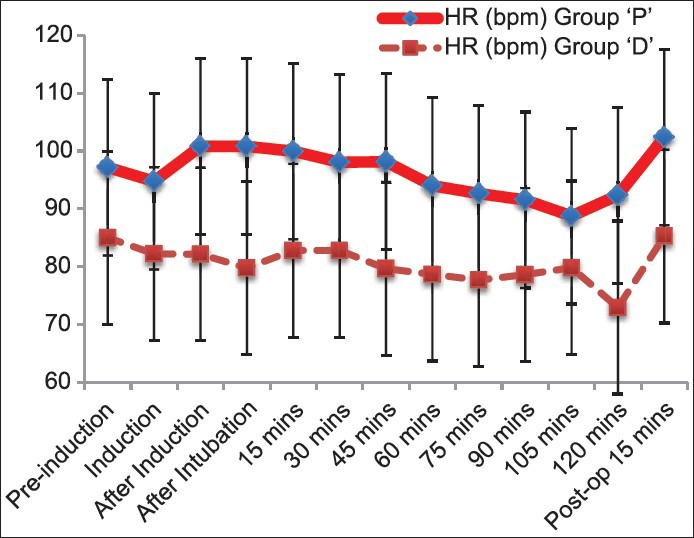
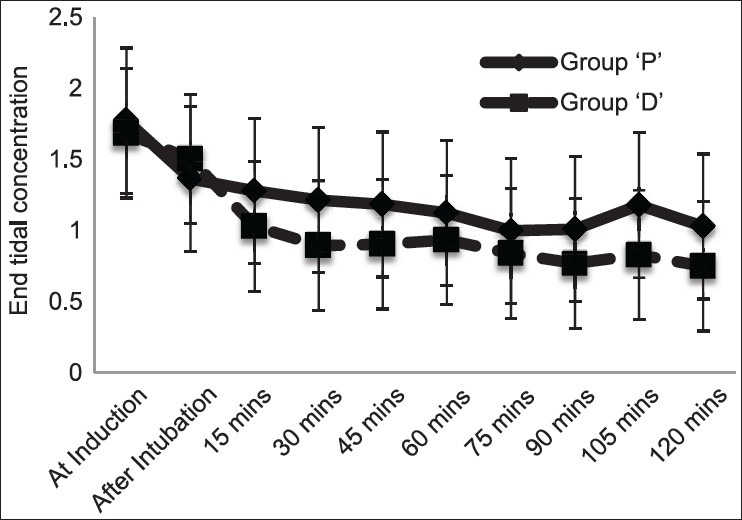
During the first postoperative hour, Dexmedetomidine group showed blood glucose levels of 118.2 ± 16.24 mg/dL, compared to placebo group which was 136.95 ± 19.76 mg/dL and it was statistically significant (P < 0.01). Mean hourly Sevoflurane requirement in Group D was 11.10 ± 2.17 mL, compared to 15.45 ± 3.97 mL in placebo group. In peri-operative period, the heart rate and MAP were significantly lower in Group D, when compared to placebo. Patients in Group D were better sedated and post-operative pain score was better in Group D compared to Group P.
IV Dexmedetomidine was effective in blunting stress response to surgical trauma as indicated by lower blood glucose levels, and reduces Sevoflurane requirements during entropy guided general anesthesia without affecting time for extubation.
右美托咪定已被证明可减轻手术应激反应。因此,设计了一项研究来评估腹部手术全身麻醉期间静脉输注右美托咪定对血糖水平以及麻醉期间七氟醚需求量的影响。
40例计划在全身麻醉下进行腹部手术的患者被分为右美托咪定(D)组和安慰剂(P)组,每组20例。D组接受负荷剂量的右美托咪定注射液,剂量为1μg/kg/10分钟,稀释至20mL,随后以0.5μg/kg/h维持,直至手术结束。P组接受相同体积的静脉生理盐水。使用氧化亚氮和氧气以及七氟醚维持麻醉,使熵维持在40至60之间。根据适用情况,使用学生t检验、卡方检验和Fisher精确检验对数据进行分析。
术后第一小时,右美托咪定组的血糖水平为118.2±16.24mg/dL,而安慰剂组为136.95±19.76mg/dL,差异具有统计学意义(P<0.01)。D组平均每小时七氟醚需求量为11.10±2.17mL,而安慰剂组为15.45±3.97mL。在围手术期,与安慰剂组相比,D组的心率和平均动脉压显著更低。D组患者镇静效果更好,术后疼痛评分也优于P组。
静脉输注右美托咪定可有效减轻手术创伤的应激反应,表现为血糖水平降低,并在熵引导的全身麻醉期间降低七氟醚需求量,且不影响拔管时间。