Lee Jung-Jin, Kwon Hyeeun, Lee Ji-Hye, Kim Dong-Gun, Jung Sang-Hyuk, Ma Jin Yeul
Korean Medicine (KM)-Based Herbal Drug Development Group, Korea Institute of Oriental Medicine, 1672 Yuseong-daero, Yuseong-gu, Daejeon 305-811, Republic of Korea.
BMC Complement Altern Med. 2014 Feb 28;14:78. doi: 10.1186/1472-6882-14-78.
Soshiho-tang (SST) is a traditional medicine widely used for the treatment of chronic hepatitis. SST has been shown to confer a variety of pharmacological activities, including prevention of hepatotoxicity, promotion of liver regeneration, and modulation of liver fibrosis. In this study, we investigated the antiproliferative activity of native and fermented (FSST) formulations of SST in vascular smooth muscle cells (VSMCs) and examined the potential underlying mechanisms driving these effects.
SST, along with preparations fermented with Lactobacillus plantarum KFRI-144 (S-A144), L. amylophilus KFRI-161 (S-A161) and L. bulgaricus KFRI-344 (S-A344), were investigated to determine their effects on the proliferation and viability of VSMCs, along with the signalling pathways underlying these effects.
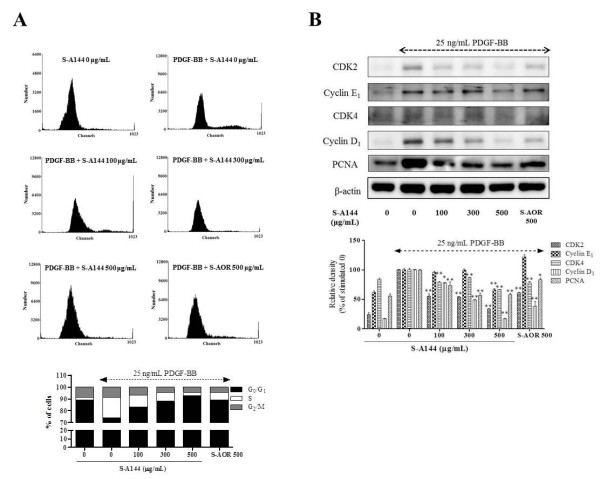
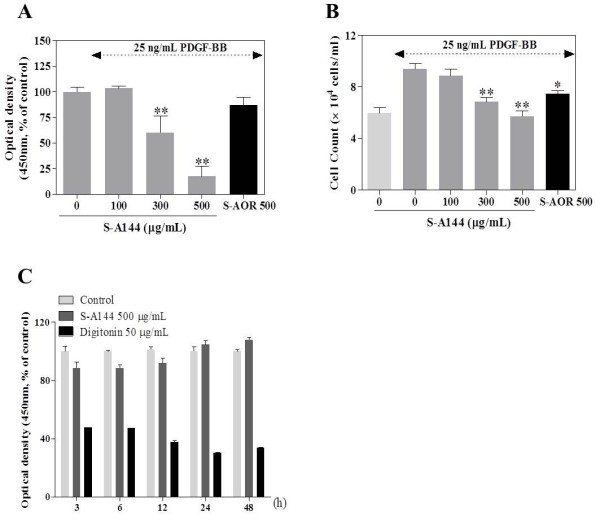
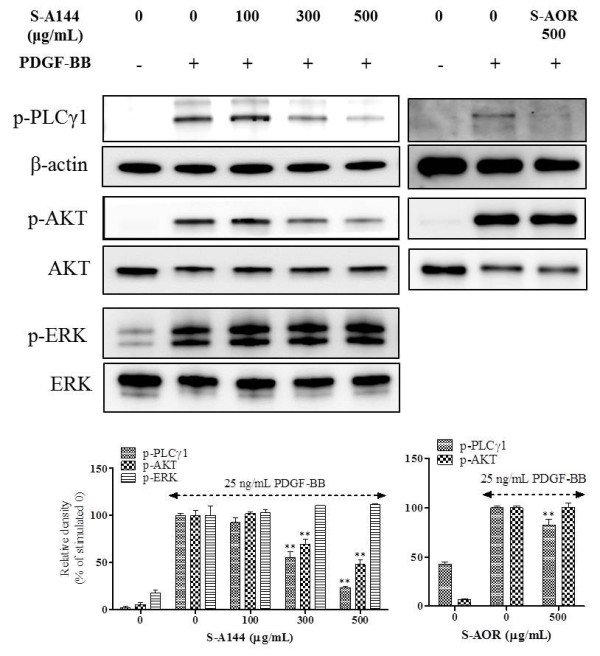
S-A144 exhibited a strong, dose-dependent inhibition of VSMC proliferation relative to untreated controls, but the others did not affect. In addition, S-A144 significantly decreased the phosphorylation of Akt and PLCγ1 in a dose-dependent manner and induced cell cycle arrest at the G0/G1 phase characterised by decreased expression of CDKs, cyclins and PCNA.
The findings suggest that S-A144 exhibit enhanced inhibition of PDGF-BB-induced VSMC proliferation comparison to S-AOR through the suppression of cell cycle progression and expression of cell cycle-related proteins, along with the downregulation of Akt phosphorylation.
芍药甘草汤(SST)是一种广泛用于治疗慢性肝炎的传统药物。已证明SST具有多种药理活性,包括预防肝毒性、促进肝脏再生和调节肝纤维化。在本研究中,我们研究了SST的天然制剂和发酵制剂(FSST)对血管平滑肌细胞(VSMC)的抗增殖活性,并探讨了驱动这些作用的潜在机制。
研究了SST以及用植物乳杆菌KFRI-144(S-A144)、嗜淀粉乳杆菌KFRI-161(S-A161)和保加利亚乳杆菌KFRI-344(S-A344)发酵制备的制剂对VSMC增殖和活力的影响,以及这些作用背后的信号通路。
与未处理的对照相比,S-A144对VSMC增殖表现出强烈的、剂量依赖性的抑制作用,而其他制剂则没有影响。此外,S-A144以剂量依赖性方式显著降低Akt和PLCγ1的磷酸化,并诱导细胞周期停滞在G0/G1期,其特征是CDK、细胞周期蛋白和PCNA的表达降低。
研究结果表明,与S-AOR相比,S-A144通过抑制细胞周期进程和细胞周期相关蛋白的表达以及下调Akt磷酸化,对血小板衍生生长因子-BB诱导的VSMC增殖表现出更强的抑制作用。