Buon Marine, Jacob Pierre, Margules Sylvie, Brunet Isabelle, Dutat Michel, Cabrol Dominique, Dupoux Emmanuel
Laboratoire de Sciences Cognitives et Psycholinguistique, Ecole Des Hautes Etudes en Sciences Sociales, Département d'Etudes Cognitives-Ecole Normale Supérieure, Centre National de la Recherche Scientifique, Paris, France.
Institut Jean Nicod, Ecole Des Hautes Etudes en Sciences Sociales, Département d'Etudes Cognitives-Ecole Normale Supérieure, Centre National de la Recherche Scientifique, Paris, France.
PLoS One. 2014 Feb 19;9(2):e88612. doi: 10.1371/journal.pone.0088612. eCollection 2014.
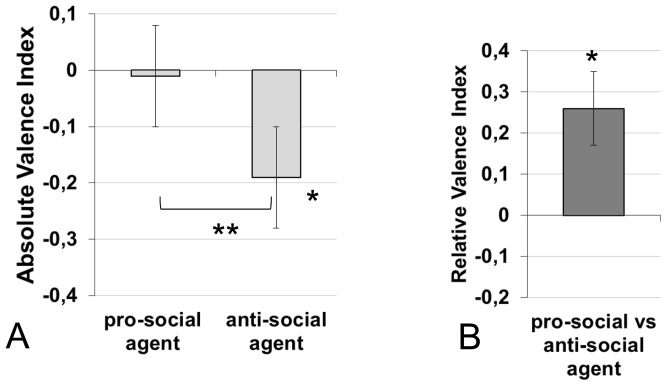
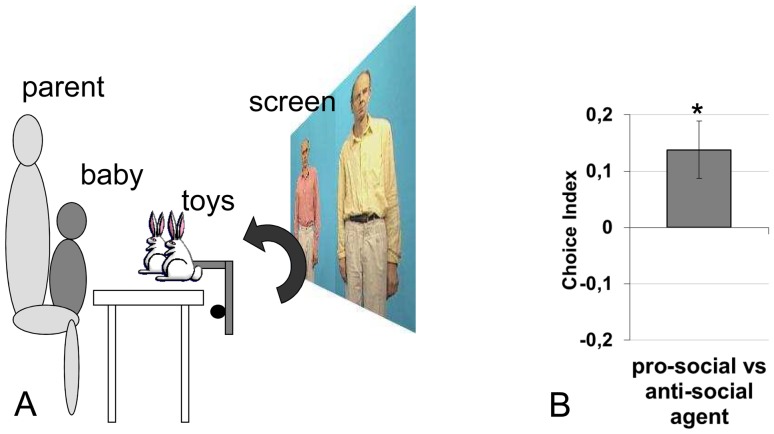
We report evidence that 29-month-old toddlers and 10-month-old preverbal infants discriminate between two agents: a pro-social agent, who performs a positive (comforting) action on a human patient and a negative (harmful) action on an inanimate object, and an anti-social agent, who does the converse. The evidence shows that they prefer the former to the latter even though the agents perform the same bodily movements. Given that humans can cause physical harm to their conspecifics, we discuss this finding in light of the likely adaptive value of the ability to detect harmful human agents.
29个月大的幼儿和10个月大的还未学会说话的婴儿能够区分两种行为主体:一种是亲社会行为主体,其对人类患者做出积极(安慰性)行为,而对无生命物体做出消极(伤害性)行为;另一种是反社会行为主体,其行为与之相反。证据表明,尽管这两种行为主体做出的身体动作相同,但他们更喜欢前者。鉴于人类会对同种个体造成身体伤害,我们根据检测有害人类行为主体的能力可能具有的适应性价值来讨论这一发现。