Wu Chin-Chia, Hsu Ta-Wen, Chang Chun-Ming, Yu Chia-Hui, Wang Yuh-Feng, Lee Ching-Chih
Department of Surgery, Dalin Tzu Chi Hospital, Buddhist Tzu Chi Medical Foundation, Chiayi, Taiwan ; Cancer center, Dalin Tzu Chi Hospital, Buddhist Tzu Chi Medical Foundation, Chiayi, Taiwan.
Department of Surgery, Dalin Tzu Chi Hospital, Buddhist Tzu Chi Medical Foundation, Chiayi, Taiwan ; School of Medicine, Tzu Chi University, Hualien, Taiwan ; Cancer center, Dalin Tzu Chi Hospital, Buddhist Tzu Chi Medical Foundation, Chiayi, Taiwan.
PLoS One. 2014 Feb 25;9(2):e89655. doi: 10.1371/journal.pone.0089655. eCollection 2014.
Gastric cancer is a leading cause of death, particularly in the developing world. The literature reports individual socioeconomic status (SES) or neighborhood SES as related to survival, but the effect of both has not been studied. This study investigated the effect of individual and neighborhood SES simultaneously on mortality in gastric cancer patients in Taiwan.
A study was conducted of 3,396 patients diagnosed with gastric cancer between 2002 and 2006. Each patient was followed for five years or until death. Individual SES was defined by income-related insurance premium (low, moderate, and high). Neighborhood SES was based on household income dichotomized into advantaged and disadvantaged areas. Multilevel logistic regression model was used to compare survival rates by SES group after adjusting for possible confounding factors.
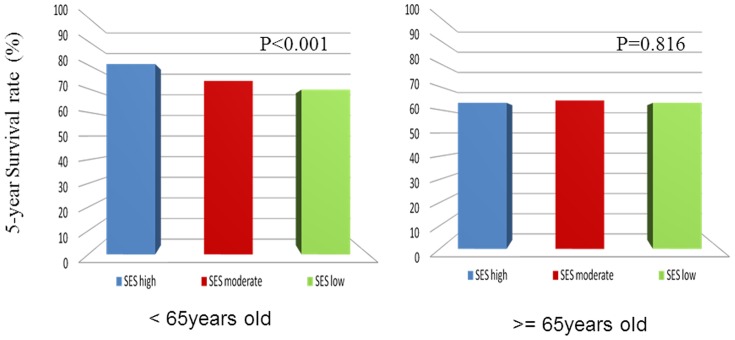
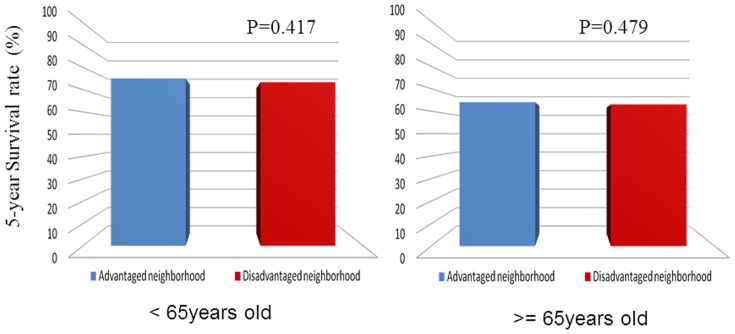
In patients younger than 65 years, 5-year overall survival rates were lowest for those with low individual SES. After adjusting for patient characteristics (age, gender, Charlson Comorbidity Index Score), gastric cancer patients with high individual SES had 68% risk reduction of mortality (adjusted odds ratio [OR] of mortality, 0.32; 95% confidence interval [CI], 0.17-0.61). Patients aged 65 and above had no statistically significant difference in mortality rates by individual SES group. Different neighborhood SES did not statistically differ in the survival rates.
Gastric cancer patients aged less than 65 years old with low individual SES have higher risk of mortality, even under an universal healthcare system. Public health strategies, education and welfare policies should seek to correct the inequality in gastric cancer survival, especially in those with lower individual SES.
胃癌是主要的死亡原因之一,在发展中国家尤为如此。文献报道了个体社会经济地位(SES)或邻里SES与生存率的关系,但两者的影响尚未得到研究。本研究同时调查了个体和邻里SES对台湾胃癌患者死亡率的影响。
对2002年至2006年间诊断为胃癌的3396例患者进行了一项研究。对每位患者随访五年或直至死亡。个体SES由与收入相关的保险费定义(低、中、高)。邻里SES基于家庭收入分为优势和劣势地区。采用多水平逻辑回归模型,在调整可能的混杂因素后,比较不同SES组的生存率。
在65岁以下的患者中,个体SES低的患者5年总生存率最低。在调整患者特征(年龄、性别、查尔森合并症指数评分)后,个体SES高的胃癌患者死亡风险降低68%(调整后的死亡比值比[OR]为0.32;95%置信区间[CI]为0.17 - 0.61)。65岁及以上的患者按个体SES组划分的死亡率无统计学显著差异。不同邻里SES的生存率无统计学差异。
即使在全民医疗保健系统下,个体SES低的65岁以下胃癌患者死亡风险也更高。公共卫生策略、教育和福利政策应致力于纠正胃癌生存率方面的不平等,特别是在个体SES较低的人群中。